
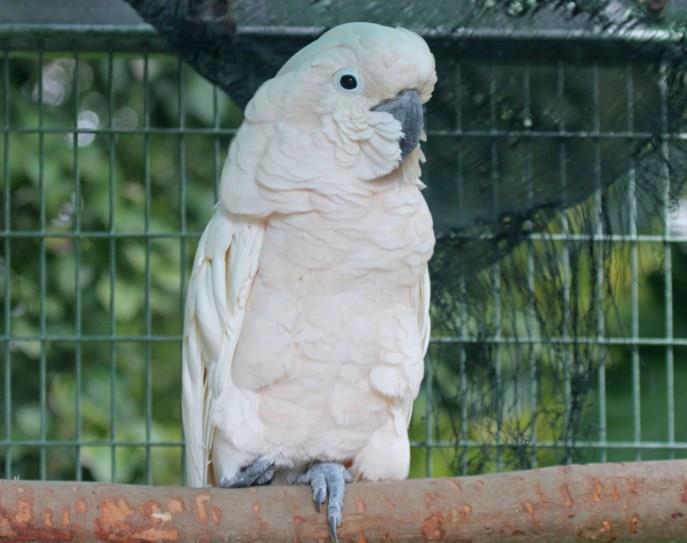
People usually start looking into umbrella cockatoos when a bird’s caught their eye at a rescue, an aviary, or online—and the big question is simple: is this a sensible pet for my home and my life? The decision matters. These cockatoos can live for decades, need daily structure and companionship, and can become unwell or develop serious behaviour problems when their environment is too small, too quiet, or too unpredictable.
Umbrella cockatoo is the common name most people use for Cacatua alba. It’s often confused with the Moluccan (Salmon-crested) cockatoo (Cacatua moluccensis), a different species. Getting the name right helps you check the right care advice, legal rules, and conservation status before you commit.1, 2
Quick facts: umbrella cockatoo at a glance
- Scientific name: Cacatua alba (umbrella cockatoo)
- Natural range: Indonesia (not native to Australia)
- Trade controls: listed under CITES Appendix II (international trade regulated)1, 3
- Reality check: this is a high-needs, long-lived parrot; many do best with experienced keepers and strong daily routines4
Physical characteristics
Umbrella cockatoos are medium–large white cockatoos with a broad, fan-like crest that lifts and spreads when the bird is alert or stimulated. They have a heavy, curved bill built for cracking and shredding, and zygodactyl feet (two toes forward, two back) that make climbing and handling food look effortless.
Colour is mostly white, often with a soft yellow wash under the wings and tail that can show in flight. Like other parrots, they’re built for movement and chewing—two traits that shape almost every part of good captive care, from enclosure design to enrichment.
Habitat and distribution (wild)
Umbrella cockatoos are native to Indonesia, not Australia. In the wild they’re associated with forested habitats and depend on large trees for roosting and nesting hollows. This matters in captivity: a bird adapted to a complex canopy life rarely thrives in a bare cage with nothing to do.
Behaviour and temperament in captivity
Umbrella cockatoos are intelligent, social parrots. In a home, that often translates to a bird that watches everything, learns patterns quickly, and expects regular interaction. When their days are empty—or when attention is inconsistent—some individuals develop escalating noise, repetitive calling, or feather-damaging behaviour.
Temperament varies by individual, but it’s common to see fast shifts from calm to intense arousal during play, handling, or household changes. Gentle, predictable routines usually work better than “big” sessions of attention followed by long gaps.
What a well-set-up home usually includes
- Time out of the enclosure every day (supervised), with safe climbing and chewing options.
- Foraging and destructible enrichment (paper, untreated wood, natural branches) to channel shredding safely.4
- Low-stress handling and consent-based interaction, especially around wings, feet, and the head/crest.
- Protection from fumes and aerosols (parrots are highly sensitive to airborne irritants).4
Diet and nutrition
A practical, evidence-based approach for many companion parrots is a high-quality formulated diet (pellets) as the foundation, with daily vegetables and other fresh foods for variety and foraging. This helps avoid the common trap of seed-heavy diets, which can be energy-dense and nutritionally unbalanced for many captive birds.4
Fresh foods can include dark leafy greens and a rotation of chopped vegetables. Fruit is best treated as a smaller portion for most birds. Clean water should be available at all times and replaced frequently.4
Calcium sources (such as cuttlebone or vet-recommended supplements) may be appropriate, particularly for laying hens, but supplementation should be guided by an avian vet—too much can also cause problems.
Training and enrichment
Training is most useful when it reduces stress and makes daily care easier: stepping up calmly, entering a carrier, allowing a towel when needed, and accepting brief health checks. Short, frequent sessions suit many cockatoos better than long drills.
Enrichment is not optional for a cockatoo. Rotate items and build foraging into the day so the bird has reasons to climb, chew, and search—behaviours that would normally fill long hours in the wild.4
Health concerns and common problems
Umbrella cockatoos can suffer the same broad categories of illness seen in many companion parrots: nutritional disease from poor diets, respiratory irritation from dusty or fume-filled environments, and secondary infections that follow stress or chronic inflammation.
Feather-damaging behaviour (often called feather plucking) is also common across cockatoos and can have multiple drivers—medical, environmental, and behavioural. It’s not a “bad habit” to ignore. If feathers start breaking, thinning, or disappearing, the safest next step is an avian vet assessment before changing a lot at once.
Regular preventative checks with an avian veterinarian, stable routines, and a diet based on reputable formulated foods and fresh produce are the quiet foundations that usually prevent the loudest problems.
Breeding and reproduction (pet context)
Breeding umbrella cockatoos is not a casual extension of pet keeping. It requires specialised housing, record keeping, veterinary planning, and a clear pathway for offspring that does not feed illegal or irresponsible trade. In many households the more relevant issue is the opposite: managing unwanted hormonal behaviour and egg laying.
If a hen is laying repeatedly, seek avian-vet advice early. Chronic laying can deplete calcium and become dangerous.
Legal considerations in Australia
Rules vary by state and territory, and the details matter. If you’re in Australia and looking at an umbrella cockatoo specifically (an exotic species), start by checking what is legal to keep where you live, and whether you’re allowed to bring a bird in from overseas at all.
At a federal level, Australia tightly restricts importing pet birds. The Department of Agriculture, Fisheries and Forestry states that pet psittacine birds can only be imported from New Zealand, and only if the species is eligible and permits are in place.5 Environment import rules also depend on whether the species is on the Live Import List under the EPBC Act.6
For native birds (a different situation), some states require keeper licences and proof that birds were bred in captivity and obtained legally. New South Wales, for example, uses bird keeper licences for many native species and sets out conditions and record-keeping expectations.7, 8
Final thoughts
An umbrella cockatoo can be a remarkable companion: watchful, physical, clever with its feet and bill, and intensely responsive to the patterns of a household. It’s also a bird that magnifies gaps in routine, space, and enrichment.
Before you commit, take time to meet adult birds, speak with an avian vet, and be realistic about noise, mess, and daily time. If you’re in Australia, check both the legal pathway and the ethical one—how the bird was sourced matters, and international trade is regulated for a reason.1, 3, 5
References
- CITES — Cacatua alba (umbrella cockatoo) listing
- CITES — Appendices (Psittaciformes listing note)
- CITES — Convention on International Trade in Endangered Species of Wild Fauna and Flora
- RSPCA Knowledgebase — How should I care for my birds?
- Australian Government (DAFF) — Importing your pet bird
- Australian Government (DCCEEW) — Live Import List
- NSW Environment & Heritage — Bird keeper licences
- NSW Environment & Heritage — Buying and caring for native birds
- Australian Border Force — Can you bring it in? Live animals and pets

Veterinary Advisor, Veterinarian London Area, United Kingdom