
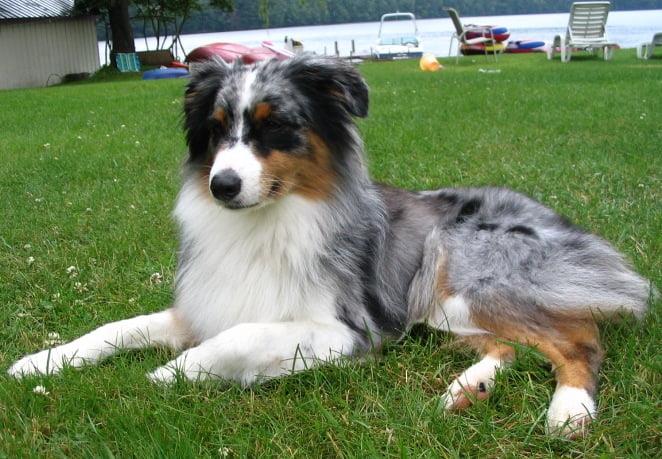
People usually look up Australian Shepherds when they’re weighing up a new dog, comparing working breeds, or trying to make sense of a young “Aussie” who seems to run on pure electricity. Get the match wrong and you can end up with a bright, athletic dog that’s bored, noisy, and inventing its own jobs.
The Australian Shepherd is a herding dog developed in the United States, built for stamina and quick decision-making. Its looks are striking, but the daily reality is simpler: this is a dog that thrives on movement, training, and steady contact with its people.1, 2
Australian Shepherd at a glance
- Type: Medium-sized herding dog with strong drive and endurance2, 3
- Best fit: Active homes, sport/working homes, or owners who enjoy training as a daily habit2, 4
- Key needs: Exercise, mental work, and early socialisation to keep behaviour steady and manageable2
History and origin (the name is misleading)
Despite the name, the Australian Shepherd was developed in the western United States, with the breed’s story tied to sheep work and ranch life. The “Australian” label is widely linked to imported sheep and dogs moving through Australia on the way to America, and to the people who worked those flocks.1, 5
The breed stayed largely in working circles for decades, then became more visible in the mid-20th century through rodeo demonstrations and public performances, which helped show the wider world how trainable and agile these dogs can be.1
What they look like (and why it suits the job)
An Aussie is compact, athletic, and designed to pivot and accelerate without losing balance. The coat is medium length with an undercoat that changes with climate, built for weather and long days outdoors.3, 6
Coat colours and markings
Breed standards recognise four base colours: black, blue merle, red, and red merle, with or without white markings and/or tan (copper) points. Merle coats often darken with age.3, 6
Eyes
Eye colour can be brown, blue, amber, or a combination (including flecks and marbling). Two different coloured eyes can occur.3, 6
Tails: naturally bobbed, docked, or left long
You’ll see variation here depending on country and context. Some Aussies are naturally bobtailed, and historically docking has been common in some places; standards describe a straight tail, either naturally bobbed or docked to a short length.7
Temperament and behaviour: bright, driven, easily bored
The Australian Shepherd is known for intelligence, stamina, and strong herding instincts. In everyday life that often shows up as watchfulness, quick learning, and a habit of noticing everything that changes—sound, movement, routines, visitors, stock, bikes, children running.2, 4
Many Aussies show initial reserve with strangers. That’s not the same as fearfulness, and it shouldn’t tip into aggression; early, calm social exposure helps keep their default response steady and sensible.4
Children and other animals
With supervision and training, Aussies can live well in family homes. The main thing to watch is herding behaviour: circling, chasing movement, or nipping at heels, especially with running children or fast-moving pets. Redirect early, reward calm choices, and give the dog structured outlets for drive.2
Training and exercise needs
This breed tends to learn quickly, including the habits you didn’t mean to teach. Short, consistent training sessions, clear boundaries, and rewards that matter to the dog (food, toys, access to play) are usually effective.
Exercise needs aren’t just about distance walked. Aussies do best when physical activity is paired with thinking work—obedience, scent games, agility foundations, trick training, herding (where appropriate), or structured fetch with rules.
Practical daily routine that suits many Aussies
- Morning: brisk walk or run plus 5–10 minutes of training
- Midday: puzzle feeder, scent game, or a short skills session
- Evening: longer exercise block (walk/hike/play) and a calm wind-down routine
Health: what to watch and what to screen for
Australian Shepherds are often long-lived for their size, and many stay active well into older age. Still, the breed has recognised risks that are worth discussing with your veterinarian and (if buying a puppy) your breeder.
Eyes
Inherited and breed-associated eye conditions are a known concern. In North America, eye screening is commonly done through the OFA Companion Animal Eye Registry (CAER) by board-certified veterinary ophthalmologists, with annual re-examination recommended. Australian Shepherds are among the breeds specifically noted in CAER guidance for certain exam considerations.8
Hip dysplasia and other orthopaedic issues
Hip dysplasia is reported in the breed. Maintaining a lean body condition, building fitness gradually, and using sensible training surfaces (especially during growth) can help reduce strain, though they don’t replace genetics and screening.9
MDR1 (ABCB1) drug sensitivity
Many herding breeds, including Australian Shepherds, can carry variants in the ABCB1 gene (often referred to as MDR1) that increase the risk of serious adverse reactions to certain medications. Genetic testing is available, and knowing a dog’s status helps vets choose safer drugs and doses.10
Grooming and coat care
The Aussie’s double coat sheds, and it tends to shed more heavily seasonally. Weekly brushing suits many dogs, with more frequent brushing during heavier shed periods. Focus on the undercoat (where tangles and dead coat build up), and check the feathering behind ears, elbows, and the breeches where mats can form.
Keep nails trimmed, ears clean and dry, and watch for skin irritation hidden under dense coat—especially after swimming, burrs, or days in long grass.
Diet and nutrition
Choose a complete and balanced diet suited to your dog’s life stage and activity level. Active Aussies often do well on diets with adequate protein and fat, but the right amount depends on the individual dog’s workload, metabolism, and whether they’re desexed.
If your Aussie is itching, has recurring ear problems, or has inconsistent stools, speak with your veterinarian before changing foods repeatedly—food intolerance and allergy-like signs can overlap with parasites, environmental allergies, and skin infections.
Famous Australian Shepherds and public visibility
The breed’s rise into the public eye is closely linked to performance and sport: rodeo demonstrations, trick work, and later, a strong presence in dog sports where speed and precision matter. That visibility can make an Aussie look like an easy “do-it-all” pet. In reality, the same traits that win applause—drive, stamina, intensity—need daily direction at home.1
Final thoughts
An Australian Shepherd is at its best when life has rhythm: movement, training, and a clear sense of what earns rewards. In the right home, the dog becomes a steady companion with a sharp mind and a body built to work. In the wrong home, the same dog can unravel into noise, chasing, and restless mischief—not from spite, but from surplus capacity with nowhere to go.
References
- American Kennel Club (AKC) — Vanished Trials and Faded Memories of Australian Shepherd History
- United States Australian Shepherd Association (USASA) — The Australian Shepherd
- Dogs Australia — Australian Shepherd breed standard
- The Kennel Club (UK) — Australian Shepherd breed standard (characteristics and temperament)
- Canadian National Australian Shepherd Association — Breed history
- Australian Shepherd Club of America (ASCA) — Coat colour (breed-standard colours)
- Australian Shepherd Health & Genetics Institute (ASHGI) — A Tale of Tails
- Orthopedic Foundation for Animals (OFA) — Companion Animal Eye Registry (CAER) overview
- Australian Shepherd Health & Genetics Institute (ASHGI) — Disease prevalence in Aussies
- Cornell University College of Veterinary Medicine — Drug sensitivity: MDR1 (ABCB1)

Veterinary Advisor, Veterinarian London Area, United Kingdom