
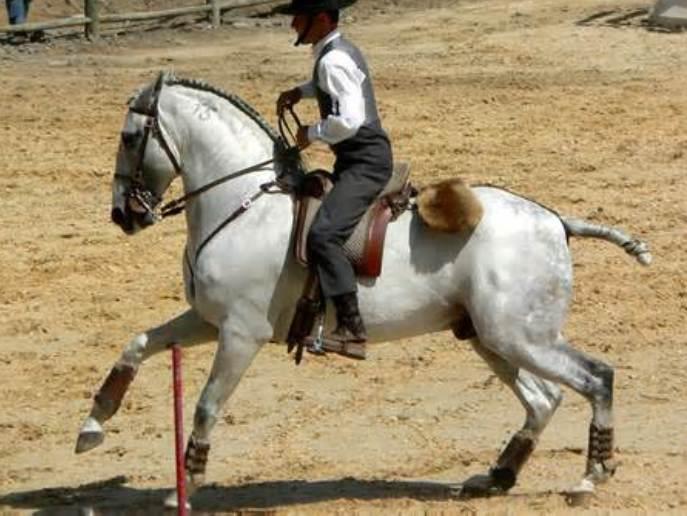
People usually end up looking up the Lusitano when they’re weighing up a horse for dressage or working equitation, checking whether a “baroque” type will suit their riding, or trying to make sense of breed labels on a sale ad. The details matter: registration affects value, suitability, and sometimes what you can compete in.
The Lusitano is Portugal’s classical riding horse—compact, powerful behind, naturally inclined to collect, and bred for partnership in the hand and under saddle. Below is a clear, grounded overview of what they are, where they came from, what they’re like to live with, and how to care for them without guesswork.
- Origin: Portugal1, 2
- Typical height: often around 15–16 hands (about 152–163 cm)1
- Typical weight: varies with type and condition (many sit in the midweight range; assess the individual)1
- Common colours: grey and bay are common; other solid colours occur1, 3
- Temperament: generally intelligent, sensitive and trainable (with variation between horses)1
- Typical uses: dressage, working equitation, driving, and traditional Portuguese equestrian work (including bullfighting in Portugal)1, 2
- Movement: agile, often elevated and comfortable, with a natural ability to collect1, 3
- Lifespan: often into the mid-to-late 20s with good care (individual variation applies)6
- Distinctive features: sub-convex (slightly convex) profile, arched neck, compact strength through the hindquarters2
- Population status: not generally described as “rare” worldwide; numbers and distribution vary by registry and country (check local breed bodies for current figures)2
What a Lusitano is (and what it isn’t)
The Lusitano is a Portuguese breed with a formal studbook managed in Portugal by the APSL (Associação Portuguesa de Criadores do Cavalo Puro Sangue Lusitano). “Lusitano” is not a loose type label: in the strict sense, it’s a registered purebred with documented parentage.4, 5
The original draft text mentions the Knabstrupper as if it were “bred from the Lusitano”. That’s not a reliable way to describe the Knabstrupper’s development, and it pulls focus from the breed readers came for—so it’s removed here.
History in brief: an Iberian horse shaped by collection
Lusitanos come from the Iberian Peninsula, shaped over centuries by the practical needs of riding in balance—turning quickly, sitting on the hindquarters, and staying adjustable under a rider’s seat.2
A closely related thread within the breed is the Alter Real line, associated with Portugal’s state stud at Alter do Chão, founded in 1748 during the reign of King João V to supply horses for classical riding and royal use.7
Conformation and movement: what you tend to see
Many Lusitanos are compact, medium-framed horses with strong coupling (short back), a rounded croup, and an uphill feel that makes collected work more accessible than it is on longer, flatter types.1, 3
The head is often described as sub-convex rather than straight, and the neck commonly shows a natural arch. Put together, it’s a silhouette built for turning and sitting—less about raw stride length, more about posture and quick balance changes.2, 3
Temperament: sensitive, quick to learn, not everyone’s “quiet” horse
Lusitanos are often described as intelligent and responsive. In practice, that usually means they notice small changes in rider position and aids—and they also notice when handling is inconsistent.1
They can suit a wide range of riders, but they do best with someone who rides softly, rewards clearly, and keeps sessions tidy rather than long and grinding. Sensitivity is an asset in dressage and working equitation; it can become tension if the horse is rushed or over-faced.
Where Lusitanos shine in sport
The breed is strongly represented in classical dressage traditions and modern competition, and it remains a natural fit for working equitation—an internationally practised sport built around the skills of field work, gates, obstacles, and precise control.2
At the studbook level, Lusitano breeding has also appeared in global sport-horse ranking discussions in dressage contexts in recent years, which reflects increasing international visibility rather than any guarantee about an individual horse’s talent.8
Training approach: what usually works best
Most Lusitanos respond best to a calm, consistent system with clear release of pressure and timely reward. Keep the aids light, keep the boundaries firm, and avoid “hanging on” the reins—many will simply shorten and brace if the contact becomes constant and dull.
- Build relaxation first. A Lusitano that is loose through the back will offer collection; a tight one will imitate it.
- Keep sessions short and varied. They often learn quickly, and drilling can flatten the horse mentally.
- Prioritise straightness and transitions. The hindquarter strength is usually there; channelling it is the art.
Care basics: diet, exercise, and health
Lusitanos don’t require exotic feeding. The foundation is still forage, water, salt, and a diet matched to workload and body condition. A useful Australian rule of thumb is that horses typically consume around 1.5–2% of bodyweight per day as dry feed (dry matter), with the exact figure shifting with season, forage quality, and the individual.9
Where owners get into trouble is not the breed, but the pattern: too much energy-dense concentrate, too little fibre, and abrupt changes. Those are well-known contributors to digestive upset such as colic across horse populations.10
Practical feeding checks
- Start with forage. Base the ration on pasture and/or good-quality hay, then add hard feed only if the horse’s condition and workload truly call for it.9
- Change feeds slowly. Make any ration change over days to weeks, not overnight, to reduce digestive risk.10
- Watch body condition, not just kilos. A compact horse can look “fine” while quietly carrying too much weight.
Registration and buying notes (quick, unglamorous, important)
If you’re buying a horse advertised as a Lusitano, ask for the registration paperwork and verify which registry is involved. The APSL manages the official Lusitano studbook in Portugal, and some countries have recognised partner bodies that handle paperwork locally.4, 5
Registration status can affect breeding eligibility, resale value, and what you can honestly call the horse—especially if it’s a cross with Iberian type rather than a purebred with studbook documentation.
Final thoughts
A good Lusitano moves like a coiled spring: compact, balanced, and ready to sit. They tend to reward tactful riding and clear, patient training, and they’re often at their best when the work is precise but not heavy-handed. If you need a big, ground-covering warmblood stride, you may need to shop carefully. If you want a horse that can learn collection early and stay adjustable in a small space, the Lusitano is worth your attention.
References
- PetMD — “Lusitano” (breed overview, height range, temperament)
- Lusitano Horse Association of Australasia — “The Lusitano” (history and breed characteristics)
- EquiSearch — “Lusitano” (general description, colours, conformation, movement)
- APSL (Portugal) — APSL and Lusitano studbook information
- U.S. Lusitano Association — “APSL & USLA – Understanding the Roles” (studbook/registration explanation)
- Royal Veterinary College — The older horse (general lifespan/ageing context for horses)
- Coudelaria de Alter (Alter do Chão) — background and founding date context (1748, King João V)
- WBFSH — “Final Rankings 2025 Announced” (studbook ranking context)
- Agriculture Victoria — “Feed requirements of horses” (dry matter intake guideline)
- The Ohio State University Extension — “Colic in Horses” (risk factors and management principles)

Veterinary Advisor, Veterinarian London Area, United Kingdom