
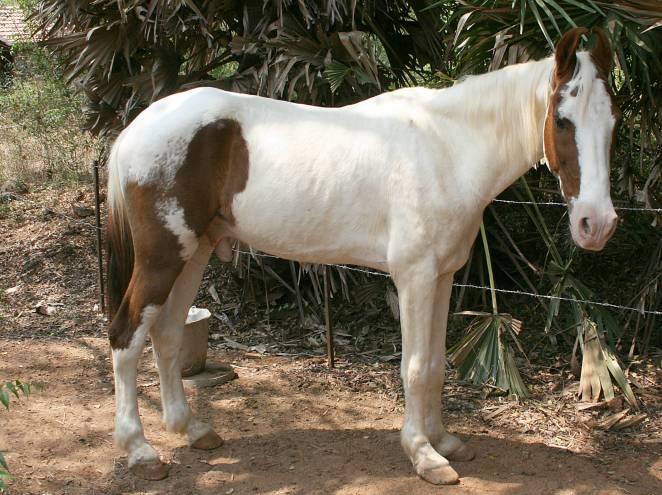
People usually go looking for Kathiawari horse information when they’re trying to identify a horse with those unmistakable inward-curving ears, check whether the breed is genuinely rare, or make sensible decisions about care, feeding, and training.
The basics are straightforward, but a few details often get repeated incorrectly (especially coat colours, population claims, and famous “breed stories”). What follows keeps the focus on the breed as it is: a small, heat-tough riding horse shaped by western India’s dry country, still valued for stamina and an efficient, smooth travelling gait.1, 2
Quick facts (at a glance)
- Origin: Kathiawar peninsula, Gujarat, western India1
- Height: commonly around 147 cm at the withers (about 14.2 hh); many are smaller, and breed descriptions often place them in the 13.3–14.3 hh range1, 2
- Build: compact, agile, “desert-horse” type suited to distance and heat1
- Distinctive feature: ears that curve inward and may touch or overlap at the tips1
- Coat colours: seen in many colours, but not black (chestnut is common; bay, grey and dun also occur)1
- Special gait: some perform an ambling/lateral pace called the revaal (also spelled rehwal)1
- Conservation status / numbers: widely cited breed numbers are inconsistent; FAO listings have described the breed as “not at risk”, and no official numbers have been reported to FAO’s DAD-IS for long periods (older reports cite about 7,500 in 1997)1
Where the Kathiawari comes from
The Kathiawari (also written Kathiawadi) developed on the Kathiawar peninsula in Gujarat. It’s closely related to the Marwari horse of neighbouring Rajasthan, with both breeds shaped by local stock and later influence from imported horses, including Arabians, over centuries of trade and empire.1, 3
Historically, these were working war and travel horses: expected to go far on sparse feed, keep their footing in rough country, and stay useful in heat that softens heavier types. That background still shows in the breed’s thriftiness and stamina.1
Physical characteristics you can actually use to identify one
The ears (the headline feature)
The inward-curving ears are the best-known marker. In many Kathiawaris, the tips curve far enough to touch or overlap. It’s distinctive, but it’s not a guarantee of purity on its own—registries and breeding records matter if you’re buying or breeding.1
Size, outline, and movement
Kathiawaris are usually around pony-to-small-horse size, with a compact, wiry outline rather than a tall, long-lined frame. Many are described around 147 cm at the withers, and traditional descriptions often keep them below about 152 cm.1
Some horses show a smooth, efficient lateral pace known as the revaal, which can make long days in the saddle easier on a rider’s body while still covering ground steadily.1
Coat colours (a common point of confusion)
One of the simplest corrections: the Kathiawari is described as occurring in many colours, but not black. Chestnut is often noted as the most common, with bay, grey, and dun also seen.1
Temperament and behaviour
Breed descriptions commonly characterise the Kathiawari as high-spirited and intelligent—alert, responsive, and usually best with calm handling and clear boundaries rather than force. Individuals vary, but the “desert horse” pattern is familiar: steady in routine, quick to notice change, and inclined to conserve energy until asked to work.1
Common uses (then and now)
Traditionally used as a cavalry and distance horse, the Kathiawari is now more often seen in general riding, harness work, and sport activities in India. Accounts also mention use for police work and tent-pegging, a discipline that suits an agile horse with sharp acceleration and tidy turning.1
Training and exercise: what tends to work best
Kathiawaris are typically described as quick learners with plenty of “go”. Training goes best when it’s steady and consistent, with enough variety to keep the horse attentive without escalating pressure. Long, quiet miles build the body they were shaped for, and short schooling sessions polish steering, brakes, and manners.
- Start with foundations: leading, yielding to pressure, standing tied, feet handling, and calm exposure to new places.
- Build stamina gradually: distance and heat tolerance don’t replace good conditioning.
- Keep sessions clean: finish on a calm, correct response; avoid drilling an intelligent horse into resistance.
Health, care, and lifespan
Many sources describe the breed as hardy and relatively heat-tolerant, shaped by arid conditions and the practical demands of travel. Even so, Kathiawaris are still horses: good management matters more than breed mythology.1
Lifespan varies with care and luck, but many horses can live into their twenties and beyond with appropriate dental care, parasite control, hoof care, and sensible feeding.
Colic risk: reduce the preventable part
Colic has many causes, but feeding and management are major levers. Australian feeding guidance commonly emphasises plenty of forage, consistent routines, clean water, and avoiding mouldy feed as practical ways to lower risk.6, 7
- Keep forage as the base of the diet, and make changes slowly.
- Watch water intake, especially in hot weather or when travelling.
- Store hay and hard feed to prevent mould and spoilage.
Laminitis: manage sugars and starch, especially in easy keepers
Laminitis risk is strongly influenced by diet (especially non-structural carbohydrates), body condition, and pasture management. Australian feed guidance for laminitis-prone horses typically recommends a low sugar/starch approach while still meeting minimum roughage needs, rather than “starving” a horse to lose weight.8
Grooming and routine maintenance
Daily grooming is less about shine and more about noticing what’s changed: heat in a hoof, a swelling under the saddle area, a rub that wasn’t there yesterday. Regular hoof care matters in every climate, but it’s especially important for horses kept on hard ground or doing mileage.
- Hooves: pick out regularly; schedule trims/shoeing to suit terrain and workload.
- Skin and coat: brush to remove dust and check for rain scald, itch, or minor wounds.
- Ears: the curved ear shape is normal for the breed; keep the outer ear clean, and leave deeper cleaning to a vet if there’s discharge or obvious irritation.
Diet and nutrition (simple, reliable principles)
A Kathiawari may be able to cope with sparse conditions, but in modern care the goal is steadiness: fibre-first feeding, clean water, and enough vitamins and minerals to match the horse’s workload and forage quality. Australian feeding references commonly highlight minimum forage targets and caution around high-grain, high-starch diets for gut and hoof health.6, 8
Fun facts (with a reality check)
The “Chetak” story
Chetak is the traditional name given to Maharana Pratap’s horse at the Battle of Haldighati (18 June 1576). Later sources describe the horse as Marwari in many tellings, though it is also recorded as Kathiyawadi in some texts; historical sources from the battle itself do not reliably name the horse.4
How rare is the breed, really?
Online summaries often claim very specific modern population figures, but those numbers are not consistently supported by an up-to-date, central reporting system. FAO-related reporting has described the Kathiawari as “not at risk”, and published notes indicate that formal breed numbers have not been reported to FAO’s DAD-IS since the late 1990s (with older figures cited around 7,500 in 1997). Treat precise “current totals” with caution unless they come from a clearly dated official registry or government release.1
Final thoughts
The Kathiawari is a horse of dry country and long distances: compact, watchful, and built to keep going when the day stretches out. If you’re choosing one, or caring for one far from Gujarat, the essentials don’t change—sound feeding, patient training, and ordinary daily observation are what keep an uncommon breed healthy and useful.
References
- Wikipedia — “Kathiawari horse” (overview of origin, characteristics, colours, gait, and notes on reporting of breed numbers)
- PetMD — “Kathiawari” (breed description, height range, and general background)
- Wikipedia — “Marwari horse” (relationship to Kathiawari and shared traits)
- Wikipedia — “Chetak” (traditional account and uncertainty in historical sources)
- FAO — Domestic Animal Diversity Information System (DAD-IS) (global framework for breed reporting)
- Logan Insurance — “Colic Control” (forage minimums and feeding management factors linked to colic risk)
- Pryde’s EasiFeed (Australia) — “Keeping stallions ‘Safe & Sound’” (high-fibre feeding and practical risk reduction for colic/laminitis)
- Hygain (Australia) — “What to feed a horse with laminitis” (roughage minimums and low sugar/starch guidance)

Veterinary Advisor, Veterinarian London Area, United Kingdom