
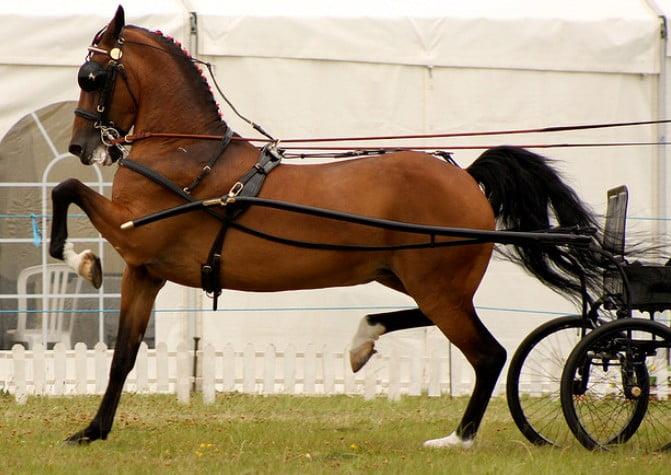
Most people look up the Hackney Horse when they’re trying to identify one at a show, check whether the breed will suit their handling skills, or work out what “high action” really means in day-to-day care. It’s a striking horse, but that style comes with practical considerations: training needs to be quiet and consistent, and soundness, diet, and hoof care can’t be an afterthought.
Below is a clear, breed-focused guide to what a Hackney Horse is (and isn’t), where it comes from, what it’s typically like to live with, and the basics of feeding, exercise, and preventative care—grounded in breed and welfare references rather than show-ring folklore.1, 7
Origin: England
Height: commonly around 14.2–15.2 hands (about 147–157 cm); some horses may be taller depending on registry and type1, 7
Adult weight: often around 450–540 kg (varies with type, sex, and condition)1, 2
Coat: short and fine
Colours: usually solid dark colours (commonly bay, brown, black; chestnut also seen); white markings can occur1, 4
Temperament: alert, energetic, sensitive; typically responds best to steady handling and clear routines1
Lifespan: commonly 20–30 years with good management (individual variation is normal)
Uses: traditionally harness and carriage; now seen in show harness, carriage and combined driving, and sometimes ridden disciplines depending on the individual1, 3
Distinguishing features: arched neck, refined head, and the breed’s famous high, crisp trot (“high action”)7
How common are they? The Hackney Horse is considered rare, with conservation groups listing it as extremely uncommon/endangered in modern populations.2, 3
What makes a Hackney Horse a Hackney?
The Hackney is a harness horse shaped by a particular look and way of going: a proud outline, strong quarters, and a trot with pronounced knee and hock flexion. In the show world, that animation is the headline. In everyday life, it translates to a horse that notices its surroundings, stays busy in its body, and benefits from calm, consistent handling.1, 7
History and origin
The breed developed in England in the 18th century, built from the Norfolk Trotter type with Thoroughbred influence, creating a stylish, fast trotter suited to the roads and carriages of the day.1
One early influential sire commonly mentioned in breed histories is Shales (foaled around 1760), linked with the emerging “Hackney” type.1, 2
Physical characteristics
Size and build
Hackney Horses are typically mid-sized, strongly muscled through the shoulder and hindquarters, with a relatively compact frame and an arched neck. Heights are often quoted around 14.2–15.2 hands, though some registries and descriptions allow a wider range depending on how “horse” versus “pony” is defined.1, 7
Movement (“high action”)
The Hackney’s trot is the feature people recognise first: rounded front action, clear hock flexion, and a balanced picture of lift and cadence. Breed guidance for in-hand movement emphasises straightness and correctness; in harness, animation is valued more highly, but straight, true placement still matters.7
Colours and coat
Solid colours are typical, with dark coats especially common (bay, brown, black), and chestnut also seen. White markings can occur, though extremes are less common in many modern show lines.1, 4
Temperament and behaviour
Hackneys are widely described as alert and energetic. Many are sensitive to handling and environment, which can be an advantage in training when managed well, and a challenge when routines are inconsistent or pressure escalates. They tend to do best with a handler who rewards relaxation, keeps sessions short, and doesn’t rush the basics.1
As a “family horse”, it depends on the individual. A steady Hackney can be a pleasure, but the breed’s natural animation and sensitivity means it isn’t always the easiest match for a novice household without experienced support.
Training and exercise needs
Early handling and socialisation
Start with the quiet foundations: leading, standing, yielding to pressure, and learning to settle. Hackneys often notice small changes—new places, new gear, new routines—so early, gentle exposure to normal life helps later on.
Training approach that suits the breed
- Keep cues clear and consistent. Sensitivity is useful when signals are fair, and confusing when they aren’t.
- Reward calm. Build “downshift” skills (standing, breathing, softening) alongside forward work.
- Protect soundness. Their action is athletic; avoid drilling tight circles or fast work on poor footing.
Exercise and enrichment
Most Hackneys thrive on regular work rather than occasional big efforts. A mix of straight-line fitness (hacking, longer trots), arena schooling for balance, and varied environments keeps their minds occupied and their bodies even.
Health considerations and lifespan
There is no single “Hackney disease” every owner should expect, but the breed’s movement and show conditioning traditions make basic management especially important: good feet, sensible workload progression, and prompt attention to any unevenness. If a horse is trained to produce extreme action, the usual welfare principles apply—soundness first, and don’t let presentation outrun comfort.
Everyday preventative care
- Regular farrier care to maintain balanced feet and support straight movement.
- Routine veterinary checks, vaccinations, and parasite control appropriate to your region.
- Dental care so the horse can chew forage properly and maintain condition.
- Monitor body condition and adjust feed early, not after weight swings become obvious.6
Diet and nutrition
Hackneys don’t need a “special” diet because of their breed, but they do benefit from the same fundamentals that keep most horses sound and settled: plenty of forage, clean water, and careful control of high-sugar/high-starch feeds when they’re not truly needed for workload.5
Forage first (how much to feed)
A practical rule of thumb used in Australian guidance is to budget roughly 1.5–2% of bodyweight per day as dry feed intake (mostly forage), adjusted for pasture availability, workload, age, and condition.5
Water
Horses need constant access to clean water. Australian government guidance notes a horse may drink roughly 25–50 litres per day depending on heat and feed moisture, and dehydration increases colic risk.6
Feeds to be cautious with
Large grain feeds and sugary “treat-style” rations can push energy intake beyond what many horses need and may increase the risk of diet-related problems in susceptible animals. If you need more condition or performance, make changes gradually and base choices on workload and body condition—not on advertising claims.5
Grooming and maintenance
The Hackney’s coat is usually short and fine, so grooming is often straightforward: daily or near-daily brushing to lift dust, check for rubs under harness or tack, and keep the skin healthy. Pay attention to the legs—cleanliness, heat, swelling, and small knocks show up there first in many active horses.
Fun facts (kept honest)
- The breed’s reputation is built on a distinctive trot developed for stylish road and carriage work, and later refined for the show harness ring.1
- Shales (foaled around 1760) is often cited as an influential early sire in Hackney history.1, 2
Final thoughts
A Hackney Horse is easiest to understand when you watch it move: a compact, athletic body, an elevated trot, and an alert presence that can fill a ring or a driveway without needing much space. In the paddock, the same traits mean it appreciates routine, thoughtful training, and management that protects soundness. For the right home, it’s a breed of crisp lines and clear rhythm—more metronome than muddle.
References
- Encyclopaedia Britannica: “Hackney” (horse breed overview and history)
- The Livestock Conservancy: Hackney Horse (breed notes and rarity status)
- US Equestrian (USEF): Hackney (breed description and modern uses)
- Horse Canada: Hackney Horses & Ponies (height range, colours, uses)
- Agriculture Victoria: Feed requirements of horses (intake as % bodyweight; feed budgeting)
- Business Queensland: Maintaining horse welfare through dry times (water needs and dehydration/colic note)
- Hackney Horse Society: Breed standard (movement guidance)
- Agriculture Victoria: Basic horse care (feeding and water guidance)

Veterinary Advisor, Veterinarian London Area, United Kingdom