
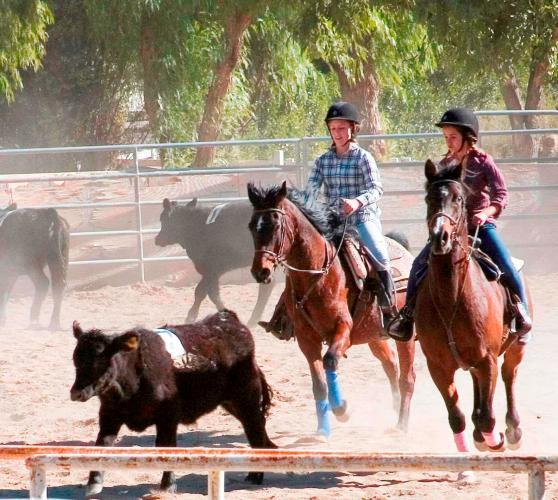
Most people find team penning because they want to know, quickly, what actually happens in the arena: how the run starts, how long you’ve got, what counts as a “no time”, and what gear and skills matter before you pay an entry fee or bring a horse to cattle.
It’s a short, sharp sport. Small misunderstandings—about the start line, the time call, or stock handling—can turn a clean run into a disqualification. The sections below sketch the sport as it’s commonly run in Australia, then point you to the kinds of rules clubs publish so you can check the fine print for your local event.
What is team penning?
Team penning is a timed western-style cattle event where three riders work as a unit to identify and move three assigned cattle from a larger mob into a holding pen at the far end of the arena.2, 3
A run starts when the first horse crosses the start (or cattle) line, and only then does the judge call the team’s assigned number or collar colour. From that moment, the job is simple to describe and difficult to do: separate the correct three without letting the mob unravel, keep “clean” cattle on the herd side of the line, and finish under control at the gate.3
Where the sport came from (and how it spread)
Team penning grew out of everyday cattle work—sorting and drafting animals for management tasks—and became formalised as competition in the United States in the mid-20th century. Accounts commonly point to early organised events in California in the 1940s.2
In Australia, it’s now established as a club-based, weekend-friendly sport, often run at showgrounds and private arenas with a strong emphasis on safe stock handling and clear arena rules.3
How a run works (the essentials)
The arena set-up
The arena is effectively split into a herd end and a pen end by a clearly marked line. The mob starts on the herd side. The pen sits at the opposite end.3
The start
- The team waits until the judge signals they may cross.
- Time starts when the first horse crosses the start/cattle line.
- The judge (or caller) announces the team’s assigned collar colour or number after the run begins.3
The objective
The team must cut out the three matching cattle and move them to the pen end, then “call time” once the assigned cattle are secured and the loose cattle are back where they should be (this detail varies slightly by rule set).3
Typical time limits (check your event)
Australian rule sets commonly use a 2-minute run time, with a 30-second warning near the end.3
Some competitions (especially outside Australia, or in certain divisions) may use shorter limits such as 60–90 seconds, so always confirm what’s published for the day.4
Rules that commonly cause “no time” or disqualification
Exact wording varies by organiser, but these are frequent tripwires in Australian-style rules:
- Too many cattle across the line: many Australian rules disqualify a run if more than five head are on the pen side at any one time.3
- Wrong cattle in the pen when time is called: if incorrect cattle are in the pen at the call, it’s commonly a “no time”.3
- Entering the pen on horseback: many organisers prohibit horses (and often riders) from entering the pen, including during removal of wrong cattle.5
- Crossing back over the line late in the run: some rule sets require all riders to commit to the pen side once the correct cattle are across, and penalise returning to the herd side.3
- Rough stock handling: unnecessary rough handling is commonly grounds for disqualification.3
Equipment and attire (what you actually need)
Team penning is gear-light compared with some disciplines, but it’s unforgiving of poor fit and poor preparation.
Horse and tack
- A sound, cattle-broke horse that can stop, turn, and hold a line without panic.
- Well-fitted saddle and bridle; a bit the horse understands (not a “stronger bit” as a shortcut).
Rider clothing and safety
Clubs set their own dress rules, but safe footwear and sensible riding clothes are the baseline. For helmets, many Australian equestrian events require approved safety standards. If you compete under Equestrian Australia rules, helmets must meet one of EA’s listed standards and be worn with the harness fastened (unless a discipline rule allows otherwise).6
Even where a club permits hats for adults, a properly fitted helmet is the quieter, safer choice—particularly for green horses, fresh cattle, or riders new to the gate call.6
Training for team penning (what to build first)
The best runs look almost slow at first glance. They’re built on control, not chase.
- Rate and stop: your horse should come back under you instantly, without bracing.
- Hold pressure: teach the horse to stay in front of cattle and “block” quietly rather than darting in and out.
- Gate manners: practise approaching the pen gate under control, then standing without creeping.
- Team communication: agree on simple roles (cut, turn-back, gate) before you enter the arena, then adapt as the cattle break.2, 3
Simple strategies that win more often than speed
- Start clean: drift in together and let the cattle settle before you pick your three.
- Make the herd smaller: once your cattle are identified, keep the rest blocked at the line instead of fighting the whole mob deep in the arena.
- Protect the line: a calm turn-back rider prevents accidental “too many across” moments that end a run.
- Don’t rush the final call: time is only useful if it’s a qualifying time—secure the right cattle, then signal clearly.3
Benefits (for riders and horses)
Team penning rewards steady riding, timing, and an eye for livestock flow. For many riders, it’s also one of the most practical ways to build stock sense: reading cattle movement, using angles instead of force, and learning how quickly pressure can spill into chaos when you overface a mob.2
Events and competitions to know about
In Australia, teams typically compete through local clubs and state circuits under published rule sets. A good starting point is your nearest association’s rules page, then the event schedule and entry conditions for the specific competition you’re considering.3
Internationally, team penning is widely associated with the United States Team Penning Association (USTPA), which publishes detailed rule guidance for its events.8
References
- Equestrian Australia: Current approved safety standards for helmets
- Team penning (overview and history)
- Australian Team Penning Association: Team penning rules (PDF link page)
- IMEHA/MEPSA guidebook: Team penning time limits and calling time (example rule set)
- Clifton Show Society: Team penning rules (example event rules, includes pen entry/WHS note)
- Equestrian Australia: Helmet regulations updated
- Horse Safety Australia: Helmet standards guidance
- USTPA handbook (rule guidance excerpted copy)

Veterinary Advisor, Veterinarian London Area, United Kingdom