
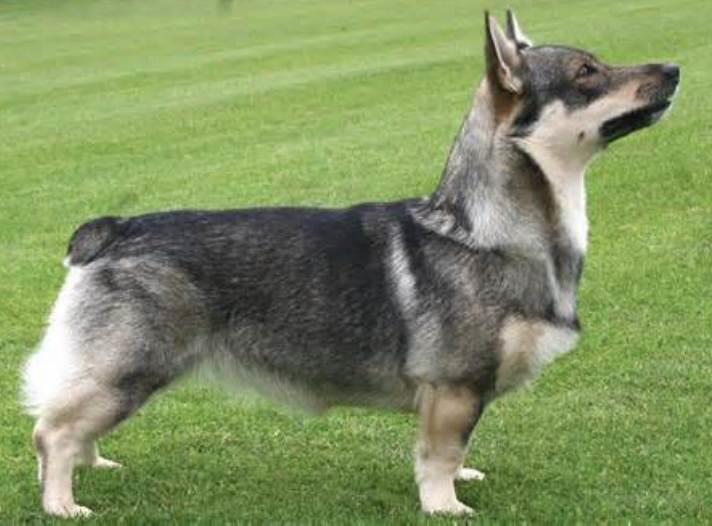
People usually start looking up the Swedish Vallhund when they’re weighing up a compact, tough little herding dog: enough energy for long walks and training, but still small enough to live comfortably in an ordinary home. The trade-off is real. This breed brings a sharp mind, a strong bark and an instinct to move things (and sometimes children) along.
Below is a practical, grounded look at what a Swedish Vallhund is like to live with: what they were bred to do, what they typically look like, how much exercise they really need, and the health checks worth asking about before you commit.1, 2
Breed name: Swedish Vallhund (Västgötaspets)
Size: Small-to-medium, sturdy herding type2
Height (at withers): Dogs 33–35 cm; bitches 31–33 cm2
Weight: About 11.5–16 kg2
Coat: Medium length, harsh topcoat with a soft, woolly undercoat (double coat)2
Colours: Grey and red shades with darker guard hairs; limited white markings may be acceptable (standards vary slightly by kennel club wording)2, 3
Temperament: Alert, active, intelligent; bred to work closely with people and livestock3, 4
Typical lifespan: Often 12–15 years (individuals vary)4
History and origin
The Swedish Vallhund is a working farm dog from Sweden, developed to shift cattle and keep watch rather than to lounge quietly indoors. Many sources trace the breed back more than a thousand years, with strong links to the rural province of Västergötland and later efforts to restore numbers after a mid-20th-century decline.4, 5
In modern terms, the “job description” still shows: they tend to be quick on their feet, responsive to training, and naturally inclined to track movement and control space.3, 4
Physical characteristics and appearance
A Swedish Vallhund looks like a small, athletic herder with spitz influence: a wedge-shaped head, pricked ears, and a body built for all-day work. The breed standard describes a slightly longer-than-tall outline (about a 2:3 height-to-length relationship), with strong hindquarters and an efficient, active gait.2
The coat is a practical double coat—harsh on top, dense underneath—and most dogs shed, often heavily during seasonal coat drops. Regular brushing keeps loose undercoat under control and helps you notice skin issues early.2, 4
Tails vary. Some are naturally short, some long; carriage and length can differ widely and still fall within kennel club descriptions.2, 3
Temperament and personality
Expect a dog that stays switched on. Swedish Vallhunds are typically bright, observant, and keen to engage, especially when there’s a task to do. In a household, that can look like shadowing you from room to room, watching visitors closely, and offering opinions—often out loud.4
They’re often good fun for people who enjoy training, scent games, agility, obedience, or any structured activity where the dog gets to think. Without that outlet, the same quick brain can turn to nuisance barking, fence-running, or persistent “herding” of anything that moves.4
Training and exercise needs
This is a working breed in a small body. Most Swedish Vallhunds do best with daily exercise plus a steady trickle of mental work: training sessions, puzzle feeders, scent trails, or a sport class. Many adults will be satisfied with roughly an hour a day if that time includes sniffing, training, and variety—not just a repetitive loop around the block.4
What helps (especially in the first 12 months)
- Short, frequent training using rewards (food, toys, access to play) rather than force.
- Early socialisation that’s calm and controlled: different surfaces, people, noises, dogs you trust.
- “Off switch” practice: teaching rest on a mat, quiet time in a crate or pen, settling after excitement.
A quick note on barking and herding behaviour
Barking is common in many pastoral breeds, and Vallhunds are no exception. It usually improves when the dog has enough exercise, predictable routines, and clear training around alerting (one or two barks is fine; endless commentary is not).4
Grooming and everyday care
The coat is designed to cope with weather and dirt, so it doesn’t need fancy styling. What it does need is consistency:
- Brush weekly (more during heavy shedding) to remove dead undercoat and reduce tangles.
- Bathe as needed, not on a strict schedule—over-bathing can dry the skin.
- Nails, ears, teeth: routine trimming/cleaning and regular dental care, as for any breed.
Because they’re low to the ground, pay attention after bushwalks: grass seeds, burrs, and ticks can hide in the coat and between toes.
Health issues and what to ask breeders about
No breed is “problem free”, and a sensible approach is to ask what’s screened in the lines you’re considering. For Swedish Vallhunds, eye disease (including forms of progressive retinal atrophy/retinopathy) is a known concern, and hip dysplasia can occur in dogs generally—particularly where genetics and growth factors combine.6, 7, 8
Useful pre-purchase questions
- What eye testing is done in the breeding dogs, and can you share results?
- Are the parents screened for hip dysplasia (and through which scheme)?
- Have there been seizures in the line (epilepsy can be complex and isn’t always predictable)?
- What support do you offer if a significant inherited health problem appears?
Hip dysplasia, in particular, is influenced by genetics and environment. Maintaining a lean body condition and using sensible exercise while a puppy is growing can reduce stress on developing joints, even though it can’t erase inherited risk.7, 8, 9
Swedish Vallhund as a family pet: practical pros and cons
Pros
- Trainable and bright—often excels at classes and dog sports.4
- Compact but robust, suited to active households that don’t want a large dog.2
- Watchful nature—tends to notice what’s happening around the home.4
Cons
- Noise: alert barking is common and needs management, not wishful thinking.4
- High engagement needs: they rarely thrive as “weekend-walk only” dogs.
- Herding habits: may chase or nip at heels if not redirected early (especially with fast-running kids).
Finding a breeder or rescue
Start with recognised breed clubs and kennel council networks, then take your time. A good breeder is usually open about health screening, happy to talk through temperament, and curious about how the dog will live. They’ll also match puppies thoughtfully rather than promising a one-size-fits-all “perfect family dog”.
If you’re adopting, ask the rescue group what they’ve observed in foster care: barking level, tolerance of handling, dog-to-dog behaviour, and how the dog settles when left alone. For this breed, that last point matters.
Final thoughts
The Swedish Vallhund suits people who enjoy a dog with opinions, stamina, and a mind that stays busy. Give them work—training, games, long sniffy walks—and they tend to move through life like a small, capable farmhand. Skip that daily outlet, and they’ll invent their own job description.
References
- Dogs NSW (Dogs Australia member body) – Swedish Vallhund breed standard
- Dogs Australia (ANKC) – Swedish Vallhund breed standard
- The Kennel Club (UK) – Swedish Vallhund breed standard
- The Kennel Club (UK) – Swedish Vallhund breed information
- American Kennel Club – Swedish Vallhund history
- PubMed – A novel form of progressive retinal atrophy in Swedish Vallhund dogs
- Cornell University College of Veterinary Medicine – Canine hip dysplasia (CHD)
- Orthopedic Foundation for Animals (OFA) – Hip dysplasia
- Animal Medical Center – Hip dysplasia in dogs

Veterinary Advisor, Veterinarian London Area, United Kingdom