
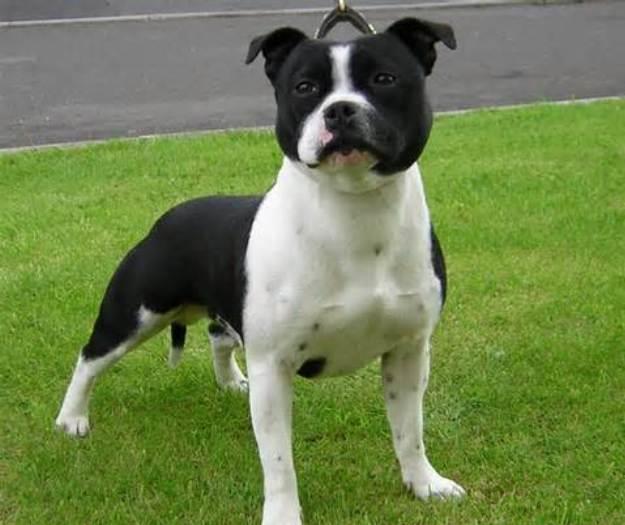
People usually look up Staffordshire Bull Terriers when they’re deciding whether a “Staffy” will fit their home—especially around children, other pets, and day‑to‑day routines. The stakes are practical: the wrong match can mean stress, preventable behaviour problems, and safety risks that are hard to unwind later.
Staffies are compact, muscular dogs with a long history in Britain and a modern reputation for being deeply people‑focused. They can be steady, affectionate companions when they’re trained well and managed thoughtfully—but they still need supervision, clear boundaries, and enough exercise to keep their minds and bodies settled.
At a glance
- Size: Medium; typical breed-standard height 36–41 cm at the shoulder. 1, 2
- Weight: Dogs 13–17 kg; bitches 11–15.4 kg (breed standard). 1, 2
- Coat: Short, smooth, close. 1, 2
- Colours: White, red, fawn, black, blue, brindle, and any of these with white (some colours are not accepted in the UK standard). 1
- Temperament (breed standard wording): “Bold, fearless and totally reliable.” 1
- Typical lifespan: Often around 12–14 years (individuals vary). 3
- Daily exercise: Many adult Staffies do well with around an hour a day, split into walks plus play and training. 3
History and origin
The Staffordshire Bull Terrier developed in 19th‑century England, shaped by the era’s bull‑and‑terrier types. Those early dogs were selected for strength, agility, and determination. As blood sports faded and laws changed, the breed’s centre of gravity shifted: the same compact power that once suited the ring became, in a more ordinary life, a dog built for close companionship and busy households.
Modern breed standards emphasise balance—muscular, active, agile—alongside steadiness with people. 1, 2
Appearance and unique traits
Build, head, and movement
A well-bred Staffy is a study in compact strength: broad skull, pronounced cheek muscles, and a body that looks “close-coupled” rather than long and rangy. They’re often heavier in the front than their height suggests, with an agile, economical gait when fit and well-conditioned. 1
Coat and grooming
The coat is short and close, usually easy to maintain. Weekly brushing is typically enough to lift loose hair and keep the coat glossy, with bathing only when needed. 3
Temperament: what people tend to notice
Staffies are widely described as affectionate and people‑oriented. Many form a tight bond with their household and prefer to be near the action—on a mat at your feet, in the doorway watching, or pressed against a leg when the day goes quiet. 3
They can also be intense dogs: quick to engage, persistent in play, and sometimes blunt with other dogs. The range is wide, but early socialisation, ongoing training, and sensible supervision make a real difference to how that intensity shows up day to day. 4, 5
A note on the “nanny dog” label
You’ll often see Staffies called “nanny dogs”. It’s a nickname, not a guarantee. Any dog can bite, and the safest families treat child–dog interactions as a supervised activity, not a background detail. 6, 7
Is a Staffy a good match for your home?
Staffies often suit people who want a companion that’s physically sturdy, emotionally close, and happy to train and play most days. They’re usually less suited to households that need an independent dog that’s content being left alone for long stretches.
They can be a good fit if you can offer:
- Daily exercise plus short, regular training sessions (they tend to enjoy having a job). 3, 5
- Early and ongoing social experiences, handled gently and with rewards. 4, 5
- Clear house rules (jumping up, mouthing, barging through doors) taught early and reinforced calmly.
- Safe management around other dogs if yours is reactive or overconfident—lead skills, space, and supervision.
Children, visitors, and other animals
Children
Many Staffies are tolerant with children, but tolerance is not supervision. The highest‑value safety habits are simple: adults stay close, kids don’t climb on dogs, and dogs get uninterrupted rest—especially around food, toys, and sleeping places. 6, 7
Other pets
Some Staffies live peacefully with other dogs and cats; others don’t. Introductions should be slow, neutral, and controlled, with plenty of space and escape routes for the resident pet. Socialisation helps, but it’s not a switch you flick once in puppyhood—it’s a lifelong pattern of calm practice. 4, 5
Training and socialisation
Staffies usually respond best to reward‑based training: food, play, and praise used deliberately, with unwanted behaviour redirected rather than punished. Harsh methods can create fear and make problems harder to treat. 5
Early socialisation: timing matters
Puppies have a critical socialisation period (often described as roughly 3–17 weeks). Gentle exposure during this window—paired with good experiences—can shape adult behaviour for years. 4
What to practise early
- Calm handling (ears, paws, collar grabs), rewarded.
- Loose‑lead walking and a reliable recall foundation.
- Settle on a mat and quiet time skills.
- Safe greetings: four paws on the floor, no barging.
Exercise and enrichment
A typical adult Staffy benefits from daily exercise—often around an hour—plus something that uses their brain: short training sessions, scent games, or food puzzles. 3
Many also enjoy tug and fetch, but it helps to teach “drop” and “enough” early so excitement stays within the rules.
Health: what to watch for
Many Staffies live long, active lives, but they do have known inherited risks. Sensible breeding and routine veterinary care are the quiet foundations here—especially if you’re buying a puppy rather than adopting an adult. 3
Conditions commonly discussed in the breed
- Hereditary cataracts (HC): A known DNA-testable condition in the breed. 8
- L‑2‑hydroxyglutaric aciduria (L‑2‑HGA): A serious inherited neurometabolic disorder with DNA testing available via breed‑health programs. 9
- Skin problems: Many Staffies have sensitive skin; recurring itch, ear infections, or sore paws deserve a proper vet work‑up rather than endless shampoo swaps. 3
Choosing a puppy: a practical health check
- Ask what health testing has been done for the parents (including HC and L‑2‑HGA) and request evidence, not just reassurance. 8, 9
- Meet the mother dog if possible and observe her temperament around visitors.
- Look for clear eyes, clean ears, and a confident but not frantic puppy.
Feeding and weight
Staffies carry muscle easily, and they can also gain weight quickly if treats and “extras” creep in. A measured diet, regular weigh‑ins, and treats used as training tools (not background snacks) help keep joints and skin in better shape over time.
Final thoughts
A Staffordshire Bull Terrier is often at its best when life is steady: daily movement, a bit of training, close contact with the household, and clear limits around rough play and greetings. In that setting, the breed’s famous compact courage softens into something more domestic—a watchful, warm-bodied companion that prefers to be near its people, day after day. 1, 3
References
- The Kennel Club (UK) – Staffordshire Bull Terrier breed standard
- Dogs SA – Staffordshire Bull Terrier breed standard
- PDSA – Staffordshire Bull Terrier: breed information and care
- RSPCA Knowledgebase – How can I socialise my puppy?
- RSPCA Knowledgebase – Dog training: recommendations and reward-based methods
- Better Health Channel (Victoria) – Animals and child safety
- Agriculture Victoria – Preventing dog attacks in the home
- The Kennel Club (UK) – DNA test information: Hereditary Cataracts (HSF4)
- North West Staffordshire Bull Terrier Club – Health issues (HC and L-2-HGA overview)

Veterinary Advisor, Veterinarian London Area, United Kingdom