
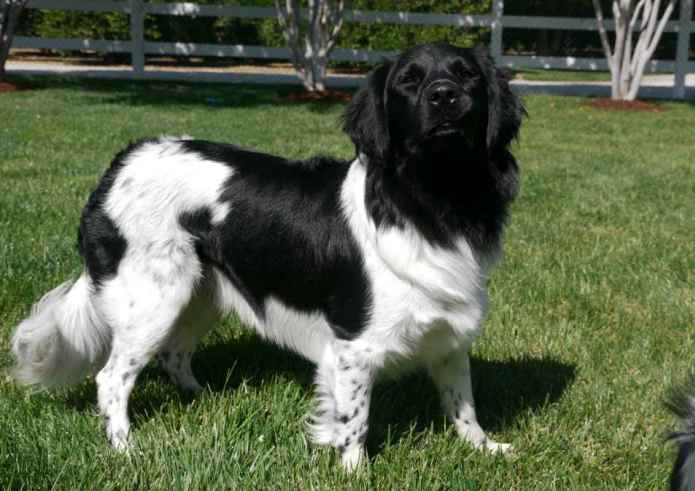
People usually start searching for “Stabyhoun” when they’re trying to check two things quickly: what this Dutch gundog is really like to live with, and whether the breed’s size, energy, grooming and health needs will fit their household.
The details matter. A Stabyhoun that’s under-exercised can become restless and noisy, while one that’s bred without health screening can bring expensive, lifelong problems. Here’s a clear, grounded look at the breed—what’s typical, what’s sometimes claimed online but isn’t quite right, and what to confirm before you commit.
Stabyhoun at a glance
- Size: Medium
- Height: Males ~50–53 cm; females ~48–50 cm (ideal range)1
- Weight: Males ~22–27 kg; females ~18–23 kg1
- Coat: Long, smooth; may be slightly wavy over the croup; dense and practical rather than fluffy2
- Colours: Black, brown or orange with white markings; ticking/roaning in the white is permitted3
- Tail: Long and natural, reaching to the hock; carried low at rest, lifted in motion but not curled over the back2
- Life expectancy: Commonly around 13–15 years6
History and origin
The Stabyhoun (also written as Stabijhoun; “Stabij” in breed standards) comes from the Dutch province of Friesland. It developed as an all-round farm and hunting dog—steady enough around home, but capable in the field, including work in water and rough ground.4, 6
Today it remains relatively uncommon outside Europe, which is part of its appeal—and part of the reason it’s worth being patient and careful when you’re looking for a puppy.
Physical characteristics and appearance
At a distance, a Stabyhoun reads as a practical athlete: medium frame, clean lines, and a coat built for wet grass and cold mornings. The official standard describes a long, smooth coat over the body, with a slight wave allowed over the croup. The head coat is shorter, and the tail is bushy rather than feathered.2
One common misconception is that the breed’s tail is “usually docked”. In the standard, the tail is naturally long and is not described as a docked feature.2
Tail docking in Australia (important note)
If you’re reading this in Australia, routine tail docking for appearance is broadly banned and generally only permitted for therapeutic reasons by a veterinarian, depending on state and territory rules.7, 8
Temperament: what they’re like to live with
A well-bred, well-socialised Stabyhoun is typically gentle and people-focused at home, with an outdoorsy engine that switches on the moment you pick up the lead. They’re often described as loyal, kind, and eager to work alongside their person—without being a constant shadow.5
Like many sporting breeds, maturity can be slow and the adolescent months can feel busy. The calm adult you’re imagining usually arrives through routine: daily movement, simple rules, and plenty of time spent learning what “normal life” looks like.
Training and exercise needs
This is a breed that does best with regular, purposeful activity. Long walks are a baseline. Off-lead running (where safe and legal), scent games, retrieving, and obedience work tend to suit them because the breed was shaped for practical tasks rather than ornament.6
- Exercise: Aim for daily movement plus something that uses their brain (tracking games, training sessions, puzzle feeding).
- Training style: Calm, consistent, reward-based training typically works well; harsh handling can make a sensitive dog wary or resistant.
- Socialisation: Gentle exposure to people, dogs, surfaces, noises and handling (ears, paws, mouth) helps later vet visits and grooming.
Health concerns to know about
No breed is “problem free”, but the Stabyhoun is often described as relatively healthy overall. Even so, several inherited conditions are known in the breed population, and responsible breeders screen and track them across lines.9
Conditions commonly discussed in the breed
- Hip dysplasia: A developmental joint condition that can range from mild to severe; screening via radiographs is commonly used in breeding programs.9
- Epilepsy: Reported in the breed, often with onset in early adulthood; careful breeding management aims to reduce risk even where no simple carrier test exists.10
The earlier draft also listed ear infections as a “breed health concern”. Stabyhouns aren’t uniquely defined by ear disease, but any dog with drop ears can be more prone to otitis externa, especially with swimming, humidity, allergies, or heavy ear hair trapping moisture.11
Grooming and coat care
The Stabyhoun coat is designed to cope with weather and bushy ground cover, but it still needs steady maintenance. Most owners do best with a simple rhythm: a thorough brush once or twice a week, and extra attention during seasonal shedding.
- Brushing: Focus behind the ears, along the feathering, and anywhere a harness rubs.
- Bathing: As needed, especially after muddy swims—rinse well and dry properly.
- Ears: Check weekly, and after water exposure. If you notice redness, bad smell, discharge, frequent head-shaking or scratching, get veterinary advice early.11
Stabyhoun as a family dog: children and other pets
In the right home, the Stabyhoun can be an excellent family companion: steady enough to live close to people, and active enough to enjoy a household that spends time outdoors. As always, success is less about the breed label and more about management—supervision with young children, teaching respectful handling, and giving the dog quiet space when it wants to rest.
With other pets, early introductions and thoughtful training matter. A Stabyhoun may have hunting instincts, so small animals should never be treated as a “guaranteed safe” match—set up calm, controlled meetings and reinforce reliable recall and impulse control.
Finding a reputable breeder or rescue
Because Stabyhouns are relatively rare, the biggest practical risk is not the breed—it’s rushing into the first available puppy. A careful search usually pays off in health, temperament, and support later.
What to look for
- Health screening results shared openly (particularly hips, and any breed-relevant monitoring the breeder uses).9
- Puppies raised in a home-style environment with normal handling, surfaces, and household noise.
- Clear information about the parents’ temperament and working/companion suitability.
- A breeder who asks you questions too, and is willing to say “not this litter” if it’s not a match.
Final thoughts
The Stabyhoun is at its best in a home that enjoys movement, has time for training, and appreciates a dog that is gentle indoors but distinctly capable outdoors. If you’re drawn to the breed, take your time: confirm health screening, meet related dogs if possible, and plan for the daily exercise that keeps this quiet Dutch hunter settled and well in modern life.
References
- Stabyhoun UK – Official Stabyhoun breed standard (FCI Standard No. 222 summary)
- Sudewyn (Friese Stabij kennel) – Stabyhoun breed standard (FCI No. 222) including tail description
- United Kennel Club (UKC) – Stabyhoun breed standard (colour, coat, height, tail)
- Fédération Cynologique Internationale (FCI) – Stabijhoun (No. 222) breed listing and standard publication details
- Stabyhoun UK – Temperament overview
- Royal Canin – Stabyhoun breed overview (life expectancy and general characteristics)
- Queensland Government (Business Queensland) – Queensland’s ban on docking dogs’ tails
- Agriculture Victoria – Prohibited procedures on dogs (including tail docking)
- Ameri-Can Stabyhoun Association (ASA) – Health information (including hip dysplasia discussion and breeding policy)
- Ameri-Can Stabyhoun Association (ASA) – Breed health notes (epilepsy and SRMA reporting)
- American College of Veterinary Surgeons (ACVS) – Otitis externa (risk factors including floppy ears, moisture, allergies)

Veterinary Advisor, Veterinarian London Area, United Kingdom