
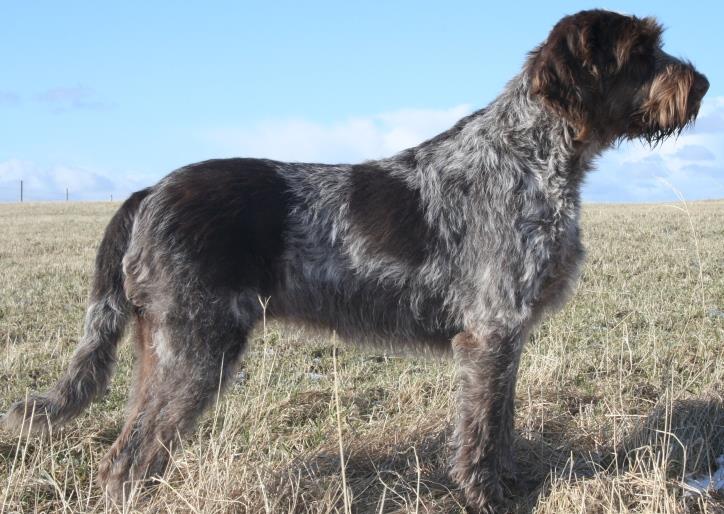
People usually start reading about the Spinone Italiano when they’re weighing up a new dog: will this big, wiry-coated gundog fit family life, handle Australian conditions, and stay healthy into old age?
The details matter. Get the exercise and grooming wrong and you can end up with a bored, stubborn dog and a coat that mats into felt. Miss the early health checks and you may not spot joint trouble until it’s limiting their movement. Here’s a clear, practical look at what the Spinone is like to live with, what they need day to day, and what to ask a breeder before you commit.
Spinone Italiano at a glance
- Size: Large, solidly built gundog
- Height: Males 60–70 cm; females 58–65 cm (at the withers)1
- Weight: Males 34–39 kg; females 29–34 kg (typical range in breed standards)1
- Coat: Coarse, dense and fairly flat; distinctive eyebrows, moustache and beard; little to no undercoat1
- Colours: White; white & orange; orange roan; white & brown (chestnut); brown roan1
- Temperament: Generally steady and people-oriented, with an independent streak common to working gundogs2
- Exercise needs: Moderate to fairly high—best suited to daily activity plus “a job” (training, scent games, retrieving)2
What the Spinone Italiano is (and isn’t)
The Spinone Italiano is an Italian hunting dog bred to work close to the handler, using nose and stamina rather than explosive speed. Traditionally, they’ve been used for tracking, pointing, and retrieving game, including in wet and rough ground where a protective coat and calm persistence are useful traits.3
In a home setting, that heritage often shows up as a dog that likes to be near you, watches what’s happening, and prefers steady routines. They’re not usually a “run in circles all day” breed, but they do tend to cope poorly with long stretches of boredom, especially when young.2
Temperament: calm company with a working-dog brain
Most Spinoni are affectionate and social with their people. They often do best when they’re treated as part of daily life—out on walks, around the yard, and included in training rather than parked outside with nothing to do.2
Independence can look like stubbornness. It’s not defiance as such; it’s a dog that was bred to make small decisions in the field. Clear rules, gentle repetition, and food or toy rewards usually work better than heavy corrections.
With children
Many Spinoni are gentle around children, especially when they’ve been well socialised and the kids know how to behave around a large dog. Always supervise: this is a heavy, strong dog that can accidentally knock over small children when excited or in tight spaces.
With other pets
They’re often sociable with other dogs. With cats and small pets, the outcome depends on early introductions, management, and the individual dog’s prey drive. Assume you’ll need training and supervision outdoors, particularly around birds and wildlife.
Exercise and enrichment: what “enough” looks like
The earlier draft claimed “at least two hours” daily, which is often more than many adult Spinoni strictly need, and not a useful single number. A more realistic baseline is roughly 60–90 minutes a day for adults, adjusted for age, fitness, weather, and what else they’re doing mentally.2
A Spinone that gets a long walk but no brain work can still feel restless. Mix physical activity with simple, quiet tasks that use the nose and the body.
Good daily options
- Long, sniff-heavy walks on a long line (where allowed)
- Retrieving games with clear “start/stop” rules
- Scent games: scatter feeding in grass, or hide treats/toys around the yard
- Obedience refreshers in short sessions (5–10 minutes)
Off-lead care
Because they’re hunting dogs with strong scent interest, many Spinoni will follow a smell further than you expect. Build recall slowly and assume you’ll need a lead or long line in unfenced areas, especially near roads or wildlife.
Training: steady, consistent, and early
Start early with calm house rules and basic skills: toilet training, loose-lead walking, recall foundations, and cooperative handling (ears, paws, mouth). The coat and ears need routine care, so the dog should learn to tolerate brushing and checks as a normal part of life.
Keep training sessions short and clear. The Spinone tends to respond well to patient repetition and rewards, and poorly to harsh handling, which can shut a sensitive dog down or turn training into a standoff.
Grooming and coat care
The Spinone’s coat is designed to be protective and practical: coarse, dense, and fairly flat, with characteristic facial furnishings and minimal undercoat.1 It isn’t a “wash-and-wear” coat, but it also shouldn’t be clipped into softness.
Routine coat care
- Brush and comb once or twice a week to prevent matting, especially in the beard, armpits, and behind the ears.
- Hand-stripping (or a groomer familiar with wire coats) may be used to maintain coat texture; heavy clipping can soften the coat over time.
- Trim carefully around the eyes if hair irritates them (avoid sharp DIY scissoring if you’re not confident).
Ears, beard, and the “wet dog” factor
Low-set, drop ears and a damp beard can create a friendly environment for irritation and infection if moisture and debris are left sitting. Regular ear checks and keeping the beard reasonably clean after meals and swims will save a lot of trouble later.
Health: what to watch for and what to test
No breed is “generally healthy” in a blanket way; it depends on breeding choices and individual lines. The Spinone, like many large breeds, can be affected by joint disease and certain eye conditions, and deep-chested dogs have a known risk of gastric dilatation-volvulus (GDV, often called bloat).4
Commonly discussed concerns
- Hip and elbow dysplasia: developmental joint conditions that can lead to pain and reduced mobility.
- Eye disease: some inherited eye conditions occur in many breeds; your breeder should be able to show current eye testing relevant to their lines.
- GDV (bloat): a fast-moving emergency where the stomach dilates and may twist; risk is higher in large, deep-chested dogs.4
GDV: a plain-language safety check
GDV is an emergency. If your dog is repeatedly unproductive retching, has a swollen abdomen, looks distressed, or collapses, treat it as urgent and get to an emergency vet immediately.4
Risk can’t be reduced to a single trick, but common recommendations include feeding two or more smaller meals, slowing down fast eaters, and avoiding hard exercise around meals. In some at-risk dogs, vets may discuss a preventative gastropexy (often at desexing).4
Feeding and nutrition: keep it simple, keep it measurable
Choose a complete and balanced diet suited to a large-breed adult (or large-breed puppy formula for growing dogs) and adjust portions based on body condition, not the label alone. Your vet can help you set a target weight and feeding plan.
For owners comparing foods, the WSAVA nutrition guidance encourages looking beyond the ingredient list and focusing on whether the diet is nutritionally complete, the company’s quality control, and whether sound expertise sits behind the formulation.5
Practical feeding habits
- Split daily food into 2 meals (sometimes 3 works better for large dogs).
- Use slow feeders or scatter feeding if your dog bolts food.
- Keep an eye on weight through the year—this breed can carry extra kilos quietly under that coat.
Finding a breeder or rescue in Australia
Start with Dogs Australia (formerly the Australian National Kennel Council/ANKC) to locate breeders and breed clubs, then do your own due diligence from there.6
Questions worth asking before you put down a deposit
- What health screening have the parents had (hips/elbows, eyes), and can you show documentation?
- How are the puppies raised and socialised in the first 8 weeks?
- What are the temperaments like in your lines (calm/active, vocal/quiet, confident/shy)?
- What support do you provide after the puppy goes home?
- Will you take the dog back if circumstances change?
Final thoughts
A Spinone Italiano suits people who like a big dog with a soft presence and a working nose—an animal that wants to move each day, then settle close by. Offer steady training, patient grooming, and enough outdoor time to let that scenting brain do its quiet work, and you’ll usually see the Spinone at their best.
References
- The Kennel Club (UK) – Italian Spinone breed standard
- Purina – Spinone Italiano breed information (overview and activity needs)
- Fédération Cynologique Internationale (FCI) – Spinone Italiano breed standard (PDF)
- Cornell University College of Veterinary Medicine – Gastric dilatation-volvulus (GDV/bloat)
- World Small Animal Veterinary Association (WSAVA) – Global Nutrition Guidelines
- Dogs Australia – Find a breeder

Veterinary Advisor, Veterinarian London Area, United Kingdom