
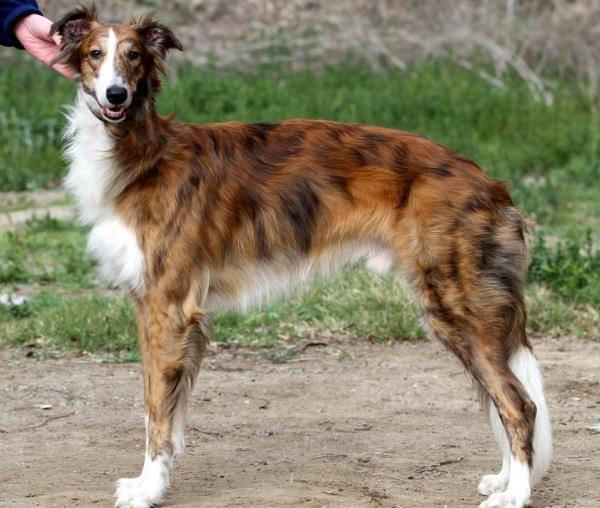
People usually end up searching for the Silken Windhound when they’re weighing up a rare sighthound as a pet: how big it really is, what daily life looks like, and whether the breed’s health and temperament are as “easy” as the name suggests.
What matters most is fit. A Silken Windhound can be calm indoors and beautifully athletic outdoors, but it is still a sight hound—quick to chase, sensitive to harsh handling, and best managed with thoughtful training, secure fencing, and steady routines.
Silken Windhound snapshot
- Height: about 47–60 cm (18½–23½ in) at the shoulder1
- Weight: commonly around 10–25 kg (varies by sex and build; some are lighter or heavier)2
- Coat: moderately long, soft and silky; straight to wavy (sometimes lightly curly), with feathering1
- Colour: all colours and markings accepted under the UKC standard1
- Temperament: typically friendly, gentle and devoted at home; strong prey drive in the field1
- Exercise: moderate daily exercise plus chances to run safely (many enjoy lure coursing and similar sports)3
- Training style: responds best to reward-based methods and calm consistency (sighthound-sensitive rather than “drilled”)1
History: a modern American sighthound
The Silken Windhound is a modern breed first developed in Austin, Texas, in the 1980s. The earliest recognised litter was whelped in 1985 at Francie Stull’s Kristull kennel, aiming for a small-to-medium sighthound with a long, silky coat and good performance ability.3
Rather than a simple “Greyhound crossed with Borzoi” story, the breed’s foundation is tied to Borzoi lines and Whippet-based lurchers, with later infusions of Borzoi and Whippets to improve structure and genetic diversity. DNA testing described by the Silken Windhound Club of America also points to Shetland Sheepdog ancestry in the foundation background.3
The International Silken Windhound Society (ISWS) was chartered in 1999 and maintains the original worldwide registry for the breed.4
Recognition and registries (including in Australia)
Silken Windhounds are recognised by the United Kennel Club (UKC) in the United States (accepted in 2011).4 They are not currently recognised by the American Kennel Club (AKC).2
In Australia, you may see dogs recorded through the ISWS registry, and some are dual-registered with other organisations depending on country and purpose. ISWS describes itself as the original registry and notes that organisations outside its listed partners are not regarded by the breed club as legitimate registries.4
Appearance: built for speed, dressed in silk
At a glance, the Silken Windhound looks like a compact coursing hound: fine-boned without fragility, lightly muscled, and balanced for quick acceleration and clean turns. Under the UKC standard, the impression should be of grace, balance, strength, and “exceptional running ability”.1
The coat is a hallmark—soft and silky, never woolly, and not so heavy that it hides the outline or interferes with running. Feathering appears along the legs, brisket, hindquarters, neck and tail, while the face and lower legs are naturally short-coated.1
Temperament: gentle at home, driven outdoors
Well-bred Silkens are often described as calm, affectionate companions in the house. The UKC standard also notes a strong prey drive in the field, with temperament faults including unwarranted timidity, nervousness, or hostility toward people or dogs.1
This mix—soft indoors, switched-on outdoors—means they tend to do best with:
- Secure fencing (sighthounds can clear or slip through weak boundaries when something moves fast).
- Lead manners and recall practice, while accepting that recall can fail when prey drive is triggered.
- Calm handling; heavy corrections often backfire with sensitive hounds.
Exercise and enrichment
A Silken Windhound usually wants a steady rhythm: daily walks, regular sniff-and-explore time, and occasional safe opportunities to run. Many thrive with sports that let them do what they were built to do—lure coursing and other sprint-style activities—without the risks of free-running near traffic or wildlife.3
Indoors, they often settle well once their exercise needs are met. Outdoors, they can be startlingly quick. Plan your environment around that reality rather than hoping training will erase it.
Training: what works best
Silkens are typically intelligent and responsive, and they tend to learn quickly when training is clear, reward-based, and short enough to stay enjoyable. The UKC standard describes an alert, friendly, intelligent expression and a gentle, devoted companion nature at home.1
Focus early on:
- Loose-lead walking (so they don’t rehearse lunging at moving targets).
- Polite greetings (many sighthounds are friendly but can be reserved with strangers).
- Handling skills (brushing, nail trims, vet checks) paired with treats.
- Impulse control games that don’t rely on physical restraint.
Health: generally robust, but not “issue-free”
No breed is free of health concerns, and it’s safer to treat “no issues specific to the breed” as a red flag rather than reassurance. Like many dogs, Silkens can experience inherited or complex conditions, and responsible breeders lean on health screening, careful mate selection, and long-term follow-up.
One emergency worth understanding is gastric dilatation-volvulus (GDV), often called bloat. It is more common in large, deep-chested dogs, but any dog can be affected. Risk factors include eating quickly, large meals, family history, and exercise soon after eating.5, 6
Act fast if you ever see a suddenly distended abdomen, repeated unproductive retching, drooling, restlessness, or rapid collapse—GDV is a veterinary emergency.5, 6
Grooming and day-to-day care
The Silken coat tends to be easier than it looks, but it still needs routine attention. Weekly brushing is a common baseline, with extra sessions during shedding or if your dog runs through burrs and grass seeds.2
Keep maintenance simple and regular:
- Brush through feathering (legs, behind ears, tail) before it mats.
- Nails kept short enough for sound movement—long nails change gait and can crack.
- Ears and teeth checked routinely, as with any breed.
Under the UKC standard, Silkens are shown in a natural coat with minimal trimming, which matches the breed’s practical, field-ready origins.1
Finding a Silken Windhound in Australia: what to look for
Because the breed is uncommon, patience matters. A thoughtful breeder or rescue contact will ask you questions, not just take your deposit.
- Ask about registration and verification: ISWS maintains the original registry and outlines its registration approach, including DNA requirements for certain processes and partnerships with other registries.4
- Ask what health screening is done and why those tests were chosen for that pair.
- Meet at least one parent if possible, and look for steady, environmentally confident behaviour.
- Be realistic about prey drive if you have cats, pocket pets, or unfenced acreage.
Final thoughts
A Silken Windhound is a small-to-medium sighthound with a true coursing build and a companion temperament that, in the right home, can feel remarkably easy: quiet feet on the floor, then a blur of movement when the world opens up.1
Do best by the breed and you’ll plan for both sides—silk-soft coat and sprinting instincts—and build a life that makes room for a dog designed to chase the wind.
References
- United Kennel Club (UKC) – Silken Windhound Breed Standard
- The Spruce Pets – Silken Windhound: Dog Breed Characteristics & Care
- Silken Windhound Club of America – History of the Breed
- International Silken Windhound Society (ISWS) – About ISWS Registration
- Cornell University College of Veterinary Medicine – Gastric dilatation volvulus (GDV) or “bloat”
- American Animal Hospital Association (AAHA) – Understanding Canine Bloat (GDV): A Medical Emergency
- International Silken Windhound Society (ISWS) – Conformation
- Wikipedia – Silken Windhound (overview and links to standards)

Veterinary Advisor, Veterinarian London Area, United Kingdom