
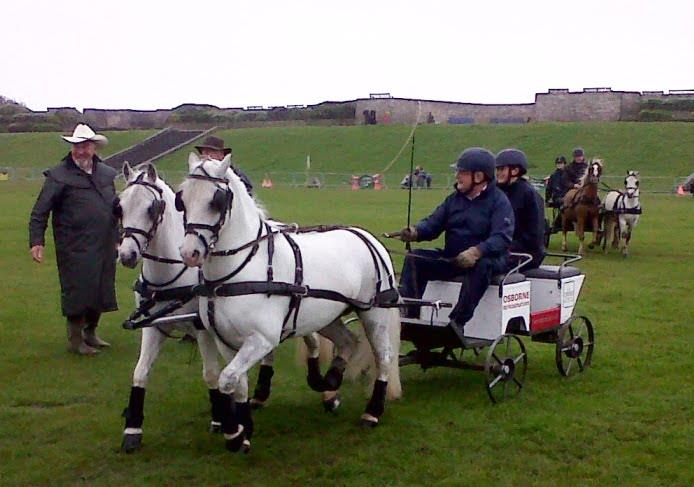
Scurry driving sits at the speedy end of carriage sport. People usually find it when they’ve seen a pair of ponies thread a cart through cones at a show and want to know what it’s called, how it’s judged, and what’s needed to do it safely.
It looks simple until you notice the margins: cones set only a little wider than the cart, tennis balls balanced on top, and a driver asking for fast, clean turns without losing straightness. One clipped cone can undo a quick run, and poor preparation can put both pony and people at risk.2, 4
What is scurry driving?
Scurry driving is a timed “speed with precision” driving class, most commonly run as a pair (double harness) pulling a small carriage through a numbered course of cone gates. The aim is to finish fast while staying accurate—typically without dislodging the balls balanced on top of the cones, which brings penalties.1, 2
In Australia, you’ll often hear scurries described as closely related to the cones phase of combined driving, sometimes with extra elements added for show spectacle (such as including one or two marathon-style obstacles). They’re popular at local agricultural shows because spectators can read the drama at a glance: speed, tight gaps, and a clear winner.4
How a scurry is usually run (and how it’s judged)
Exact rules vary by organising body and show schedule, but most scurries share the same spine: a set cone course, driven in sequence, with the clock running and penalties for lack of precision.2, 4
- Course: a line of cone “gates” (pairs of cones) with a ball on each cone.
- Objective: quickest time with the fewest errors.
- Common penalties: dislodging a ball, missing a gate, or taking the wrong line/sequence (depending on the rules in use).2, 4
If you’ve watched combined driving, the feel will be familiar: cones are set only slightly wider than the vehicle’s track, so a neat line matters as much as raw speed. Official driving descriptions in Australia note just how small the clearance can be, and that ball-down penalties are part of the standard cones test.4, 5
Scurry driving’s background (what’s true, and what’s often overstated)
Scurry driving, as it’s recognised today, developed in the United Kingdom as a modern show discipline rather than a centuries-old aristocratic sport. UK scurry organisations describe its growth through the later 20th century, with formal administration evolving over time and a dedicated Scurry Driving Association formed in 2001.3
So if you’ve heard claims about scurry driving being “first seen in the 1500s”, treat them as colourful storytelling rather than reliable history.
The ponies: what suits scurry driving
A good scurry pony doesn’t need to be “hot”. It needs to be clear-headed in noise, willing to move forward, and able to come back to the driver without argument when the turns tighten.
Look for a pair that:
- stays straight between the shafts and doesn’t lean through turns
- accepts rein and voice aids consistently (especially for half-halts and quick corrections)
- remains settled around crowds, loudspeakers, and other horses
- matches stride and rhythm with its partner, so the pair can turn as one unit
In Australian driving pathways, cone work is commonly framed as a test of obedience, suppleness and manoeuvrability after faster phases—qualities that matter just as much in a scurry, even when the run is short and sharp.5, 6
Technique: what tends to make the difference
The quickest rounds often look almost quiet: a steady line in, a brief change of bend, then the pair flows out without wobble. The cart follows the ponies, not the other way around.
Driving lines and turns
- Enter each gate straight. Most ball-downs happen when a turn begins too early and the outside wheel drifts.
- Turn from the shoulders, not the speed. Ask the pair to rebalance first, then turn; a rushed turn widens and costs more than a half-halt.
- Plan your “escape line”. A clean exit sets up the next gate and protects time across the whole course.
Pair work
- Keep the contact even. Uneven rein feel can pull one pony ahead, twisting the pole line and swinging the vehicle wide.
- School transitions within pace. Being able to lengthen and shorten quickly (without breaking rhythm) is a practical skill in any timed driving phase.6
Equipment basics (and what to prioritise)
Scurry driving uses normal driving equipment, but the tolerances are tighter because speed magnifies every small issue.
- Vehicle: stable, well-maintained, and suited to the class; wheels and brakes (if fitted) checked before every run.
- Harness: correctly fitted for each pony, with no rubbing points; breastcollar or collar matched to workload and conformation.
- Reins and pole/trace alignment: even and tidy, so the pair pulls straight and the cart tracks cleanly through narrow gates.
For Australian competitors, the most useful next step is often joining a carriage driving club and learning within an established safety culture, with coaching and appropriate settings for new combinations.7
Safety: the non-negotiables
Speed and wheels change the risk picture. Put the basics in place before you chase time.
- Wear an approved helmet. For Equestrian Australia (EA) affiliated driving events, helmet tagging has been mandatory since 1 July 2022, and EA states accredited helmets are compulsory for anyone on the carriage at any time.8
- Drive within organised rules and layouts. EA publishes national driving rules (current rules effective 1 January 2026), and clubs can use accredited course layouts and designers for cones courses.9
- Use trained help. Many disability driving programs formalise this with an experienced “whip” beside the participant and multiple ground helpers, which is a useful picture of what good risk management looks like around vehicles and horses.10
If something feels off—pony tension you can’t settle, harness slipping, cart handling strangely—scratch the run. A clean withdrawal is part of good horsemanship.
Competitions and where scurries fit in Australia
In Australia, scurries often appear as show classes alongside broader carriage driving disciplines. State driving pages describe scurries as a faster, entertainment-friendly cousin of the precision cones course, sometimes with additional obstacles, and judged on the fastest clear round.4
If you’re starting out, combined driving clubs and affiliated events are still one of the best places to build the foundations—accuracy between cones, calm turnout, and safe routines—before you add more speed.7
Final thoughts
Scurry driving is not just “flat-out fast”. It’s speed that stays inside narrow boundaries—two ponies, a vehicle, and a line that has to be drawn again and again between cone tops that barely clear the wheels.
Get the basics right: a steady pair, correct harness and vehicle, calm handling, and a rule set you understand. Time comes later, almost as a side effect.
References
- Wikipedia: Driving (horse) – Scurry driving overview
- British Carriage Driving: Scurry Driving (double harness through cones)
- Scurry Driving Association (UK): History and organisation
- Equestrian NSW: Driving NSW (includes scurry driving description)
- Equestrian South Australia: Carriage driving (cones phase and ball-down penalties)
- Equestrian Queensland: What is driving? (cones phase description)
- Carriage Driving NSW: ACDS clubs and participation
- Equestrian Australia: Helmet tagging for driving mandatory from 1 July 2022
- Equestrian Australia: Driving rules & regulations (current rules effective 1 January 2026)
- Riding for the Disabled Association (NSW): Carriage driving safety measures

Veterinary Advisor, Veterinarian London Area, United Kingdom