
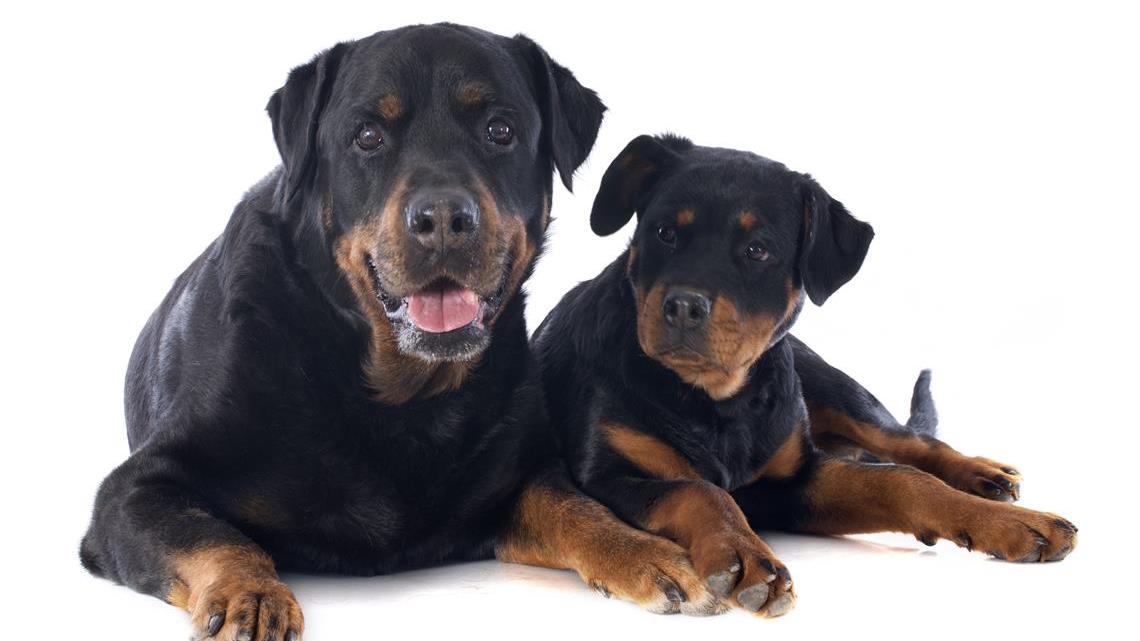
People usually start looking up Rottweilers when they’re weighing up a new dog, trying to make sense of a breed’s reputation, or checking whether their home and routine suit a powerful working breed. The details matter: size, exercise needs, training, and a handful of health risks can shape day-to-day life for the dog and everyone around it.
Below is a clear, practical guide to what a Rottweiler is like to live with, where the breed comes from, what to watch for in health and behaviour, and how to set one up for a steady, well-mannered life.
Rottweiler at a glance
- Size: Medium to large
- Height (at withers): Males 61–68 cm; females 56–63 cm1
- Typical weight: Often around 50 kg (male) and ~42 kg (female) as an approximate guide in the breed standard (healthy weight varies with build and condition)1
- Coat: Double coat (top coat and undercoat); dense and coarse, with slightly longer hair on the hind legs1
- Colour: Black with clearly defined rich tan markings1
- Temperament (when well-bred and well-raised): Confident, steady, loyal; typically reserved with strangers but closely bonded to their household
- Energy level: Moderate to high; thrives on daily exercise and training
- Lifespan: Commonly around 8–10 years, though some live longer; individual health, size, and care make a difference2, 3
History and origin
The Rottweiler’s story is tied to work. Dogs of this type travelled with Roman armies, moving livestock and guarding camps, then settled into the trading routes of southern Germany. In and around the town of Rottweil, they became valued all-rounders for moving cattle and protecting money and goods during market trips.
As industrial transport replaced droving, the breed’s future narrowed for a while. Formal breed organisations and standards helped stabilise type and temperament, and Rottweilers later found a place in modern working roles—security, police work, obedience, and as companions—when their training and management matched their strength and instincts.
Physical characteristics
Build and movement
A typical Rottweiler is compact, strongly muscled, and built to trot for hours rather than sprint. In motion, the back should stay firm and stable, with an easy, ground-covering stride that looks economical rather than flashy.1
Coat and markings
Rottweilers have a protective double coat: a dense top coat with undercoat beneath. The classic pattern is black with rich tan markings on the cheeks, muzzle, throat, chest, legs, above the eyes, and under the tail base.1
Tail docking (what to know in Australia)
You may still see docked tails in older photos, but routine tail docking is restricted in Australia and is generally not done for pets. If you’re viewing puppies, a natural tail is now the norm.
Temperament and behaviour
At their best, Rottweilers are composed dogs with a calm watchfulness—quiet in the house, alert at the gate, and deeply attached to their people. They’re not a “set and forget” breed. Without steady training and early socialisation, their size and guarding instincts can become hard to manage.
Well-run Rottweilers often show a pattern that feels almost predictable: they notice changes, they pause, they watch, and they take their cue from the household. That steadiness is built, not assumed.
Rottweilers with children and other pets
Many Rottweilers live safely with children, but supervision is non-negotiable—especially with toddlers—simply because a large, solid dog can knock a child over without meaning to. With other animals, outcomes vary. Early, careful introductions and ongoing management matter more than good intentions.
Training and exercise needs
Early training and socialisation
Start early, keep it regular, and make it specific. A young Rottweiler needs calm exposure to everyday life: visitors, cyclists, other dogs at a distance, different surfaces, car travel, grooming, vet handling. The aim isn’t to make them “love everyone”, but to teach them how to stay neutral and responsive.
Training approach that works
Reward-based training suits the breed well: food rewards, play, and praise, paired with clear boundaries and consistent routines. Harsh methods can create uncertainty and defensive behaviour—exactly what you don’t want in a powerful, protective dog.
How much exercise?
Most adult Rottweilers do best with daily activity that includes both movement and thinking. A brisk walk alone is rarely enough for long. Mix in:
- structured lead walking and calm greetings
- short training sessions (obedience cues, recalls, leash manners)
- safe strength-and-control games (tug with rules, scent games, puzzle feeders)
Health and lifespan
Like many large breeds, Rottweilers are more exposed to certain conditions. A good breeder, good growth management in puppyhood, and routine veterinary care can reduce risk, but not erase it.
Common health concerns to discuss with your vet
- Hip and elbow dysplasia: developmental joint problems that can lead to pain and arthritis later in life; screening is important in breeding dogs.4
- Gastric dilatation-volvulus (GDV, “bloat”): a life-threatening emergency more common in large, deep-chested dogs.5
- Heart disease and some cancers: seen in the breed; regular check-ups help with early detection.
What “8–10 years” really means
Many guides quote 8–10 years as a typical range. Large studies and breed-focused research show that Rottweiler lifespan varies widely, with averages commonly falling around this range, and a smaller number reaching into the teens.2, 3
Preventative care that makes a real difference
- Keep them lean: excess weight loads the joints and can worsen mobility issues.
- Feed in a way that reduces GDV risk: avoid one huge meal a day, slow down “bolt” eaters, and skip hard exercise straight after meals.5
- Routine dental care: at-home toothbrushing and regular veterinary dental checks help prevent periodontal disease, which is common in dogs.6
- Desexing decisions: timing and pros/cons can differ by dog; ask your vet for guidance that suits your dog’s size, sex, and health history.7
Grooming and maintenance
Rottweilers are relatively low-maintenance, but they do shed. A weekly brush usually keeps the coat tidy and helps you spot skin problems early. During heavier seasonal shedding, brushing a few times a week is often enough.
Keep nails short, ears clean and dry, and build a calm routine around handling—paws, mouth, collar grabs—so grooming doesn’t become a wrestling match in a full-grown dog.
Diet and nutrition
A Rottweiler’s body is built like a working tool: muscle, bone, and a steady engine. Choose a complete and balanced diet appropriate for their life stage (puppy, adult, senior). Large-breed puppy diets can be helpful for managing growth rate and supporting joint development.
For many Rottweilers, the biggest nutrition issue isn’t “what food”, but “how much”. Body condition matters more than the number on the scale.
Foods to avoid
Some everyday human foods are dangerous for dogs. Chocolate, grapes/raisins, onions, and some sweeteners (like xylitol) can cause serious poisoning.8
Fun facts (kept in perspective)
You may hear owners mention the “Rottie rumble”, a low vocalisation some dogs make during relaxed interaction. It can be misread by strangers, so it’s worth watching the whole body: loose muscles, soft eyes, and easy movement suggest calmness; stiffness and hard staring suggest tension.
On-screen, Rottweilers often appear as tough guard dogs. In real life, the difference between a safe, steady Rottweiler and a difficult one is usually ordinary daily work: training, boundaries, and calm exposure to the world.
Final thoughts
A Rottweiler is not a decoration and not a status symbol. It’s a large, intelligent working dog with the strength to make mistakes expensive. In the right home—steady routine, clear training, good fencing, thoughtful socialisation—they can be remarkably grounded companions, moving through family life with a quiet, watchful confidence.
References
- National Rottweiler Council Australia — FCI Breed Standard for the Rottweiler
- Waters DJ et al. (2013). Exceptional longevity in female Rottweiler dogs is not encumbered by investment in reproduction (PubMed)
- Scientific Reports (2023). The effect of neuter status on longevity in the Rottweiler dog
- Orthopedic Foundation for Animals (OFA) — Breed statistics and dysplasia information
- Cornell University College of Veterinary Medicine — Gastric dilatation-volvulus (GDV) “bloat”
- RSPCA Australia — Taking care of your dog’s teeth
- RSPCA Knowledgebase — Desexing: what age should my dog or cat be desexed?
- ASPCA Animal Poison Control — People foods to avoid feeding pets
- Australian Veterinary Association (AVA) — Dental disease in dogs and cats

Veterinary Advisor, Veterinarian London Area, United Kingdom