
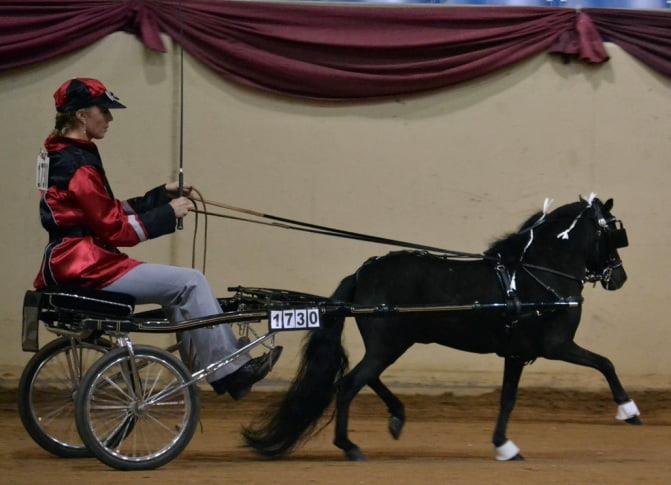
People usually look up “roadster horse showing” when they’ve seen a fast, sulky-style class at a show and want to know what it actually is, what’s judged, and what you need before you enter. It’s easy to confuse roadster with harness racing, combined driving, or ordinary ridden showing, and that confusion can waste training time (and entry fees) quickly.
Roadster is a specific show-ring discipline most strongly defined in the United States rule system, where horses are shown at distinct trotting gaits, often in a lightweight two-wheeled “bike”, with drivers in racing-style silks. In Australia, you’ll see related turnout and driving classes depending on the breed society or show schedule, but the term “roadster” is not used consistently across all Australian competitions.1, 2, 3
What “roadster” means (and what it doesn’t)
In show-ring terms, roadster is about a horse trotting with speed, straightness, and animation while hitched to a vehicle (often a two-wheeled bike), or sometimes shown under saddle depending on the rule set. Horses are typically shown at a jog trot, a faster “road gait”, and then “at speed” in the final phase, while maintaining form and control.1
It is not the same thing as:
- Harness racing (a regulated racing sport, usually with different equipment, track rules, and licensing).
- Combined driving (dressage, marathon, cones), which is governed in Australia by Equestrian Australia’s driving rules and has a very different test-based format.2, 4
- Ridden showing (hacks, riding horses, hunters), where judging priorities and turnout are different again.
Where roadster fits in Australia
The original draft described roadster showing as a long-running, broadly established Australian show tradition with recorded national milestones. In practice, “roadster” as a named discipline is far more clearly established in the United States show system, and in Australia it tends to appear through particular breed communities and show schedules rather than as a single nationwide, standardised program.
If you’re planning to compete in Australia, the safest approach is to work backwards from the schedule: find the exact class name, then get the rulebook for that society or event. For driving competitions run under Equestrian Australia (EA), roadster-style classes are not the core format; EA driving focuses on dressage, marathon obstacles, and cones, under the National Driving Rules (current set effective 1 January 2026).2, 4
Typical roadster classes and what happens in the ring
Roadster classes vary by organisation, but under the US Equestrian (USEF) description you’ll commonly see:
- Jog trot (settled, controlled trot to establish manners and straightness)
- Road gait (a faster, forward trot)
- At speed (fastest trot while maintaining form; often signalled and ended by a whistle)1
Vehicles may include a two-wheeled bike or a four-wheeled wagon, depending on the class. Some roadster formats also allow showing under saddle.1
Turnout and equipment: what’s actually expected
Driver attire
In roadster as described by USEF, drivers often wear racing silks in stable or “farm” colours. This is one of the easiest visual cues that you’re watching a roadster-style class, not a combined driving turnout class.1
For any Australian competition, follow the host organisation’s safety requirements first (helmet standards, footwear, gloves if required) and the schedule’s turnout notes second.
Tack and vehicle
Roadster is vehicle-dependent, and small details matter. Check the schedule for permitted vehicle type, wheel size, shafts, and any restrictions for bits and boots. If you are training in an EA driving environment, you’ll also need to meet EA equipment and safety expectations relevant to driving competitions.2, 4
Judging: what tends to be rewarded
Roadster judging is not about jumping efforts or obstacle technique. Under the USEF description, the picture is a trotting horse with animation and “brilliance”, going straight and true at each gait, then showing speed without losing form or control.1
Even when the class looks fast, judges are still watching for the quiet basics: rhythm, straightness, consistency in the contact, and a horse that stays organised while the pace rises.
Training: building speed without losing shape
Speed in the ring comes last. First you build a trot that stays balanced when you ask for more.
- Conditioning first: short, regular work that gradually increases duration and intensity, so the horse can hold a strong trot without scrambling.
- Transitions within the trot: practise stepping up and down between a working trot and a stronger, longer trot while keeping the line straight.
- Steering under pressure: large circles and shallow changes of direction at trot, then repeat at a quicker pace once the horse stays steady.
- Short “at speed” efforts: brief, controlled bursts with plenty of recovery, so the horse learns to stay together rather than just run.
If you’re preparing for EA driving rather than a roadster-specific show class, training priorities shift (accuracy in dressage figures, obstacle lines, and cones technique). EA’s description of driving disciplines is a good map of those demands.4
Common mistakes that cost marks (or cause trouble)
- Training only for speed: the trot gets faster, but the frame falls apart and the horse loses straightness.
- Ignoring the schedule’s fine print: vehicle type, attire, and safety gear can be class-specific.
- Turning up with the wrong rule set in mind: combined driving rules and roadster-style show classes are different sports with different expectations.1, 2, 4
- Equipment in poor order: worn harness, ill-fitting bridle, or vehicle faults are safety risks first and performance problems second.
How to get involved (without guessing)
If you’re in Australia and want to compete, start with the event schedule and work out which framework it sits under:
- If it’s an EA driving event: use EA’s driving overview and the current National Driving Rules (effective 1 January 2026) as your baseline.2, 4
- If it’s a breed show or speciality show: get that society’s rulebook and confirm whether “roadster” means a bike class, a harness turnout class, or something else entirely.
For a sense of how major Australian shows structure horse competition schedules (and how qualification and entries work), the Sydney Royal Horse Show competition information is a useful reference point, even though it covers many disciplines beyond driving.5
References
- US Equestrian (USEF) – Roadster (discipline overview)
- Equestrian Australia – Driving Rules & Regulations (rules effective 1 January 2026)
- Equestrian Australia – Driving (discipline overview: dressage, marathon, cones)
- Fédération Equestre Internationale (FEI) – Driving (discipline information)
- Royal Agricultural Society of NSW – Horse competitions (Sydney Royal information)
- Harness Racing Australia – Australian Harness Racing Rules (index)
- Queensland Government – Sharing the road with horses and horse-drawn vehicles (road rules and safety)
- US Equestrian (USEF) – Rulebook search (Roadster division)

Veterinary Advisor, Veterinarian London Area, United Kingdom