
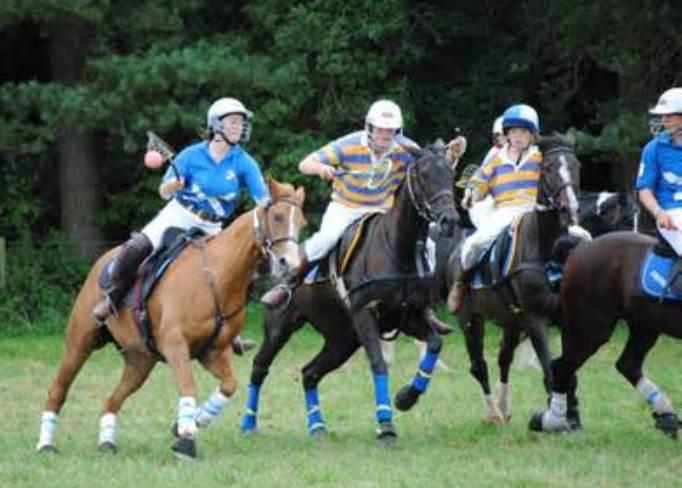
People usually look up polocrosse when they’ve seen a match (or a clip), heard it described as “polo meets lacrosse”, and want to know what’s actually going on — how the teams rotate, who can score, and why the play is funnelled into certain parts of the field.
It’s a fast sport, and the details matter: where each position is allowed to ride, how the ball can move across the penalty line, and what makes a goal legal. Here’s a clear, grounded guide to how polocrosse works in Australia, where it began, and what to expect if you’re thinking of joining a club.
What is polocrosse?
Polocrosse is an amateur team sport played on horseback using a racquet with a shallow net to carry, catch, and throw a soft ball. It borrows the pace and riding lines of polo, then adds the passing and marking pressure you’d recognise from ball sports. In Australia it’s often described as a “one-horse sport”, because players generally use one horse for a match, with limited exceptions (such as injury).1, 2
Where polocrosse came from
The modern game took shape in Australia in 1939, and Australian associations still describe that year as the sport’s origin point.2, 3
Common accounts of the sport’s early history trace key influence to Edward and (often noted alongside him) his wife, who encountered a riding-school exercise in England and helped adapt it into a competitive outdoor game once back in Australia.4
The field, at a glance
A standard polocrosse field is 146.5 metres long and 55 metres wide, divided into three sections: a large centre area and two goal-scoring areas at each end.5
In Australian descriptions of the game, the goal-scoring areas sit beyond the “penalty line”, and each end also has a semi-circle in front of goal (10 metres radius). Shots at goal must be taken from outside that semi-circle, while still being within the goal-scoring area.1
Teams, positions, and why only three riders are on the field
Each team has six players split into two sections of three. Those sections alternate onto the field each chukka, so only three riders per side are playing at any moment.1, 6
Within each three-player section, roles are fixed:
- No. 1 (Attack): the only player who can score, and they do it from within the goal-scoring area.1
- No. 2 (Midfield/Centre): a linking player who plays in the centre area only.1
- No. 3 (Defence): the key defender near goal; in the goal-scoring area, it’s the No. 3 who can defend against the opposing No. 1.1
That structure isn’t decorative. It shapes the flow of the match, forcing movement and passing rather than allowing a single rider to carry the play end-to-end.
How play starts, and how the ball moves
Play begins in the centre, with an umpire throwing the ball in overarm above the lined-up riders. From there, riders catch in the racquet, throw on the run, and can also pick the ball up from the ground with the racquet while mounted.1
A key constraint is the penalty line: a player can’t simply carry the ball over it in their racquet. The ball needs to be bounced over the line or passed across, so possession changes hands cleanly between field zones and players.7
Scoring and match structure
A goal is scored by throwing the ball between the goal posts from outside the goal semi-circle, and only the No. 1 is allowed to score for their team.1
Matches are divided into chukkas, with chukkas commonly running up to eight minutes, and matches often made up of four, six, or eight chukkas depending on the competition format.1, 7
Skills that matter (for rider and horse)
At speed, polocrosse is built on a handful of quiet fundamentals: balanced riding, accurate throwing and catching one-handed, and the ability to turn sharply without losing the line of play. Most good teams look calm because their spacing is disciplined — riders offering a safe passing option, then peeling away before the next collision of momentum.
For horses, the useful traits are practical rather than flashy: responsiveness, agility, and enough stamina to repeat short, sharp efforts across a match. Australian polocrosse descriptions also note that there’s no height restriction on horses, and that players usually ride one horse per match except in limited circumstances such as injury.1
Safety and welfare basics
Polocrosse is a contact sport with horses, so good habits aren’t optional. Wear a properly fitted, approved riding helmet with the chin strap fastened; in Australia, Equestrian Australia publishes a list of current helmet safety standards used across many organised equestrian settings.8
For horses, conditioning and recovery matter as much as match-day effort. A fit, well-managed horse should finish work with steady breathing, sound movement, and no heat or swelling that lingers into the next day — the small observations that prevent bigger problems.
Polocrosse in Australia today
Australia remains the sport’s centre of gravity, with national bodies describing it as the largest polocrosse-playing country, and noting that the game is played from club level through to state and national pathways.3
The Australian Polocrosse National Championships are held every two years and bring together teams from each state and territory. The next event listed by Polocrosse Australia is scheduled for 2026 at Fred’s Pass in the Northern Territory.9
Polocrosse beyond Australia (and the World Cup)
Internationally, the sport is governed by the International Polocrosse Council (IPC), formed in 1976, and it lists polocrosse as being played in 18 countries.10
At the top end sits the Polocrosse World Cup. Polocrosse Australia’s World Cup summary notes the first event was held in Warwick, Queensland in 2003, and that the 2024 World Cup was held in Shongweni, South Africa (15–28 July 2024), where South Africa defeated Australia 29–28 in the final.2
Is polocrosse hard to learn?
If you can already ride with control at a canter and feel comfortable riding near other horses, the early learning curve is mostly about handling the racquet: catching cleanly, throwing accurately, and keeping your eyes up while your hands work.
Do you need a particular breed of horse?
Not necessarily. Australian descriptions of the sport note there’s no height restriction and that many breeds play; what matters most is trainability, soundness, and turning ability.1
How long is a match?
It depends on the competition, but matches are played in multiple chukkas, commonly up to eight minutes each, with formats often running four, six, or eight chukkas.1, 7
References
- Polocrosse Victoria — About Polocrosse
- Polocrosse Australia — The World Cup
- Polocrosse Australia — About
- Wikipedia — Polocrosse (overview and history)
- Government of Western Australia (CITS) — Sports Dimensions Guide: Polocrosse
- Polocrosse Australia — The Rule Book (rules effective from 1 January 2025)
- Polocrosse Association of South Australia — The Sport
- Equestrian Australia — Current approved safety standards for helmets
- Polocrosse Australia — Australian Polocrosse National Championships
- International Polocrosse Council (IPC) — Official site

Veterinary Advisor, Veterinarian London Area, United Kingdom