
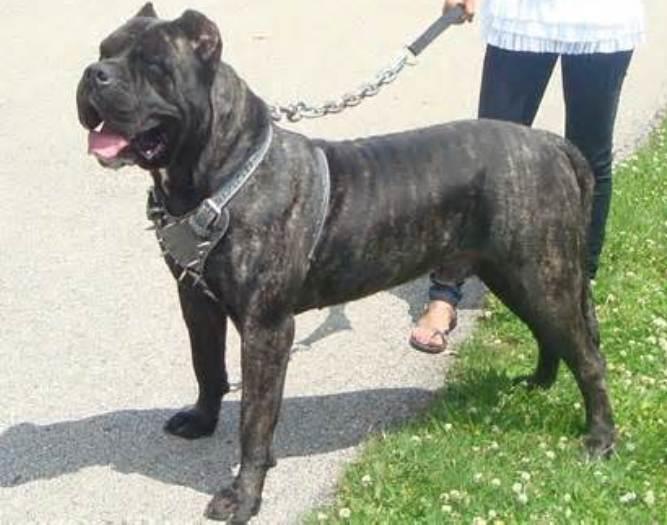
People usually look up the Perro de Presa Canario (also known as the Dogo Canario) when they’re weighing up a powerful guardian breed: how big it really gets, what it’s like to live with, and whether it’s even legal where they live.
The details matter with this dog. Size, early training, and local regulations can shape everything from insurance to where you can rent — and, more importantly, how safe and settled the dog will be in everyday life.
Perro de Presa Canario at a glance
- Origin: Canary Islands (Spain)1
- Height: Males 60–66 cm; females 56–62 cm (measured at the withers)1
- Weight: Typically at least 50 kg (males) and 40 kg (females); some individuals heavier1
- Coat: Short, coarse, flat; usually without an undercoat1
- Colours: Brindle and fawn are typical; small white markings may occur; black mask is standard on brindle/fawn dogs1
- Life expectancy: Commonly quoted around 9–11 years (varies with genetics, weight, and care)2
History and original purpose
The Perro de Presa Canario developed in the Canary Islands as a utilitarian farm dog: strong enough to hold livestock, steady enough to patrol property, and bold enough to deal with threats when needed.1
Modern dogs still carry that working outline — a heavy front, a broad head, and an alert, watchful presence that can feel calm right up until it decides something matters.
Physical characteristics
This is a large, muscular molosser-type dog with substantial bone and a compact, powerful frame. The coat is short and tactile — flat to the body, coarse to the touch, and generally low-maintenance compared with double-coated breeds.1
Colour is most often brindle or fawn, and a dark mask is typical (and, in breed standards, expected) on those coats. Small white markings may appear on the chest, throat, or feet, but are usually described as something to keep minimal in show specimens.1
Temperament: what to expect day to day
A well-bred, well-raised Presa Canario is typically self-possessed at home, deeply attentive to its people, and naturally wary when something unfamiliar enters its space. That watchfulness is part of the breed’s make-up — useful in the right hands, risky in the wrong ones.
It’s more accurate to say the breed can be selective than “aggressive”. Some individuals will be socially neutral and calm in public; others will stay guarded even with careful handling. With a dog this powerful, management matters as much as personality.
The breed standard itself makes a point: dogs that are aggressive or overly shy are considered a serious problem (and are disqualified in conformation settings).1
Training and socialisation: start early, keep it quiet and steady
For a Presa Canario, training isn’t about tricks. It’s about building predictable responses under distraction — loose-lead walking past another dog, settling on a mat when visitors arrive, and calmly handing over control when asked.
Early socialisation should be short, positive, and paced to the puppy in front of you. The aim is not to “meet everything”, but to learn that novelty is safe and boring. RSPCA guidance focuses on keeping sessions brief, upbeat, and not overwhelming the puppy with too much at once.3
- Choose exposures, not chaos: controlled introductions to people, surfaces, sounds, and environments, paired with calm rewards.4
- Prioritise handling skills: muzzle training, cooperative vet handling, and being comfortable with restraint can prevent future battles.
- Get professional help early: look for a qualified trainer experienced with guarding breeds and modern, reward-based methods.
Exercise and enrichment
Despite the heavy build, many Presa Canarios are active dogs that benefit from daily movement and structured outlets for their brains. Long, sniff-rich walks, basic obedience games, and calm strength work (like controlled hill walking) often suit them better than frantic fetch in a small yard.
Mental stimulation matters. A bored, under-handled guardian breed doesn’t usually “switch off” — it invents its own job, and that job may be fence-running, territorial barking, or scrutinising every passer-by.
Health concerns to discuss with a vet and breeder
Like many large breeds, Presa Canarios can be vulnerable to orthopaedic problems, including hip dysplasia, and may also experience eyelid and skin issues in some lines. The practical takeaway is simple: don’t buy on looks alone.
Ask what health screening the parents have had, what issues the breeder sees in their lines, and what support they offer if problems appear. Keep adult weight steady — excess weight is a quiet amplifier of joint pain in big dogs.
Legal considerations in Australia (read this before you commit)
In Australia, the legal status of Presa Canarios varies by state and territory, and it can change. Some jurisdictions treat the Perro de Presa Canario (Presa Canario) as a restricted or prohibited breed, with strict limits on ownership, transfer, and control requirements.
New South Wales
In NSW, “restricted dogs” include several named breeds and also any breed whose importation into Australia is prohibited — with the Perro de Presa Canario explicitly listed as an example. There are offences for selling, advertising, giving away, or transferring a restricted dog, and owners must meet permit and control requirements.5
Queensland
Queensland lists the Perro de Presa Canario / Presa Canario among prohibited dog breeds under its regulated dog framework, with restrictions around ownership and supply.6
If you’re unsure about your area, check your state government and local council rules before you buy or rehome a dog, and consider insurance and housing constraints as part of the decision — not as an afterthought.
Perro de Presa Canario as a working dog (and as a pet)
This breed can excel in roles that suit a steady, powerful dog with good nerve: property guardianship in appropriate settings, structured obedience, and disciplined, controlled work that rewards composure over reactivity.
As a household companion, it tends to suit homes that are calm, experienced, and realistic — people who can provide boundaries, daily structure, and secure containment. In busy, unpredictable environments, the breed’s natural suspicion can become a constant management task.
Final thoughts
The Perro de Presa Canario is built like a boulder and often thinks like a sentry: observant, decisive, and not automatically social. In the right home, with early training and sensible handling, that can translate into a steady companion with a quiet presence.
In the wrong home — rushed socialisation, inconsistent rules, weak containment, or legal blind spots — the same traits become expensive, stressful, and sometimes dangerous. With this breed, preparation isn’t optional. It’s part of the care.
References
- FCI Standard No. 346: Dogo Canario (Perro de Presa Canario) — size, coat and colour
- The Spruce Pets: Presa Canario breed overview (includes commonly quoted lifespan)
- RSPCA Knowledgebase: How can I socialise my puppy?
- RSPCA Australia: Socialising your puppy
- NSW Office of Local Government: Restricted dogs
- Queensland Government: Regulated dogs (prohibited dog breeds list)

Veterinary Advisor, Veterinarian London Area, United Kingdom