
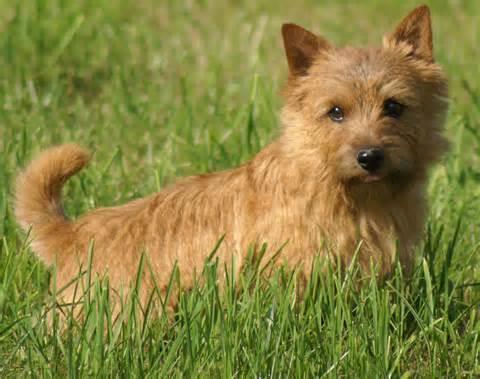
People usually start looking up the Norwich Terrier when they’re weighing up a small dog that can keep up: lively, sturdy, and companionable, but still very much a terrier. The practical questions tend to be the same—how much exercise is “enough”, what grooming really involves, and which health checks matter before you commit.
Norwich Terriers are compact, wiry-coated ratters from England with a bright, busy way of moving through the day. They can suit apartment life if their daily walk and curiosity are taken seriously, and they do best with calm, consistent training that channels terrier drive rather than trying to squash it.1, 2
Norwich Terrier at a glance
- Breed name: Norwich Terrier
- Height: ideal 25 cm at the withers (breed standard guide)1
- Typical weight: around 5–6.5 kg (varies by build and condition)3, 4
- Coat: hard, wiry, straight outer coat with thick undercoat1, 2
- Colours: red, wheaten, black and tan, or grizzle; white markings are undesirable in some standards1, 2
- Temperament (typical): alert, active, affectionate with their people; can be independent-minded2, 4
- Exercise needs: up to about an hour a day for many adults, plus sniffing and play2, 5
- Life expectancy: often over 10 years; commonly around 12–15 years4, 5
History and origin
The Norwich Terrier developed in England in the late 1800s, in and around East Anglia. Small, game terriers were valued for vermin control on farms and around stables, and they also became popular companions—famously among Cambridge University students—because they were small enough to live close, yet bold enough to work.6, 7
For a long time, what we now call the Norwich Terrier and Norfolk Terrier were shown as one breed, with ear carriage (prick or drop) as a key difference. In the UK, the split is often described as settling into the modern Norwich (prick ears) and Norfolk (drop ears) after being shown together historically.5
Physical characteristics
Norwich Terriers are low to the ground, compact, and surprisingly substantial for their size. The breed standard describes a hard, wiry coat that lies close to the body, with a thick undercoat and a rougher “ruff” around the neck that frames the face. The overall impression is neat, weather-ready, and built for squeezing through tight places.1, 2
They’re best recognised by their pricked ears, dark, watchful eyes, and a whiskery little face. Colours include red, wheaten, black and tan, and grizzle.1, 2
Temperament and behaviour
A Norwich Terrier is typically friendly and engaged, with the terrier habit of noticing everything. They often enjoy being near their people, but they’re not usually a “sit still and admire the scenery” breed. Expect curiosity, quick reactions, and an independent streak that shows up most clearly when something interesting moves across the ground.4, 5
Many Norwich Terriers do well in homes of all sizes, including flats, as long as their daily exercise and mental stimulation are treated as non-negotiable routines rather than optional extras.5
Children and other animals
With sensible supervision and respectful handling, Norwich Terriers can be good family dogs. Like most small terriers, they tend to prefer interactions that aren’t too rough or chaotic. Early socialisation helps them cope calmly with visitors, busy streets, and other dogs.5
Because they were bred to hunt small pests, some individuals may be inclined to chase small animals. Management, training, and secure fencing matter more than wishful thinking.
Training and exercise
Norwich Terriers are bright and often keen, but they can lose interest if training becomes repetitive. Short sessions, clear rules, and reward-based methods tend to work best. Consistency matters: the same behaviour rewarded one day and ignored the next is where terriers start writing their own rules.4
How much exercise do they need?
Many adults do well with up to about an hour of activity a day, broken into walks and play. What matters isn’t just distance—it’s variety: sniffing, exploring, and learning to settle afterwards.5
- Good options: brisk walks, on-lead “sniffaris”, short training games, gentle agility-style obstacles at home
- Watch-outs: boredom (often shows up as digging, barking, or pestering)
Health and lifespan
Norwich Terriers are often long-lived, but they do have known breed health concerns. If you’re buying a puppy, the most useful question is not “Are they healthy?” but “Which health tests have been done, and can I see the results?”8, 9
Commonly discussed conditions in the breed
- Patellar luxation (kneecap slipping out of place)8, 9
- Hip dysplasia8, 9
- Upper Airway Syndrome (a respiratory condition reported as a major breed concern by the Norwich Terrier Club of America)8
Practical preventative care
- Keep them lean—extra weight can worsen joint problems.9
- Ask breeders about screening for hips, patellas, and eye health, and look for results recorded through recognised schemes (such as the CHIC framework used by the parent club in the US).8, 10
- Take noisy breathing seriously, especially if it worsens with heat, excitement, or exercise—have it assessed early rather than waiting for it to “settle”.8
Grooming and maintenance
The Norwich coat is designed to be tough and practical. To keep the correct texture, many owners use hand-stripping (removing dead hair by hand or with a stripping knife) every few months, with regular combing in between. Clipping can be easier, but it tends to soften the coat texture over time.4
- Weekly: comb through the coat, check ears, keep teeth and nails maintained
- Every few months: hand-strip or book a groomer who understands wire coats4
Diet and nutrition
Feed for steady condition rather than a “rounded” look. Norwich Terriers are small, and weight creep can be surprisingly quick. A complete, balanced diet suited to their life stage, measured portions, and careful treats usually does the job. If your dog has itchiness or recurring ear/skin trouble, speak with your vet before assuming it’s “just allergies”.
Famous Norwich Terriers and common mix-ups
Norwich Terriers are sometimes linked to Toto from The Wizard of Oz, but the original Toto was a Cairn Terrier, not a Norwich. It’s an easy confusion: small, scruffy terrier silhouette, similar screen presence, different breed history.
Final thoughts
The Norwich Terrier suits people who want a small dog with real momentum—alert, sturdy, and ready to be involved. Their best life is simple: daily movement, a job to do (even if it’s just finding treats in the grass), clear boundaries, and grooming that respects the coat they were built to wear.1, 5
References
- Dogs Australia (ANKC) – Norwich Terrier breed standard
- The Kennel Club (UK) – Norwich Terrier breed standard
- United Kennel Club (UKC) – Norwich Terrier breed standard
- VCA Animal Hospitals – Norwich Terrier breed information
- The Kennel Club (UK) – Norwich Terrier (breed information)
- Encyclopaedia Britannica – Norwich terrier
- Norwich Terrier Club (UK) – History of the breed
- Norwich Terrier Club of America – Norwich health conditions
- Norwich Terrier Club of America – Health testing
- American Kennel Club (AKC) – Terrier group health testing requirements (Norwich Terrier)

Veterinary Advisor, Veterinarian London Area, United Kingdom