
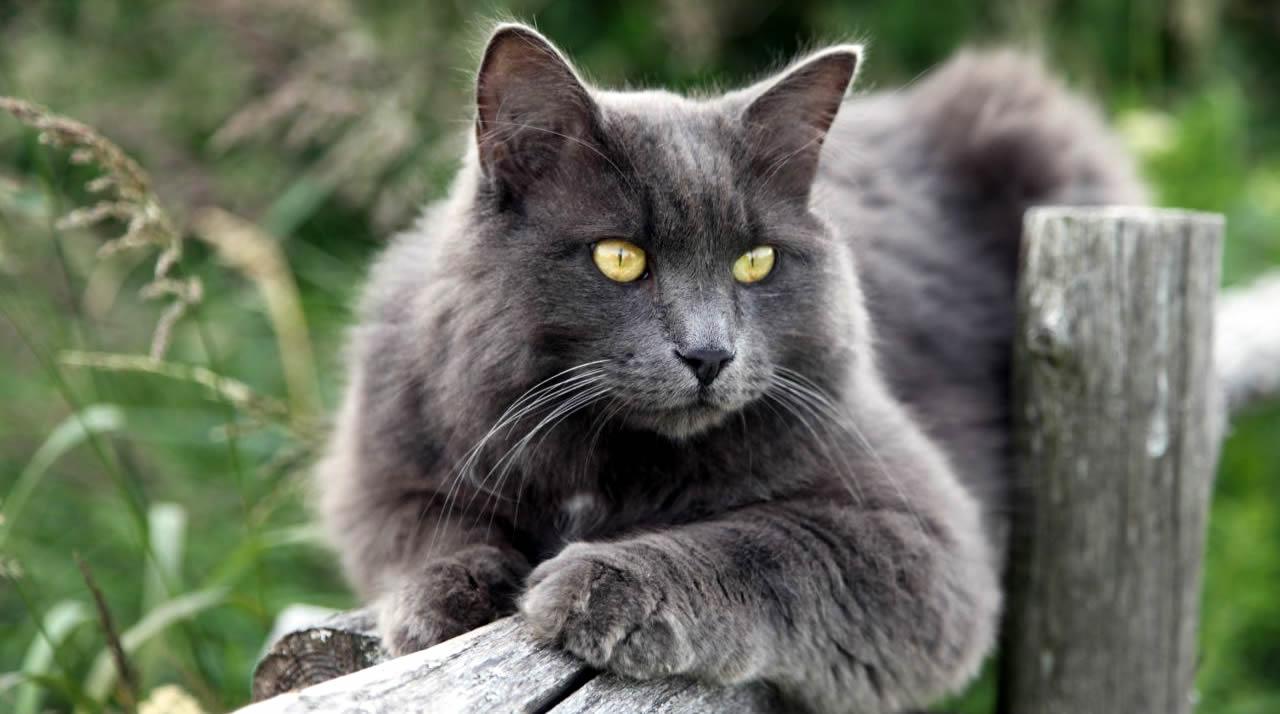
People usually start looking up the Nebelung when a blue-grey, long-haired cat turns up in their life—through a breeder, a rescue listing, or a friend’s “Russian Blue, but fluffier” description—and they want to know what they’re really dealing with. The details matter: this is a rare, pedigreed type with a particular coat, a particular build, and a temperament that often suits quieter homes better than chaotic ones.
The Nebelung is best understood as a longhaired relative of the Russian Blue: medium-sized, solid blue with silver tipping, and (in adults) vivid green eyes. It’s generally considered a hardy breed, but like any cat it still needs routine health care, weight control, and a home that matches its nature.1, 2
At a glance
- Size: Medium-sized (often longer-bodied than “chunky”)
- Typical weight: Females commonly ~3.5–5 kg; males ~4.5–6.5 kg (individuals vary)1
- Coat: Semi-long, silky double coat; solid blue with silver tipping (“misty” sheen)2, 3
- Eyes: Vivid green in adults; kittens may start yellowish and change with maturity1
- Temperament (typical): Affectionate with family, often reserved with strangers; intelligent and playful in a measured way2, 3
- Life expectancy: Often quoted around 11–18 years, with many sources placing them in the mid-to-late teens2, 3, 4
- Known breed-specific issues: No consistently recognised, specific inherited disease is widely agreed on by major registries; obesity is a common practical concern3, 4
History and origin
The modern Nebelung story begins in the United States in the 1980s. The foundation cats most often cited are Siegfried (born 1984) and Brunhilde (born 1985), owned by breeder Cora Cobb. Working with geneticist Dr Solveig Pflueger, Cobb developed a breed standard based on the Russian Blue type, but with a semi-long coat, and the name “Nebelung” (linked to the German word for mist/fog).1, 2
Although the Nebelung is sometimes described informally as a “long-haired Russian Blue”, registries treat it as its own breed, and it remains relatively uncommon compared with more established pedigrees.2, 3
Physical characteristics
A Nebelung has a long, firm body (often described as “foreign” type), balanced rather than cobby, with a plumed tail and tufting between the toes. The head is a modified wedge, with large ears and prominent whisker pads that add to the breed’s distinct expression.1, 4
The coat is the feature most people notice first: solid blue, sound to the roots, with silver tipping on the guard hairs that creates a soft, frosted sheen. Seasonal coat change is normal—many carry more density in winter and feel lighter through warmer months.1, 3
Personality and temperament
Nebelungs tend to move like quiet observers: present, alert, and often happiest when they can watch from a shelf, a cat tree, or the back of the sofa. Many are affectionate and devoted with their own people, while staying cautious with visitors until they’ve had time to map the room and settle into the routine.2, 3, 4
This isn’t a breed that reliably enjoys constant handling or sudden noise. Early, gentle socialisation helps, and so does giving them choice—some will arrive for pats when the house goes still, rather than on demand.3
Grooming and coat care
Despite the long coat, grooming is usually manageable because the hair is often described as silky rather than cottony. Regular combing helps prevent tangles, removes loose hair, and keeps the coat lying cleanly along the body.2, 3
- Combing: Aim for a thorough comb once a week; increase during seasonal shedding.2, 3
- Eyes and ears: Check weekly; wipe away discharge with a soft damp cloth and monitor for irritation or odour.2
- Dental care: Tooth brushing helps reduce dental disease risk (a common issue across cats, not specific to Nebelungs).5
- Bathing: Only when needed. Most do not require routine bathing if combed regularly.
Exercise, enrichment, and training
Nebelungs are often described as intelligent and quite energetic once comfortable, especially indoors where the whole world is condensed into a few rooms. They do best with daily play that mimics hunting—short sessions with a wand toy, a toy mouse dragged along the floor, or food puzzles that make them work for part of a meal.3
If you plan any outdoor time, keep it controlled: a secure cat run or harness training is safer than free roaming, which carries real risks (cars, dogs, fights, and disease exposure).6
Health, lifespan, and what to watch for
Most registry-style breed profiles describe the Nebelung as hardy, with few health problems and no widely agreed, breed-specific inherited disease. That said, “generally healthy” does not mean “never sick”: they still benefit from routine veterinary checks, vaccination appropriate to lifestyle, parasite control, and dental care.3, 7
Obesity is a recurring practical issue mentioned in breed guides. A long coat can hide body shape, so it helps to use hands as well as eyes: you should be able to feel ribs with light pressure and detect a waist from above. If weight is creeping up, measure food, use puzzle feeders, and build play into the daily rhythm.2, 3
Life expectancy is commonly reported in the mid-to-late teens, with many sources citing ranges from roughly 11 up to 18 years depending on genetics, care, and simple luck.2, 3, 4
Living with a Nebelung: what tends to work best
A Nebelung often suits homes that run on predictable patterns. They typically appreciate calm spaces, vertical territory (cat trees, shelves), and a quiet retreat where they can rest undisturbed when the house is busy.3, 4
- If you want an always-outgoing “social butterfly” cat: a Nebelung may be too reserved, especially with strangers.3
- If you want a steady companion who bonds closely: this is where many Nebelungs quietly shine, following familiar people from room to room once trust is built.2, 3
- If you’re away long hours: provide enrichment (puzzle feeders, safe window perches, rotating toys) and a consistent routine; individual tolerance varies.4
Final thoughts
The Nebelung is a mist-coloured cat in both coat and manner: soft-edged at first glance, but built with athletic balance and a watchful intelligence. If you can offer steady routines, gentle socialisation, and simple weekly coat care, you’re likely to find a loyal companion who prefers closeness that arrives naturally, on quiet feet, at the end of the day.2, 3
References
- Nebelung (breed overview, history and physical characteristics) — Wikipedia
- Nebelung — The International Cat Association (TICA)
- Nebelung — Governing Council of the Cat Fancy (GCCF)
- What to know about a Nebelung cat — WebMD
- Pet dental care — American Veterinary Medical Association (AVMA)
- Should I let my cat roam outside? — RSPCA Knowledgebase
- Nebelung cat breed health and care — PetMD
- Obesity in pets — American Veterinary Medical Association (AVMA)

Veterinary Advisor, Veterinarian London Area, United Kingdom