
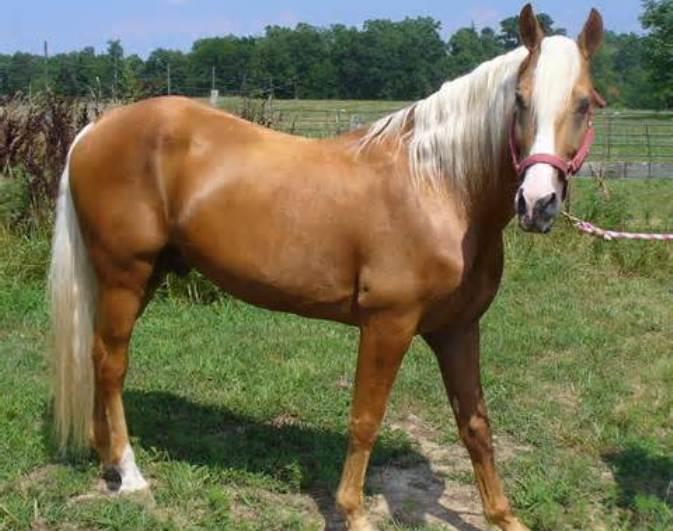
People usually find the Missouri Fox Trotter when they’re trying to solve a practical riding problem: covering distance without being rattled, staying steady on uneven ground, and finding a horse that remains comfortable to sit as the kilometres add up. The difference often comes down to one thing—gait—and whether it’s naturally smooth or simply trained to look smooth.
The Missouri Fox Trotter is a gaited horse from the Ozark Mountains of the United States, best known for the “fox trot”: a four-beat, broken diagonal gait where the front foot lands a split second before the opposite hind, keeping the horse more continuously connected to the ground.1, 2 That small timing shift is what many riders feel as steadiness rather than bounce.
At a glance: Missouri Fox Trotter
- Origin: Missouri (Ozark Mountains), United States1, 2
- Height: commonly 14 to 16 hands (about 142–163 cm)2
- Weight: often around 900–1,200 lb (about 410–545 kg)2
- Colours: seen in many solid colours; markings vary by individual and registry rules1
- Signature gaits: flat foot walk, fox trot, canter4
- Common uses: trail and pleasure riding, stock work, showing2
History and origin
The breed developed in Missouri’s Ozark region in the early 1800s, shaped by settlers who needed a horse that could travel reliably over rocky country, work when asked, and stay manageable for long days.1, 3 Over time, various light-horse and gaited influences contributed to a type that kept its feet under it and offered a smoother ride than a standard trot in rough terrain.1
The Missouri Fox Trotting Horse Breed Association was established in 1948, formalising registration and a written standard around the breed’s characteristic way of going.2, 3
What makes the Missouri Fox Trotter different: the fox trot gait
In the fox trot, the horse moves in a broken diagonal pattern: the front foot of the diagonal pair touches down just before the opposite hind. The steps arrive in four beats rather than two, and the horse does not show the same moment of suspension that creates “bounce” in a true trot.1, 4
Breed standards also recognise two other signature gaits: the flat foot walk and the canter. Together, these gaits are the foundation of the Missouri Fox Trotter’s identity as a riding horse built for comfort and distance.4
Quick check: what a correct fox trot tends to look and feel like
- Rhythm: four distinct beats (not the two-beat “jolt” of a trot)1, 4
- Footfalls: front lands just before the opposite hind (broken diagonal timing)4
- Rider feel: more glide than bounce, especially over distance1, 2
Characteristics and appearance
Most Missouri Fox Trotters sit in the middle sizes of riding horses—commonly around 14 to 16 hands—with a practical, muscular build suited to carrying riders over varied terrain.2 The overall impression is often “stock horse with extra gears”: strong through the body, generally sure-footed, and able to stay efficient at an intermediate speed without rushing.1
Temperament is individual and shaped by handling, but the breed is widely valued as a sensible, willing mount for pleasure and trail riding.2
Uses and disciplines
Because the gait is comfortable at an in-between speed, the Missouri Fox Trotter is commonly chosen for trail riding and all-day saddle time.2 In its home country it has also been used as a general-purpose horse—useful under saddle, handy around livestock, and presentable in the show ring.1, 2
In Australia, the same strengths matter: long rides, mixed footing, and riders who want smoothness without losing practicality.
Training and handling tips
Most of what works for any well-started riding horse applies here: clarity, repetition, and fair boundaries. With gaited horses, the extra consideration is balance—many problems blamed on “attitude” are actually the horse losing rhythm or falling onto the forehand.
- Start with relaxation and straightness. A calm, marching walk is the doorway to a clean flat foot walk and a more consistent fox trot.
- Reward the rhythm you want. When the horse offers a clear four-beat pattern, soften and let it travel forward.
- Don’t chase speed. The fox trot is about timing and efficiency, not racing. Pushing too hard often produces a rougher, mixed gait.
- Use experienced help for gait questions. A knowledgeable instructor can spot whether you’re seeing a true broken diagonal fox trot or a different gait pattern that only looks similar.
Health and care considerations
Missouri Fox Trotters are generally managed like any other riding horse: good nutrition, routine dental and hoof care, sensible workload, and early attention to soreness before it becomes a pattern. Claims that they have “no health issues” are too broad—any breed can develop common equine problems, and individual conformation, diet, and management matter more than the label.
For Australian owners, biosecurity deserves a quiet, steady place in everyday care. If you live in, travel through, or agist in areas where Hendra virus is a concern, talk with your veterinarian about vaccination and risk reduction (feed and water placement, hygiene around body fluids, and what to do if a horse becomes unwell). Government guidance is clear that vaccination is the most effective way to help manage Hendra virus risk, alongside everyday precautions.7, 8
Famous Missouri Fox Trotters
Lists of “famous” Missouri Fox Trotters often circulate without verifiable records, and the names can be repeated across different horses and bloodlines. Rather than guess, it’s more reliable to look for documented results from official breed shows, hall of fame listings, and registry histories published by recognised organisations.3
Breed associations and registries
The main registry for the breed is the Missouri Fox Trotting Horse Breed Association (MFTHBA), established in 1948 in Ava, Missouri.3 It sets breed standards and describes the signature gaits used to identify and evaluate Missouri Fox Trotters.4
Future and conservation
The Missouri Fox Trotter is not generally treated as a rare breed, but like any purpose-bred horse, its long-term quality depends on selection that protects soundness, temperament, and the clarity of the gait. Breed standards and registries play a central role by documenting bloodlines and defining what a correct fox trot should look like, so the breed doesn’t drift into a rougher imitation over time.4
Final thoughts
The Missouri Fox Trotter is, at heart, a distance horse for real terrain—an animal shaped by a landscape where sure footing mattered and comfort wasn’t a luxury. If you want a horse that can travel with a steady, four-beat rhythm through the middle speeds, the fox trot is the detail to pay attention to, because it’s where the ride is won or lost.2, 4
References
- Missouri Secretary of State — State Horse: Missouri Fox Trotting Horse
- Encyclopaedia Britannica — Missouri fox-trotting horse
- Wikipedia — Missouri Fox Trotter (overview and registry history)
- Missouri Fox Trotting Horse Breed Association — Gaits of the Missouri Fox Trotting Horse
- Missouri Fox Trotting Horse Breed Association — Fox Trot or Running Walk?
- Australian Government (DAFF) — Hendra virus (biosecurity, prevention and vaccination)
- Queensland Government (Business Queensland) — Hendra virus vaccine for horses
- Queensland Government (Health) — Hendra virus infection

Veterinary Advisor, Veterinarian London Area, United Kingdom