
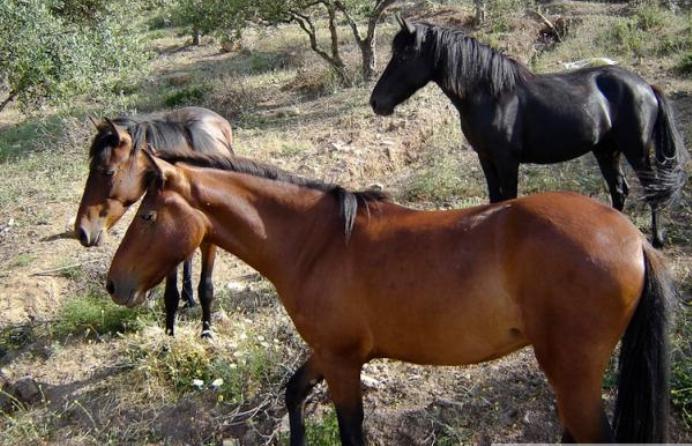
People usually look up the Messara Horse when they’re trying to confirm what it is (and isn’t), how big it gets, and whether it’s truly endangered. Those details matter: this is a rare Cretan breed, and small errors get repeated quickly—especially around size, origins, and conservation status.
The Messara (also called the Cretan horse) is a small, tough riding and light-draught horse from Crete, valued for steady footing on rocky ground and, in many animals, a naturally smooth lateral gait. It remains rare, with formal conservation work and a studbook established in the 1990s.1, 2
Messara Horse at a glance
- Also known as: Cretan horse (sometimes local names are used in Crete)1
- Origin: Crete, Greece (named for the Messara Plain)1
- Height: commonly about 132–142 cm at the withers (roughly 13–14 hands)3
- Weight: often reported around 350–450 kg (varies by type and condition)4
- Typical colours: bay/brown, black, grey1
- Known for: hardiness, sure-footedness, and in many horses a natural pacing/lateral gait1, 3
- Uses: riding, local racing, transport, light farm work1, 3
- Population status: rare; conservation programme and studbook operating since the 1990s1, 2
History and origin
The Messara horse is tied closely to Crete’s working landscape—plains, stony tracks, and steep foothills where a small horse with balance and endurance is more useful than a tall, delicate mount.1
Some popular summaries push the breed’s story deep into the Bronze Age and Minoan times. It’s safer to treat that as cultural association rather than firm breed identity: modern breed accounts generally describe the Messara as a native Cretan type shaped over centuries, with documented influence from Arabian horses introduced during the Ottoman period in the 1600s.1
Physical characteristics
Most Messara horses are compact and muscular, built for balance rather than height. Breed descriptions commonly place them in the low-to-mid 130 cm range at the withers, with a practical, work-ready outline—strong back and quarters, and a neck that’s more functional than ornate.3, 4
Coat colours are typically bay/brown, black, and grey. Markings vary, but the colour range is narrower than many larger riding breeds.1
The distinctive gait (often called a natural pace)
One of the Messara’s best-known traits is a smooth lateral gait seen in many animals. In simple terms, the legs on the same side move in sequence, producing a rolling, ground-covering rhythm that can feel very steady on rough tracks.1, 3
Temperament and handling
Temperament varies with breeding, early handling, and daily life, but the Messara is widely described as sensible and tractable—traits that suit farm work, trekking, and busy village settings where horses must cope with noise, uneven footing, and long hours.1
Training approaches don’t need to be exotic. Quiet consistency, clear boundaries, and short, repeatable sessions tend to suit hardy island breeds that learn through repetition and routine. As with any horse, welfare fundamentals matter more than technique: adequate forage, clean water, hoof care, and a workload that matches fitness.
Traditional and modern uses in Crete
Historically, the Messara was used for transport and light agricultural work—small-scale hauling, moving people and goods, and farm tasks that suited a nimble horse rather than a heavy draught animal.3
Today, the breed is also used for riding and local racing. In some areas, stallions have been used to produce mule-type working animals (such as hinnies) by crossing with female donkeys, reflecting a practical tradition of creating sure-footed hybrids for work.1
Conservation status and what threatens the breed
The Messara is considered rare, with sources commonly describing only a small number of animals remaining and noting formal conservation steps beginning in the 1990s, including the establishment of a studbook and a conservation programme.1
The main pressures are familiar across many local horse breeds:
- Mechanisation and changing land use, reducing the need for small working horses.
- Crossbreeding, which can dilute distinctive local traits when numbers are already low.
- Small population size, which raises long-term genetic risks if breeding isn’t carefully managed.2
Conservation efforts
Breed survival depends on two things happening at once: accurate recording of bloodlines, and enough healthy foals each year to keep numbers rising without narrowing the gene pool. The Messara’s studbook and organised conservation work—reported as operating since 1994—are the practical backbone of that effort.1
At a broader level, Greece’s livestock-breed reporting and monitoring connects into European and global animal genetic resources systems (EFABIS and FAO’s DAD-IS framework), which exist to track breeds and support coordinated conservation planning.2, 5
Frequently asked questions
Is the Messara Horse a “pony” or a “horse”?
It sits in the grey zone. Many descriptions place the breed around 132–142 cm, which overlaps common pony heights, but “horse” is often used because it’s a distinct local landrace/type with riding and light-draught roles rather than a children’s pony breed.3, 1
How tall is a Messara Horse?
Commonly about 132–142 cm at the withers (roughly 13–14 hands). Claims of 1.45–1.55 m are usually too tall for this breed as it’s typically described in the low 130s to around 140 cm range.3, 4
Are Messara horses gaited?
Many are reported to have a natural lateral gait (a smooth pace) that’s comfortable for riding and useful on uneven ground, though not every individual will show it equally.1, 3
Are they still used for farm work?
Yes, but typically for light work and local transport rather than heavy draught. Riding and small-scale local events are also common modern roles.1, 3
References
- Messara horse (overview, characteristics, history, uses)
- EFABIS Greece (FAO DAD-IS): Greece’s national animal genetic resources information system
- Amalthia: Messara horse (history and morphological traits, including height)
- Horses of the World: Cretan–Messará (height/weight summary and studbook note)
- FAO DAD-IS: European Farm Animal Biodiversity Information System (EFABIS) overview
- European Commission CORDIS: EFABIS project summary
- European Federation of Animal Science (EAAP): EFABIS project description
- Horses in Greece (context on recognised Greek breeds, including Messara/Cretan)

Veterinary Advisor, Veterinarian London Area, United Kingdom