
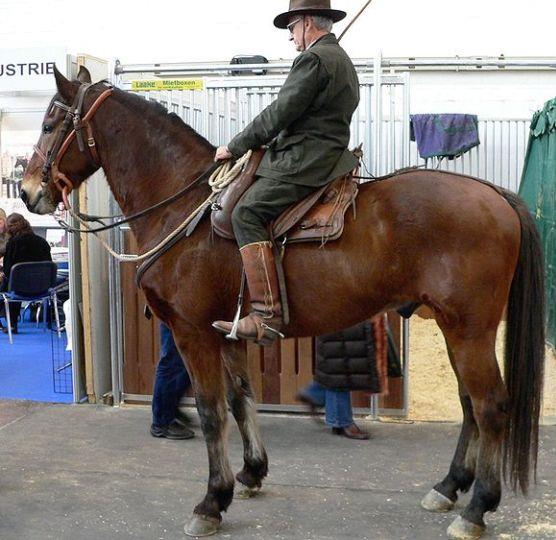
People usually look up the Maremmana (more accurately, the Maremmano) when they’re weighing up a hardy riding horse for trekking, stock work, or general saddle use—or when they’ve seen the name online and want to check what’s true. Breed names from the Maremma region are often confused across species (horse, cattle, dog), so a quick check can save you from buying the wrong “facts” along with the romance.
Below is a clear, practical profile of the Maremmano horse: where it comes from, what it typically looks like, what it’s used for, and what day-to-day care tends to matter most. Any details that were off in the original draft (especially coat colour, size, and “uses”) have been corrected.
Maremmano horse: quick facts
- Country of origin: Italy (Maremma in Tuscany and northern Lazio)1, 2
- Height: commonly around 156–158 cm at the withers (many modern lines are taller; some sources describe 160–172 cm)2, 3, 4
- Weight: often reported around 450–500 kg (can vary with type and condition)2
- Typical coat colours: mostly bay or black; chestnut is usually limited/conditional in some breed descriptions; grey is not typically described as the main colour4, 5
- Traditional role: working saddle horse for the butteri (Italian stockmen) managing cattle in rough country1, 3
- Modern uses: saddle horse (trekking/trail), some sport and general riding; also used in working and institutional mounts in Italy1, 6
Origin and history
The Maremmano is a native Italian horse from the Maremma—once a harsh, marshy coastal plain and hill country spanning southern Tuscany and northern Lazio. For generations it was shaped by outdoor keeping, sparse feed, and the steady, unglamorous demands of stock work.1, 3
Formal, organised selection is relatively recent. A stud book has been in place since about 1980, which helped stabilise breeding goals and record-keeping after long periods of regional, practical breeding for work rather than show-ring uniformity.7, 1
Physical characteristics and appearance
In the paddock, a Maremmano tends to read as compact strength: a robust frame, solid limbs, and the sort of feet that don’t look surprised by stones, mud, or long days. Many descriptions note a longer head and a generally tough, functional build—less “decorative”, more ready.6, 3
Coat colour is a common point of confusion. The breed is not “mainly white”. Reputable breed descriptions most often describe bay and black (and related dark shades), with chestnut sometimes restricted depending on registry or tradition, and grey not generally described as the defining colour.4, 5, 6
Size also varies by line. Some sources describe averages around 1.56–1.58 m at the withers, while others (often describing the more modern, taller type) give a broader range extending into the low 170s cm.4, 2, 3
Temperament and behaviour
The Maremmano’s reputation is built around steadiness under pressure—useful on cattle, useful on uneven ground, useful in weather that doesn’t cooperate. Depending on breeding and handling, individuals can be forward and lively rather than placid, but the traditional aim has been a mount that stays workable for long hours and repeated tasks.3, 6
As with any breed, temperament is shaped by more than genetics: early handling, feed, pain, saddle fit, and day-to-day routines all matter. Treat any blanket promise (“never spooks”, “always calm”) as marketing, not biology.
Uses and roles in Italy (traditional and modern)
The breed’s classic job is as the horse of the butteri, the mounted stock workers of central Italy, moving cattle across country that can be dry, rough, and occasionally boggy. That heritage still shows in the breed’s practical way of going and its ability to keep travelling when the surface turns ugly.1, 3
Today, Maremmani are primarily saddle horses. Many are used for trekking and general riding, and some bloodlines have been shaped towards a more athletic “improved” type through historical crossbreeding with Thoroughbred and other horses.6, 7
Care: feeding, soundness, and everyday management
A Maremmano is often described as hardy, but “hardy” doesn’t mean “maintenance-free”. Good basics still apply: consistent forage, clean water, routine dental care, and hoof management that suits local ground conditions and workload.
- Diet: base the ration on quality forage (pasture/hay), adding concentrates only when workload, age, or body condition calls for it.
- Hooves and legs: tough feet are an advantage, but regular trims and early attention to cracks, thrush, and uneven wear prevent small issues turning into lameness.
- Colic and respiratory health: these are not “breed signatures” so much as common horse problems. Reduce risk with steady routines, dust control around hay/bedding, parasite management, and sensible feeding changes.
- Arthritis and wear-and-tear: any working horse can develop joint issues over time. Manage with appropriate conditioning, weight control, footing choices, and veterinary guidance when stiffness appears.
Training and handling
The most effective training style for a Maremmano is the same one that works for most sensible horses: quiet consistency, clear boundaries, and enough repetition to make the right response feel easy. When a horse has grown up moving freely over mixed terrain, it often benefits from varied schooling—hills, poles, and long, steady rides—rather than drilling in one small arena.
Keep sessions short when learning something new. Build fitness gradually. If a horse is “difficult”, rule out pain first (feet, teeth, back, saddle fit), then revisit the cues you’re using and whether they’re consistent.
Conservation, breeding, and population pressures
Like many regional livestock breeds, the Maremmano’s long-term security depends on active breeding programs and practical demand. The establishment of a formal stud book and structured selection has been part of keeping the breed identifiable and viable, especially after periods where crossbreeding produced more varied types.7, 6
Concerns about genetic diversity can be real in localised breeds, but they’re not well served by vague claims. If you’re buying or breeding, ask for registry details, performance records, and transparent breeding goals rather than relying on dramatic “near extinction” language.
Breed organisations
In Italy, the breed is supported through formal structures around the stud book and selection. A practical starting point for background reading (history and breed context) is the Italian horse racing and breeding authority’s breed page, and for deeper technical detail, peer-reviewed overviews exist through academic publishers.1, 7
If you find an “association” in another country, check whether it is a genuine registry with published standards and a stud book, or simply an enthusiast group. Both can be useful, but they are not the same thing.
Final thoughts
The Maremmano is best understood as a landscape-shaped horse: built for long days, variable ground, and a rider who values steadiness over sparkle. If you’re choosing one, look past the breed label and assess the individual—soundness, handling history, and the sort of work it has already done are usually more predictive than any single sentence in a breed summary.
References
- UNIRE (Italy) – Il cavallo maremmano
- Agraria.org – The Maremmano (Italian breeds of horses)
- Treccani Vocabolario – “maremmano” (includes Maremmano horse description)
- Wikipedia (Italian) – Maremmano (cavallo) (morphology and coat notes)
- Treccani Enciclopedia – Maremma (includes “razza maremmana” overview)
- Wikipedia – Maremmano (horse) (history, uses, general characteristics)
- Cambridge Core (Animal Genetic Resources) – “The Maremmano horse” (Silvestrelli, 2011)
- Il Portale del Cavallo – Razze equine: Maremmano (height and coat summary)

Veterinary Advisor, Veterinarian London Area, United Kingdom