
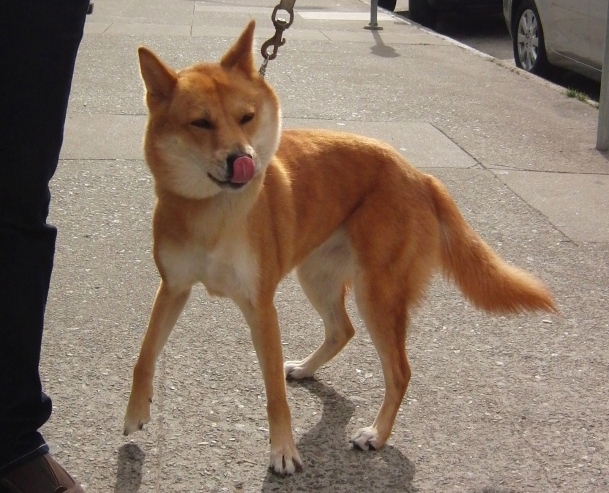
People usually search for the Korean Jindo Dog when they’re weighing up a rare, high-drive breed: how big it gets, what it’s like to live with day to day, and whether its famous loyalty will fit a busy household.
The key detail is that a Jindo is not a “go-with-the-flow” companion. It’s a capable hunting dog with a strong sense of territory and a tendency to make its own decisions. That can be deeply rewarding in the right home, and frustrating in the wrong one.
Size: Medium
Height: males 50–55 cm; females 45–50 cm (breed standard ranges)1, 2
Weight: males 18–23 kg; females 15–19 kg (breed standard ranges)2
Coat: double coat; harsh, straight outer coat with a soft, dense undercoat2, 3
Colours: red fawn, white, black, black and tan, wolf grey, brindle (other colours not accepted under breed standards)2, 3
Lifespan: often around 12–15 years (some sources cite ~14–15 years)6
Temperament: loyal, alert, independent; typically reserved with strangers and may be selective with other animals2, 6
Energy level: active; needs regular physical exercise and daily mental work6
Trainability: intelligent but not automatically compliant; does best with calm, consistent training and early socialisation6
Grooming: weekly brushing most weeks, with heavier shedding seasonally; bathe as needed6
Origins and history
The Korea Jindo Dog developed on Jindo Island, off the south-west of the Korean peninsula, where geographic isolation helped keep the type consistent over time.7
In South Korea, the Jindo is formally protected as Natural Monument No. 53, designated in 1962 under Korea’s cultural heritage protections.5 Internationally, the breed is recognised by the Fédération Cynologique Internationale (FCI) as “Korea Jindo Dog” (FCI No. 334), with definitive recognition from 6 July 2005.1
Physical characteristics and appearance
The Jindo is a medium-sized, spitz-type dog: wedge-shaped head, prick ears, and a thick tail that’s commonly carried curled or sickle-like over the back. The overall impression is tidy and athletic rather than heavy.2, 3
The coat is built for weather. A soft, dense undercoat sits under a harsher outer coat that stands slightly off the body, with longer furnishings on the neck, rump, tail and backs of the thighs.2, 3
Personality and temperament
Jindos are widely described as loyal and attentive to their own people, often forming a particularly strong bond with one primary handler.6 They tend to be naturally reserved with strangers, and that reserve can tip into pushy guarding if boundaries aren’t clear.6
Many Jindos have a pronounced prey drive. That matters most in the small moments: an open gate, a loose lead, a dash of movement in the scrub. Management and training need to be practical, not hopeful.6
Early, steady socialisation helps a Jindo read the world without overreacting, but it doesn’t erase the breed’s core traits. Expect a dog that watches first and decides second.6
Training and exercise requirements
A Jindo usually responds best to training that is quiet, consistent and clear. Harsh handling tends to backfire; sloppy handling is simply ignored. The handler’s job is to be calm enough that the dog doesn’t feel the need to take over.6
Exercise is not just “wearing them out”. It’s daily movement plus structured mental work—otherwise the dog will make its own projects, often involving fences, gates and the neighbourhood horizon.6
- Daily movement: brisk walks, running alongside (once mature), or free movement in a secure area
- Daily thinking work: scent games, structured obedience, problem-solving feeders, short training blocks
- Containment: secure fencing and a plan for doors/gates; prey drive and roaming can be strong6
Common health issues and care
The breed is often described as generally healthy, but like any dog population, some conditions do show up. The point isn’t to assume illness—it’s to avoid surprises and plan sensible screening with your vet.6
Issues reported in the breed include:
- Hypothyroidism6
- Discoid lupus erythematosus (DLE) (an immune-mediated skin condition affecting the nose/face, with sunlight often worsening signs)6
- Hip dysplasia (reported, though not always common)6
Routine care is simple but not optional: weight management, parasite control, dental care, and a grooming rhythm that keeps the undercoat from compacting during shedding seasons.
The Korean Jindo Dog in culture
In Korea, the Jindo’s reputation has been shaped by its working past: a capable hunting dog, a close guardian, and an animal prized for steadiness and loyalty. That cultural status is reflected in its protected designation as Natural Monument No. 53.5
Adopting and owning a Korean Jindo Dog: what to expect
Living with a Jindo is often less about teaching tricks and more about building reliable habits: calm greetings, predictable boundaries, and daily outlets for movement and scent work. When those pieces are in place, the dog’s independence becomes a feature rather than a fight.6
In many homes, the make-or-break factors are not the basics (food, walks, grooming). They’re the practical realities:
- Secure containment (fences, gates, and routine)
- Time for training beyond puppyhood
- Management around other animals, especially small pets, depending on the individual dog6
- Comfort with a dog that’s reserved rather than instantly friendly to everyone6
Future of the breed: challenges and opportunities
As the Jindo becomes more visible outside Korea, the opportunity is broader appreciation for a distinctive, capable spitz breed. The risk is careless breeding for looks or novelty, which can erode temperament and health in any pedigree dog.
Breed standards exist to anchor what a Jindo is meant to be—sound, functional, and recognisably itself—rather than a rough lookalike shaped by trends.1, 2
Final thoughts
A Korean Jindo Dog suits people who enjoy a dog with opinions: alert, athletic, and selective in its trust. Give it structure, secure space, and steady training, and you tend to get a companion that moves through the world with quiet confidence—watching, assessing, and staying close to the people it recognises as its own.
References
- Fédération Cynologique Internationale (FCI) – Korea Jindo Dog (No. 334) breed nomenclature
- United Kennel Club (UKC) – Breed Standards: Jindo
- The Kennel Club (UK) – Korean Jindo breed standard
- Korea Kennel Federation – Korean breeds: Korea Jindo Dog (FCI Standard No. 334 overview)
- Wikipedia – Korean Jindo (background on Natural Monument designation and general overview)
- PetMD – Jindo: breed information and health issues
- European Korean Jindo Dog Association – FCI standard summary (size, weight, coat, colours)
- European Korean Jindo Dog Association – Health notes for the breed
- FCI – Official breed standard PDF for Korea Jindo Dog (No. 334)

Veterinary Advisor, Veterinarian London Area, United Kingdom