
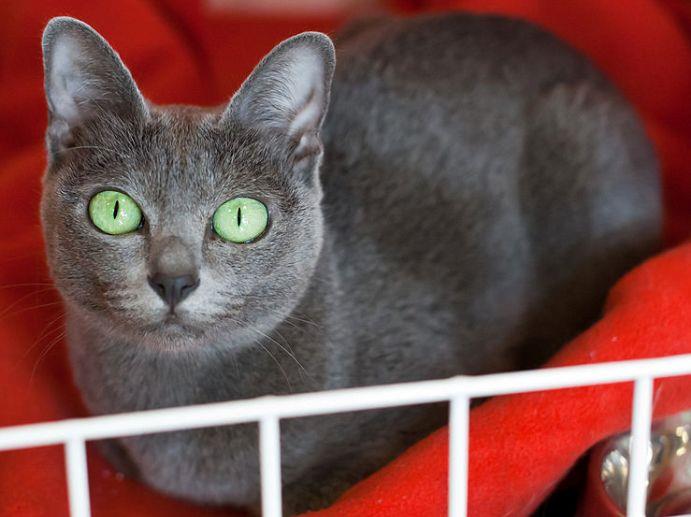
Most people end up reading about Korat cats when they’re weighing up a kitten from a breeder, checking whether the breed will suit a quieter home, or trying to understand what “silver-blue with green eyes” really looks like as the cat matures. With a rare breed, small details matter: coat colour rules, eye colour timelines, and the health tests a responsible breeder should already be doing.
The Korat is a natural Thai breed with a compact, muscular build and a short blue coat tipped with silver. Its famous green eye colour often arrives slowly, and—despite the breed’s generally robust reputation—there are inherited conditions (notably GM1 and GM2 gangliosidosis) that make genetic screening part of sensible due diligence.1, 2, 3, 4
At a glance: Korat cat
- Origin: Thailand (known as the Si-Sawat in Thailand)1, 2
- Size/weight: small-to-medium; females often ~2.7–3.6 kg, males commonly ~3.6–4.5+ kg (varies by individual)1
- Coat: short, close-lying blue with silver tipping (the Korat is only accepted in this colour in major breed standards)1, 2
- Eye colour: luminous green preferred; kittens may start blue then shift through yellow/amber before turning green as they mature (often 2–4 years)2
- Temperament (typical): intelligent, people-attached, playful; often prefers close companionship and can be sensitive to being left out1
- Life expectancy: commonly into the mid-teens or longer; some lines live into later life with good care1
- Grooming: low—weekly brushing is usually plenty1
- Known inherited health risks: GM1 and GM2 gangliosidosis (genetic tests available; responsible breeders screen)3, 4, 5
Origin and history
The Korat is an imported, natural breed from Thailand, long valued in its homeland and often linked with traditions of good fortune. Outside Thailand it remains relatively uncommon, which is part of the appeal—and part of why careful breeder selection matters.1
In Western cat registries, the Korat is treated as a distinct breed with a strict colour requirement: blue with silver tipping only. Outcrossing is not accepted in major standards, which helps preserve the breed’s look, but also means genetic health management needs to be deliberate and transparent.1, 2
Physical characteristics (what to look for)
A Korat’s silhouette is compact and muscular—often described as heavier than it looks when you lift one. The head is a defining feature: a heart-shaped outline, with pronounced brow ridges and large, round eyes when fully open.1
The coat is short and close-lying, showing the body’s muscle underneath. The colour is not a range; it is specifically blue with silver tipping that gives a soft sheen, especially in good light.1, 2
Eye colour: why Korats don’t always have green eyes straight away
Many people expect instant green eyes because that’s how adult Korats are photographed. In reality, eye colour develops over time: kittens may begin with blue eyes, then shift through yellow/amber shades, with the preferred luminous green often not settling until maturity (commonly around two to four years).2
Personality and day-to-day temperament
Korat cats are typically social and people-focused. They often choose a favourite person, stay close, and join whatever is happening—quietly, but with intent. Many are lively and intelligent, enjoying interactive play and mental challenges rather than endless independent zooming.1
They can also be sensitive to household noise and disruption. That doesn’t mean they can’t live with children or other pets, but it does mean the gentlest introductions tend to work best—steady routines, safe hiding places, and play that doesn’t corner them.1
Health: what’s true, what’s overstated, and what to check
It’s common to see Korats described as having “no breed-specific health issues”. That’s too broad. While many Korats are healthy, the breed is known to have two serious inherited neurodegenerative diseases—GM1 and GM2 gangliosidosis—both inherited in an autosomal recessive pattern. Genetic tests are available, and reputable breeders use them to avoid producing affected kittens.3, 4, 5
GM1 and GM2 gangliosidosis (why screening matters)
Gangliosidoses are progressive, fatal neurological conditions caused by enzyme deficiencies leading to abnormal storage of certain lipids in nerve tissue. In affected Korat kittens, signs typically begin very young and progress over months.3, 4, 6
- GM1 gangliosidosis: documented in Korats; onset can be around a few months of age, with progressive neurological decline and premature death.3, 5
- GM2 gangliosidosis: also affects Korats; likewise progressive and severe, with a recessive inheritance pattern (carriers are clinically normal).4
If you’re speaking with a breeder, ask to see written proof of DNA test results for both parents (or for the kitten, depending on the breeding program). For recessive diseases, “tested clear” or “carrier x clear” matings are how breeders avoid affected kittens.3
Care and grooming
The Korat’s coat is straightforward: short, close, and usually low-shed compared with longer-coated breeds. A gentle weekly brush helps remove loose hair and is often enough to keep the coat glossy.1
Like any cat, a Korat benefits from routine veterinary care and parasite prevention matched to your local risks. If your cat’s vaccination history is unknown, vets often recommend a restart course before mixing with other cats.7
Vaccinations in Australia (the practical baseline)
Australian guidance commonly frames “core” cat vaccination as the F3 vaccine, with boosters every 1–3 years depending on the product used and the individual cat’s circumstances, as advised by your vet.7, 8
Microchipping and identification
Microchipping is widely recommended because it dramatically improves the chance of reunion if a cat is lost. Just as important: keeping your contact details current on the registry.9
Training and exercise
Korats tend to enjoy interactive play—short, frequent sessions suit them well. Many will happily chase, pounce, and climb, then return to watch from a high perch. Puzzle feeders and rotating toys help keep their sharp minds busy.1
Training is usually less about obedience and more about cooperation: coming when called, accepting handling, entering a carrier calmly. Gentle repetition and food rewards often work better than pressure, especially with a breed that can withdraw when overwhelmed.1
Korat cats as family pets: who they suit best
A Korat often suits homes that want a companion cat rather than a purely independent presence. They’re typically affectionate and playful, and many do well with respectful children and other animals, provided introductions are slow and the cat has control over distance and escape routes.1
If your household is empty all day and lively all night, plan ahead. Korats are known for wanting companionship and can become withdrawn if routinely ignored, so enrichment and predictable attention matter more than fancy accessories.1
Breeding and showing (briefly, for buyers)
If you’re buying a Korat for showing, the essentials are simple and strict: the correct blue coat with silver tipping, the characteristic head shape, and eye colour that matures over time. Kittens may show “ghost” markings and may not yet have fully green eyes; that’s normal development, not automatically a fault.2
Whether you plan to show or not, the more important question is health transparency. For Korats, that means documented testing for GM1 and GM2 gangliosidosis in the breeding lines.3, 4
Famous Korat cats in history and pop culture
Korats appear in cat literature and registry histories, but many “famous Korat” claims online are muddled or plainly incorrect. For example, Greyfriars Bobby was a dog, not a Korat cat, and should not be used as a breed anecdote.
If you’re looking for something real to anchor the breed’s story, the most reliable sources are formal breed registries and standards, which document the Korat’s Thai origin, defining traits, and the breed’s development outside Thailand.1, 2
Final thoughts
The Korat is a quietly striking cat: silver-blue coat, bright eyes that deepen with age, and a dense, athletic body that feels like it’s built from springs. In the home, many are devoted, observant, and keen for companionship without being relentlessly demanding.1
The main practical takeaway is simple. Treat “rare” as a prompt to check paperwork: verify colour/standard if it matters to you, and verify genetic screening for GM1 and GM2 if you’re buying from a breeder. With that groundwork done, you’re left with the real thing—a Korat being a Korat, quietly present in every room.3, 4
References
- The International Cat Association (TICA) — Korat (breed information and standard overview)
- Cat Fanciers’ Association (CFA) — Korat (breed profile/standard notes on coat and eye colour)
- UC Davis Veterinary Genetics Laboratory — Korat GM1 Gangliosidosis (DNA test information)
- UC Davis Veterinary Genetics Laboratory — Korat GM2 Gangliosidosis (DNA test information)
- PubMed — Beta-galactosidase deficiency in a Korat cat: a new form of feline GM1-gangliosidosis
- Universities Federation for Animal Welfare (UFAW) — Korat: GM1 gangliosidosis
- RSPCA Knowledgebase — What vaccinations should my cat receive?
- Cat Protection Society of NSW — Vaccinations factsheet (notes on AVA guidance and F3)
- RSPCA Australia — Microchipping

Veterinary Advisor, Veterinarian London Area, United Kingdom