
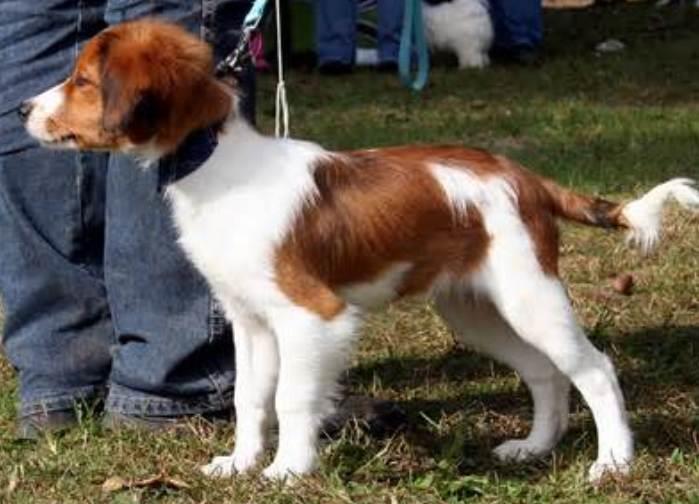
Most people look up the Nederlandse Kooikerhondje (often shortened to “Kooikerhondje”) when they’re deciding whether this small Dutch gundog will fit their home — or when they’re trying to fact-check size, temperament, coat colour, and common health screening before they contact a breeder.
It’s a breed that can be quietly adaptable indoors, then suddenly bright and busy outdoors. The difference between “a lovely little companion” and “too much dog for our week” usually comes down to daily exercise, training consistency, and choosing a pup from health-tested lines.1, 3
Quick breed snapshot
- Breed name: Nederlandse Kooikerhondje (Kooikerhondje)
- Origin: The Netherlands
- Height: roughly 35–40 cm for females and 37–42 cm for males (varies by standard)2, 4
- Coat: medium-length, straight or slightly waved, with feathering; presented naturally (not sculpted)1, 2
- Colour: distinct orange-red patches on white; a little ticking is acceptable; black “earrings” (black hair tips on the ears) are often preferred but not required by all standards1, 2, 4
- Temperament (in plain terms): lively, agile, alert and generally not noisy; often friendly with familiar people and more reserved with strangers1, 2
History and origin
The Kooikerhondje was developed in the Netherlands to work around duck decoys (eendenkooien): the dog moves calmly behind screens, using its visible, feathered tail to lure ducks deeper into the trap system. It’s a specialised job that rewards steadiness, quick observation, and an ability to work close to water without rushing in.2
The breed declined sharply and was rebuilt in the mid-20th century from a small remaining population, with organised efforts in the Netherlands underpinning modern standards and registration.2
Physical characteristics
A Kooikerhondje is a small sporting dog with an almost square outline, a clean, athletic frame, and a plume-like tail that is carried level with or slightly above the back when alert. The coat is functional: water-resistant with a dense undercoat, and feathering on the ears, legs and tail.1, 3
Colour is not “anything orange and white”. Breed standards emphasise clear orange-red patches on a white background. Some black hairs mixed through the orange-red and a little ticking can be acceptable, but heavy black interspersing is treated as a fault in at least some standards. Tri-colour and black-and-white are disqualifying in the AKC standard.1, 2
Temperament: what they’re like to live with
Kooikerhondjes are typically lively and attentive, with enough persistence to keep working a task without becoming frantic. Many are affectionate with their own people, yet can be a little reserved with strangers — not aggressive, just watchful and slow to spend their trust.1, 2
They tend to do best when their day has shape: a walk with time to sniff, a few short training sessions, and something to carry, search for, or retrieve. Without that outlet, the energy often leaks into nuisance behaviours such as barking, chasing moving things, or busy, self-appointed “patrols” of the house and yard.
Training and exercise needs
This is a smart, responsive breed that generally learns quickly with positive reinforcement and calm consistency. Short, frequent sessions suit them better than long drills. Clear boundaries matter, especially around doorways, visitors, and small animals.1
Daily exercise should be non-negotiable. The exact amount varies by age and individual temperament, but most do well with:
- a decent daily walk plus a second short outing, or
- a walk paired with structured play (retrieving games, scent work, basic agility foundations).
Because the breed’s traditional work involves water and movement around wetlands, many Kooikers take naturally to swimming — but introduce it thoughtfully and safely, and don’t assume every individual will enjoy it.
Health concerns and sensible screening
The original draft listed hip dysplasia and patellar luxation, which are relevant orthopaedic issues to be mindful of. In practice, responsible breeding also commonly includes eye examinations and DNA-based screening for certain inherited conditions reported in the breed (requirements vary by country and breed club programs).8
If you’re speaking with a breeder, ask to see evidence of health screening (not just a vet “check”). In the US, many results are recorded through the Orthopedic Foundation for Animals (OFA), and breed screening programs are often tied to CHIC numbers and documented test outcomes.8
Grooming and maintenance
The coat is designed to be practical. Weekly brushing usually keeps feathering from matting and removes shed hair, with a little more attention during seasonal coat changes. Standards describe a natural, untrimmed presentation (other than tidy feet), so heavy scissoring and sculpting is not part of correct breed care.1
Basic maintenance still counts:
- check ears regularly (especially after swimming or damp weather)
- keep nails short enough that the dog stands and turns comfortably
- rinse and dry feathering if the dog has been in muddy water.
Kooikerhondje as a family pet: a clear-eyed view
Pros
- Compact but athletic: small enough for many homes, sturdy enough for active weekends.1, 2
- Trainable and engaged: often excels in dog sports and structured activities.1
- Typically not “yappy” by design: standards describe them as alert but not noisy, though individuals and environments vary.1, 2
Cons
- Needs daily outlets: under-exercised dogs can become restless, barky, or overly watchful.
- Can be reserved with strangers: early socialisation and steady exposure to visitors matters.1
- Not a “set and forget” breed: they do best with owners who enjoy training and routine.
Choosing a breeder or rescue (Australia-focused checks)
If you’re buying a puppy in Australia, start by speaking with a breeder who is registered with a Dogs Australia (ANKC) member body, and be prepared to ask direct questions about health testing, temperament, and how pups are raised in the home. Dogs Australia publishes practical prompts that breeders should be comfortable answering, including what hereditary conditions exist in the breed and whether you can view test results.7
Look for steady, observable signs of good practice:
- parents with documented health screening relevant to the breed
- a breeder who asks you questions too (work hours, fencing, other pets, plans for training)
- pups raised with normal household sounds and careful handling, not isolated in a run.
Final thoughts
The Kooikerhondje is not a tiny ornament dog, and it’s not a big-demand working dog either. It sits neatly between: small, bright, active, and sensitive to the tone of the household. With daily movement, patient training, and a breeder who takes health screening seriously, it can be a steady companion with a quietly distinctive way of moving through the world.
References
- NKCUSA – AKC Official Standard of the Nederlandse Kooikerhondje
- The Kennel Club (UK) – Kooikerhondje Breed Standard (last updated 1 November 2025)
- United Kennel Club (UKC) – Kooikerhondje Breed Standard
- Vereniging Het Nederlandse Kooikerhondje – Breed Standard
- WebMD – Nederlandse Kooikerhondjes: What to Know
- Westminster Kennel Club – Nederlandse Kooikerhondje (breed overview)
- Dogs Australia – Choosing a Breeder
- KOOIKEROLOGY – Kooikerhondje Health Testing (overview of commonly recorded screening)

Veterinary Advisor, Veterinarian London Area, United Kingdom