
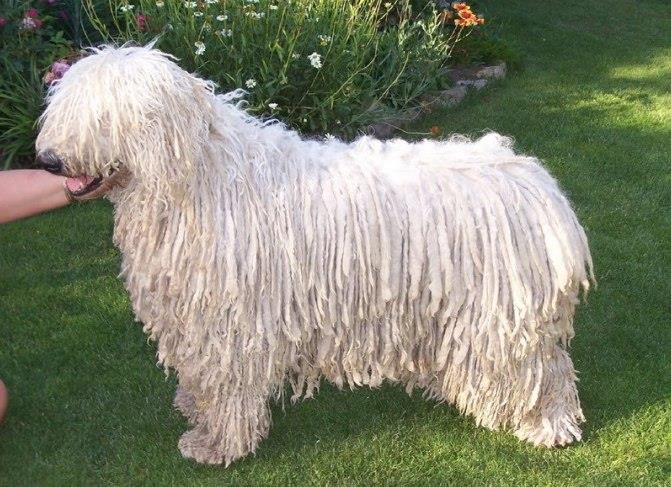
People usually start looking up the Komondor when they’ve seen a “mop dog” online and want to know what it’s really like to live with one. The coat is the headline, but the bigger decision is temperament: this is a livestock guardian—large, watchful, and naturally suspicious of what it doesn’t know.
Below is a practical snapshot of size, personality, coat care, training needs, and the health issues to plan for, using recognised breed standards and veterinary guidance rather than folklore.
Komondor at a glance
- Size: Large, heavy-boned and muscular
- Height (at withers): males minimum 70 cm; females minimum 65 cm1
- Weight: males 50–60 kg; females 40–50 kg1
- Coat: long, corded (“tassel-like” cords form from outer coat and undercoat)2
- Colour: ivory (breed standard); often described broadly as white1, 3
- Temperament: steady courage, territorial, wary of strangers; devoted to its own people1
- Energy: moderate; built for long hours of alertness rather than constant sprinting
- Typical lifespan: often cited around 10–12 years (individuals vary)4
- Common health concerns to ask about: hip dysplasia, bloat (GDV), ear and skin issues4, 5
History and original job
The Komondor is a Hungarian livestock guardian, developed to stay with stock and hold ground when predators appear. The modern breed standard still reads like a working brief: a dog that considers territory its own, tolerates little intrusion, and prefers to observe quietly by day and patrol by night.1
Physical characteristics: what you’ll notice first
Under the cords is a tall, rectangular, athletic dog—substantial but not meant to feel lumbering. Mature cords can be long and heavy, and they change how the dog moves through the world: rain, burrs, mud and drying time all become daily considerations, not occasional hassles.2
The corded coat (and why “daily brushing” is the wrong model)
A Komondor isn’t maintained like a double-coated shedding breed. The cords form as the harsher outer coat traps the soft undercoat, and owners usually maintain them by hand-separating new mats near the skin so they become neat, individual cords rather than broad plates.6
- Cords don’t appear overnight: they typically begin forming from roughly 8–12 months, and take time to mature.6
- Drying matters: a wet, dense corded coat can take a very long time to dry; trapped moisture can lead to odour and skin trouble, so airflow and thorough drying are part of responsible care.6
- Hands-on coat checks: debris can hide in the cords, so regular, methodical “part and inspect” sessions are normal life for the breed.6
Temperament: calm on the surface, decisive when it counts
The Komondor’s manner is often quiet, even still, until something crosses a line. The breed standard describes a dog that guards and defends without fuss, is suspicious by nature, and treats its territory as property.1
In a home setting, that can look like a dog that bonds deeply with family, watches visitors carefully, and needs introductions handled with steady routine rather than force. It’s not a personality that suits constant foot traffic, dog parks, or households that want an easygoing social butterfly.
Training and exercise needs
Komondors are intelligent, but they were shaped to make decisions at a distance from people. Training works best when it’s consistent, calm, and started early, with an emphasis on social exposure that’s controlled and positive rather than chaotic.
- Exercise: think steady daily walks and time to move and patrol in a secure area, not repetitive high-impact running.
- Socialisation: aim for “neutral and settled” around strangers and new places, not indiscriminate friendliness.
- Boundaries: secure fencing and clear household rules matter, because territorial habits can strengthen with maturity.1
Grooming and coat care: a realistic routine
Coat care is mostly prevention. Once cords are established, your job is to keep them separated at the base, clean enough to avoid skin problems, and dry enough to avoid lingering damp.6
- Separate cords by hand: especially during the months when cords are forming, and whenever new growth tries to felt together at the skin.6
- Rinse dirt early: dried-in mud can discolour and harden in cords; a quick rinse before it sets is simpler than a full bath.6
- Plan for long drying time: towels plus airflow; don’t assume “air dry” is harmless in a dense corded coat.6
- Check ears and skin: cords can hide irritation and foreign material, so routine inspections are as important as washing.6
Health issues to know before you commit
Hip dysplasia and joint disease
Like many large breeds, Komondors can be affected by hip dysplasia, which can lead to osteoarthritis and long-term pain. Ask breeders for documented hip screening results and what those results mean for the parents and close relatives.4, 7
Bloat (gastric dilatation-volvulus, GDV)
GDV is a sudden, life-threatening emergency where the stomach distends and can twist. Large, deep-chested dogs are at higher risk, and rapid treatment is critical.5
Ear and skin problems
A corded coat can trap moisture and debris. Regular inspection and drying helps reduce the chance of hot spots, infections, and ear issues developing unnoticed under the cords.4, 6
Komondors as working dogs: then and now
The Komondor’s original role—living with stock, watching quietly, acting decisively—still explains the modern dog. In the right rural or semi-rural setting, with secure boundaries and a steady routine, that guardian nature can be an asset. In a busy suburban life with constant visitors, close neighbours, and frequent unfamiliar dogs, the same instincts can become exhausting to manage.1, 6
Finding and choosing a Komondor
Start with temperament and health, then worry about coat perfection.
- Meet adult dogs if possible: you’ll learn more from an adult Komondor’s presence and vigilance than from any puppy description.
- Ask for health screening documentation: particularly hips, and a clear discussion of GDV risk in the line.4, 5, 7
- Be honest about lifestyle: this breed is rarely a good match for first-time dog owners or homes that can’t manage territorial behaviour safely.4
- Commit to coat labour: cord maintenance is ongoing; neglected cords can mat into heavy plates that pull on skin and hide problems.2, 6
Final thoughts
A Komondor is not a novelty coat on legs. It’s a serious guardian wrapped in cords—quiet, imposing, and built to make choices. If you have space, secure fencing, time for coat work, and the patience to train a dog that doesn’t automatically defer, the Komondor can be a steadfast companion with a very old job written into its bones.1
References
- Dogs NSW (ANKC) breed standard: Komondor
- American Kennel Club (AKC) – Corded breeds and how corded coats form (includes Komondor)
- Fédération Cynologique Internationale (FCI) – Komondor (No. 53) breed listing
- VCA Animal Hospitals – Komondor: care, grooming and health concerns
- Cornell University College of Veterinary Medicine – Gastric dilatation-volvulus (GDV/bloat)
- Komondor Club of America – Coat formation and cord maintenance guidance
- Merck Veterinary Manual – Osteoarthritis/hip dysplasia context and screening notes

Veterinary Advisor, Veterinarian London Area, United Kingdom