
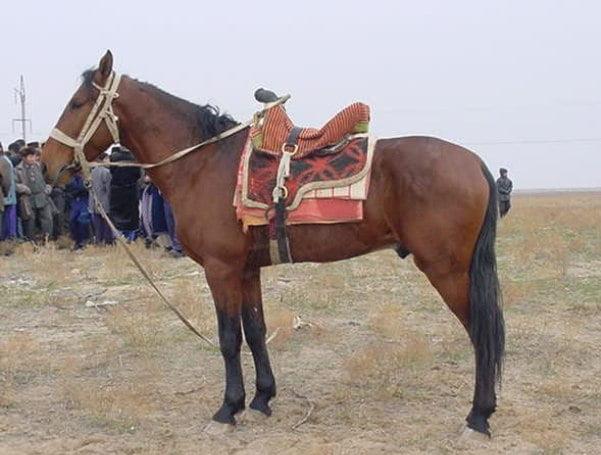
People usually start searching for the Karabair when they’ve seen the name in a breed list, a studbook, or a sales ad—and quickly notice the descriptions don’t agree. One source places it in Russia, another in the Middle East, and the colours and height can shift from paragraph to paragraph.
The Karabair is a Central Asian breed, developed chiefly in Uzbekistan and northern Tajikistan. What follows sticks to verifiable breed references, clears up the common mix-ups, and keeps the focus on what a Karabair is actually like to live with and ride.1, 2
Karabair horse at a glance
- Region of origin: Central Asia (especially Uzbekistan and northern Tajikistan)1, 3
- Typical height: around 151–156 cm at the withers (about 14.3–15.1 hands), with stallions averaging taller than mares3, 4
- Common colours: bay, chestnut, grey, black3
- General type: a practical “saddle-and-harness” horse—compact, agile, built to work and keep going3
History and origin
The Karabair is a long-established breed from Central Asia, shaped where desert-type horses from the south met tougher steppe horses from the north. Over generations, this produced a horse suited to long travel, variable feed, and hard ground—useful under saddle and in harness, and closely tied to local horse culture.1, 2
The breed is particularly associated with Uzbekistan and northern Tajikistan, where it has been recorded in formal breeding and population reporting.1
Physical characteristics
Karabairs are generally medium-sized, with a workmanlike outline rather than extreme refinement. Descriptions in breed references tend to agree on a clean, medium head (often straight to slightly convex in profile), a medium-to-long neck set fairly high, a short, strong back, and strong legs with visible tendons.2, 3
Heights vary by sex and by the population measured. One widely cited studbook-based set of averages lists stallions at about 156 cm and mares about 151 cm at the withers.3
About that “black and white” claim
The Karabair is not defined by black-and-white colouring. Standard references describe common coat colours as bay, chestnut, grey and black; pinto patterns are not typically treated as a breed hallmark.2, 3
Temperament and behaviour
Most breed descriptions present the Karabair as lively and responsive, with the steadiness you’d expect from a horse developed for daily work and long distances. As with any breed, temperament still depends heavily on handling, feeding, pain, workload, and the individual horse.2
Uses and abilities
The Karabair is valued for versatility. It has been used as a riding and driving horse, and it performs well in local equestrian sports in its home region. Endurance is a recurring theme in breed references, with documented performance in long rides and in harness work with substantial loads.3, 4
What it tends to suit
- trail and station-style riding where sure-footedness and stamina matter
- general riding club work (when trained and conditioned appropriately)
- driving/harness, particularly for steady work rather than high-knee show action2, 3
Breeding and genetics
Breed references describe several intra-breed types (commonly given as basic, heavy, and saddle), reflecting different selection pressures for load, speed, and general usefulness. These distinctions can blur over time, especially where demand shifts and breeding goals change.2, 3
Training and handling
A Karabair responds best to calm, consistent handling and clear aids. Keep early sessions short, build fitness gradually, and treat “lively” as information: it can be energy, confusion, pain, or simply a horse that has not yet learned to balance itself in the job you’re asking for.
For any horse used in regular work, the quiet fundamentals matter more than breed name—teeth, saddle fit, feet, forage, and progressive conditioning. When those are steady, training becomes much more straightforward.
Health and care notes
Older breed summaries note that, under poor feeding conditions, some Karabairs showed underdeveloped knee joints or cow-hocked hind legs. In practice, this reads less like a “breed defect” and more like the visible signature of nutrition, growth management, and workload—especially in young stock.3
Popularity and conservation status
The draft you provided described the Karabair as “vulnerable” on the IUCN Red List. That’s not how livestock breeds are typically assessed by the IUCN, and the Karabair is not commonly presented there as a threatened wild species.
In contrast, livestock-focused sources report the Karabair’s risk status as “not at risk” (FAO, 2007), and population figures reported for Uzbekistan have been substantial.1, 4
Common mix-ups: Karabair vs similar names
The name is often confused with other breeds that sound similar. Two common mix-ups:
- Karabakh horse: a different breed associated with Azerbaijan, with its own history and conservation concerns.5
- Karachay horse: a different breed from the Northern Caucasus region of Russia.6
Famous Karabair horses in history and culture
Claims such as Queen Victoria owning a “Karabair” called Black Beauty, and that horse being buried at Windsor Castle, don’t hold up. Black Beauty is best known as the fictional horse in Anna Sewell’s 1877 novel, not a documented royal Karabair.7
Final thoughts
The Karabair is a Central Asian working breed: medium-sized, adaptable, and bred for useful movement and staying power rather than ornament. If you’re considering one, judge the individual—soundness, handling, feet, and training history—then let the breed background fill in the likely strengths: durability, practicality, and a forward way of going.1, 3
References
- Karabair (breed overview and distribution)
- Oklahoma State University – Karabair Horses
- FAO/UNEP (1989) – Animal Genetic Resources of the USSR: Horses (Karabair section and measurements)
- FAO/UNEP (1989) – Animal Genetic Resources of the USSR (publication record)
- Karabakh horse (distinct breed)
- Karachay horse (distinct breed)
- Encyclopaedia Britannica – Black Beauty (novel by Anna Sewell)

Veterinary Advisor, Veterinarian London Area, United Kingdom