
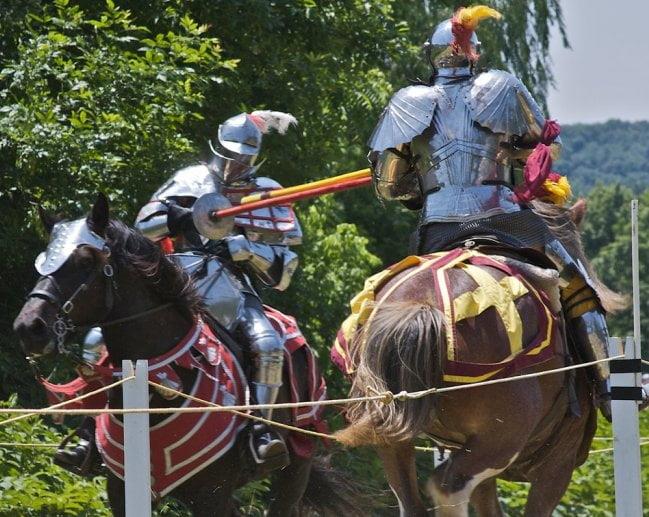
Most people come looking for jousting because they’ve seen it at a festival, a museum tournament, or on screen—and want to know what’s real. Is it a sport with rules, or a staged show? Is it actually dangerous? And what does “modern jousting” even mean when horses, armour and lances are involved?
Jousting sits at a crossroads of history, horsemanship and controlled impact. The details matter: the kind of lance, how the pass is judged, what safety kit is used, and whether the event is competitive or choreographed. The sections below keep it practical and grounded, with enough history to make sense of what you’re watching (or considering trying).
What jousting is (and what it isn’t)
A joust is a mounted contest where two riders charge one another with levelled lances, each aiming to strike the opponent cleanly—often with the traditional goal of unhorsing, though many formats score controlled hits instead.1 Historically, the joust grew out of the broader medieval tournament culture, which also included group mock battles (mêlées). Over time, the joust became the headline event and later fell out of favour in Europe by the early 1500s.1
Modern jousting can mean a few different things:
- Competitive jousting with scoring and marshals (the closest descendant of tournament “tilting”).
- Demonstration jousting designed for education and spectacle, sometimes with scripted outcomes.
- Skill-based ring jousting (“tilting at the ring”), where a rider spears small rings at speed rather than striking another rider.1
A short, accurate history of jousting
In medieval western Europe, tournaments were military games: training, status display, and public entertainment braided together. Early tournaments centred on mêlées—mass mock battles between groups of mounted men—while the one-on-one joust became increasingly prominent later on.2
By the later Middle Ages, the joust had become a specialised discipline with dedicated equipment and formal “lists” (the enclosed ground where the contest took place). Jousting declined as warfare, fashion and court culture changed, and by the beginning of the 16th century it had largely lost its central place in elite sport and ceremony.1
How modern competitive jousting is typically run
There isn’t one universal rulebook for all modern jousting. Some organisations operate more like umbrella networks: event organisers set their own rules, scoring and safety requirements, rather than following a single global standard.3 That means “jousting” can look quite different from one arena to the next.
Still, a few features are common in competitive formats:
- A straight track where riders make repeated passes, often separated by a central barrier (sometimes called a tilt rail) to help keep horses on line.
- Marshals and judges positioned to see strikes clearly and score consistently.
- Scoring for quality of hits rather than simply trying to unhorse every time.
One published modern scoring example (based loosely on a 15th-century English ruleset) awards different points depending on where a lance breaks on impact, with low strikes disallowed and head strikes controlled by pre-agreed rules.4 The underlying idea is familiar: reward precision and control, not chaos.
What “winning” looks like
In many competitive settings, the winner is decided by points for clean, rule-compliant strikes and controlled breaks, with penalties for dangerous or disallowed hits. Unhorsing can still end a pass or a bout in some formats, but it is not the only measure of skill in modern competition.4
Equipment: armour, lances and horses
Jousting is often described as “armour and lances”, but the quiet work happens underneath: fit, balance and repetition. Armour must protect without locking the rider into stiffness, and the horse must tolerate noise, sudden movement and the pressure of riding straight at a closing target.
Armour
Historically, tournament armour could be highly specialised. In modern jousting, armour choices vary with the ruleset and level of contact, but the same principle holds: it’s protective equipment first, costume second.
Lances
Modern events typically use lances designed to reduce piercing risk and manage how force is delivered. Exactly how that’s done depends on the organiser (materials, tips, intended break points, shield targets), which is another reason rules matter as much as spectacle.3
Horses
A jousting horse needs straightness, responsiveness and calm exposure to unfamiliar sights and sounds. Training focuses on staying in a lane, accepting armour movement, and holding rhythm through the run-up and impact moment.
Safety and risk: what’s actually changed
Jousting is inherently high risk: speed, height, impact and animals all in the same frame. Modern jousting reduces risk through rule design, protective equipment, controlled lance construction, and structured event management. It does not remove the risk.
Even outside jousting, mainstream equestrian sport treats protective headgear as non-negotiable in many competition settings. Equestrian Australia’s general regulations, for example, require approved helmets (with the chin strap fastened) in EA competitions unless a sport rule allows otherwise, and recommend an approved helmet when riding at any time.5
A practical safety check before you watch or participate
- Ask whether it’s competitive or choreographed. A good event will tell you plainly.
- Look for clear rules and trained officials. Scoring criteria, penalties and stops should be defined.3
- Check protective headgear and standards. In Australia, EA publishes current approved helmet standards and markings; use that as a baseline if you’re riding at an organised event.5
- Don’t treat “historic” as a safety standard. Authentic-looking kit can still be poorly protective if it’s badly designed or badly fitted.
Women in jousting
Women participate in modern jousting across different circuits and formats, and you’ll increasingly see mixed-gender fields at contemporary events. Because rulesets differ widely between organisers, the most meaningful indicator of inclusion is simple and observable: whether an event’s entry requirements, safety standards and judging criteria are written and applied consistently for all competitors.3
Jousting today: where you’ll actually see it
Modern jousting appears in three main places: heritage venues, festivals, and specialist equestrian groups. One example on the public calendar is the Royal Armouries Museum in Leeds, which runs an advertised “International Jousting Tournament” event with multiple teams competing over set dates (3–6 April 2026).6
Events like this often sit beside talks, demonstrations and “have-a-go” activities—useful if you want context, not just noise and splinters.6
Jousting in films and fairs: what to enjoy, what to question
Popular culture tends to compress jousting into a single idea: two riders, one impact, one decisive fall. Real tournaments—historical and modern—are usually more repetitive and more technical. The drama is built from small differences in line, timing and strike placement, and from the discipline required to do it again and again without losing control.4
The future of jousting
Jousting’s modern revival is less a single movement than a patchwork: heritage institutions presenting competitive weekends, specialist organisations coordinating communities, and local event organisers writing rules that fit their horses, riders and risk tolerance.3 The sport’s shape will keep changing for the same reason it changed before—because equipment, audiences and safety expectations keep moving.
References
- Encyclopaedia Britannica – “Joust”
- Encyclopaedia Britannica – “Tournament (medieval military games)”
- Joust.US – FAQ (International Jousting League approach to event rules)
- Destrier – “Real Tournament” (example modern scoring system based on historical rules)
- Equestrian Australia – Current approved safety standards for helmets
- Royal Armouries – International Jousting Tournament (event listing)

Veterinary Advisor, Veterinarian London Area, United Kingdom