
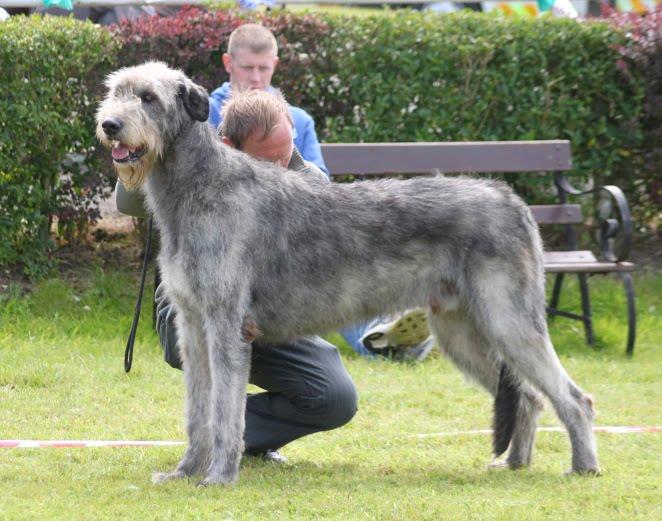
People usually look up the Irish Wolfhound when they’re weighing up a giant-breed dog: how big they really get, what they’re like to live with day to day, and what the health trade-offs are. Size is the obvious headline, but the quieter reality is cost, space, handling, and a short lifespan that can catch first-time owners off guard.
Below is a clear, practical profile: typical height and weight, temperament, exercise that suits a fast-growing giant, and the health risks that matter most—especially bloat (GDV), heart disease, and bone cancer.1, 2
Irish Wolfhound at a glance
- Size: Giant. Breed standards set a minimum of 79 cm (dogs) and 71 cm (bitches) at the shoulder; many adult males average around 81–86 cm.1
- Weight: Breed standard minimums are 54.5 kg (dogs) and 40.9 kg (bitches). Individuals vary widely.1
- Coat: Rough and harsh on body, legs and head; especially wiry and long over the eyes and under the jaw.1
- Colours: Grey, brindle, red, black, white, fawn, wheaten and steel grey are recognised in the standard.1
- Temperament: Typically gentle, kind and friendly; calm at maturity, but still a large, physical youngster for a long time.1, 2
- Energy level: Often moderate rather than “high-drive” in the home—yet they still need daily movement and room to stretch out safely.4
- Lifespan: Commonly around 6–8 years, with some sources placing the average closer to ~7–7.5 years.4, 5
- Known health risks: Bloat/GDV, heart disease (including dilated cardiomyopathy), and cancers (notably osteosarcoma) are major concerns in the breed.5, 6
History and origin
The Irish Wolfhound is an ancient Irish sighthound type, historically valued for hunting large game (including wolves) and for its sheer presence. Modern Irish Wolfhounds were shaped through organised revival and standard-setting in the late 1800s, with breed clubs established in 1885 and an early standard formalised soon after.7, 8
Physical characteristics
In motion, the breed should look easy and active rather than lumbering: long legs, deep chest, and a stride built for covering ground. The head is long, the ears are small and rose-shaped, and the coat sits rough and weatherproof over a lean, muscular frame.1
It’s worth correcting a common mix-up: Irish Wolfhounds are often described as “up to 32 inches”, but the breed standard sets 31 inches (79 cm) as the minimum height for males, with an expressed desire for many adult males to average 32–34 inches (81–86 cm).1
Temperament and personality
At their best, Irish Wolfhounds are quiet company—gentle, kind, and socially steady. Many are reserved at first meeting, then settle once the household rhythm is familiar. Their size does most of the talking; the temperament shouldn’t.1, 2
They’re not generally suited to serious guarding work. Breed organisations note that, while they can be alert, they are not meant to be suspicious or aggressive, and should not be relied on as a protection dog.2
With children, they’re often tolerant, but supervision matters for simple physics: a young Wolfhound can knock a child over without meaning to, especially during the long, awkward adolescent phase.2
Training and exercise
Training is less about tricks and more about manners that keep everyone safe: walking on a loose lead, calm greetings, reliable recall in appropriate areas, and comfort with handling (feet, ears, mouth) for grooming and vet visits. Positive reinforcement and consistency suit the breed’s typically sensitive nature best.2
Exercise needs change sharply with age. Adult Wolfhounds do well with daily walking plus regular opportunities for safe, free movement—short, natural bursts rather than endless forced running. A long “power walk” every day is not automatically better, especially in heat.3
Puppies: go gently
Wolfhound puppies grow fast, and their joints and soft tissues are working overtime. Guidance from breed-care resources stresses avoiding formal, forced exercise when very young and focusing on free play, rest, and gradual lead-walking as the pup matures.3
- Avoid repetitive high-impact activity and long forced runs, especially on hard surfaces.
- Don’t “march” a growing pup at a child’s pram pace for long stretches—an unnatural stride can place stress through a developing body.3
- Build calm habits early: settle on a mat, wait at doors, and polite lead-walking before their strength arrives.
Health issues and care
The Irish Wolfhound can be robust in day-to-day life, but the breed carries a small set of serious, life-limiting risks. If you’re choosing a puppy, it’s worth treating health screening and breeder transparency as non-negotiable—not because problems are guaranteed, but because the consequences can be severe and fast-moving.5
Bloat (GDV): the emergency to know by name
Irish Wolfhounds are deep-chested, and GDV (gastric dilatation-volvulus) is a real risk. It’s an emergency that can deteriorate quickly and needs immediate veterinary treatment.5
- Common warning signs: sudden abdominal swelling, repeated unproductive retching, restlessness, drooling, collapse.
- What to do: treat it as urgent—go straight to an emergency vet. Don’t wait to “see if it passes”.5
Heart disease (including dilated cardiomyopathy)
Heart disease is among the major causes of death reported in the breed. Some wolfhound-specific health guidance recommends routine screening (often annually after around age two) so problems can be detected earlier, when treatment may be more effective.5
Cancer risk (especially osteosarcoma)
Large-breed cancer is one of the hard truths of the Irish Wolfhound. Reported mortality data and breed health libraries repeatedly identify cancer—particularly osteosarcoma—as a leading cause of death.5, 6
Hips, elbows and eyes
Orthopaedic and eye issues can occur. Breed health resources commonly recommend screening breeding dogs for hips, elbows, heart, and inherited eye problems, even when some conditions are described as “not common”.5
Grooming
The rough coat is functional rather than fancy, and routine care is mostly about preventing tangles and keeping skin healthy. A thorough brush a few times a week, plus occasional hand-stripping or tidy-ups as needed, usually keeps them comfortable. Pay attention to the beard and feet: they collect the outdoors with quiet efficiency.1
Living conditions: space, heat, and the practical reality of “giant”
Wolfhounds can be surprisingly calm indoors once mature, but they take up physical space even when asleep. That means wide walkways, a big resting spot, and a car they can enter and exit without awkward lifting. Apartment living can work for some households, but only if daily exercise and handling are genuinely manageable—and neighbours are tolerant of a very large dog using shared lifts and corridors.
Heat needs respect. Giant breeds can overheat, and wolfhound-care guidance cautions against exercising in the heat of the day. Early morning and evening outings are safer in warm weather, with shade and water always available.3
Owning an Irish Wolfhound: clear pros and cons
Pros
- Typically gentle, calm companion at maturity.1, 2
- Striking presence without a matching need for constant high-intensity activity.2, 4
- Coat is generally straightforward to maintain with steady brushing.1
Cons
- Short lifespan is common for the breed, and loss can come sooner than many owners expect.4, 5
- Higher risk of serious conditions (GDV/bloat, heart disease, cancer).5, 6
- Cost and logistics scale up: food, medication dosing, bedding, transport, and the simple fact that a “small problem” can be physically difficult to manage.
- Long adolescent period: they may look grown before their body and judgement have properly finished developing.3
Final thoughts
The Irish Wolfhound is built like a landmark and often behaves like quiet weather—present, steady, hard to ignore. For the right home, that calm heft is the point. For the wrong one, the same traits become strain: handling challenges, vet bills, and a lifespan that asks you to love decisively, without assuming time is plentiful.2, 5
References
- The Kennel Club (UK) – Irish Wolfhound breed standard
- Irish Wolfhound Club of America – About Irish Wolfhounds
- IrishWolfhounds.org – The care of your Irish Wolfhound (exercise, grooming & training)
- PetMD – Irish Wolfhound: Dog breed health and care
- Irish Wolfhound Foundation – General health
- Irish Wolfhound Club of America – Longevity in the Irish Wolfhound (1966–1986)
- Irish Wolfhound Club of Ireland – Homepage / club background
- Irish Wolfhound Club (UK) – About us (club established 1885)

Veterinary Advisor, Veterinarian London Area, United Kingdom