
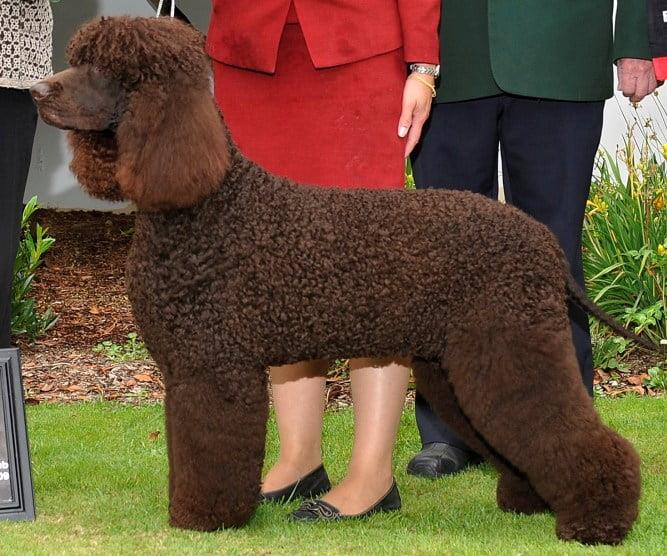
People usually start looking up the Irish Water Spaniel when they’re weighing up a curly-coated “water dog” for an active home — or trying to confirm the basics: size, coat colour, exercise needs, grooming, and what health checks matter before committing to a pup.
This breed can be a steady, capable companion, but only if its daily movement, training, and coat care are taken seriously. Here’s the plain-detail overview: what an Irish Water Spaniel is like to live with, what’s typical (and what’s marketing), and what to watch for in Australia.
Irish Water Spaniel at a glance
- Height: Dogs 53–58 cm; bitches 51–56 cm at the withers.1, 2
- Weight: Commonly around 25–31 kg for males and 20–26 kg for females (roughly 55–68 lb and 45–58 lb).3
- Coat: Dense, tight curls with natural oiliness; shaped trimming is often used to keep it workable and clean.3, 4
- Colour: Rich liver to dark liver with a distinctive purplish tint (often described as “puce liver”).1, 2, 3
- Signature features: A pronounced topknot of curls and a mostly smooth “rat tail” (hair at the base, then tapering smooth).3
History and origin
The Irish Water Spaniel was developed in Ireland as a water-loving gundog, valued for working hard in cold, wet places and bringing game back through reeds and mud. Its deeper origins are debated, but modern breed history is often linked to influential mid-19th-century dogs, including one called Boatswain, associated with breeder Justin McCarthy.5
Despite the “spaniel” name, it’s commonly described as working more like a retriever in the field — particularly when the job is swimming out, finding fallen game, and returning it cleanly to hand.5
Physical characteristics
An Irish Water Spaniel is a medium-to-large, strongly built dog with a barrel-shaped rib cage and the kind of muscle you’d expect in a swimmer. The coat is functional rather than decorative: dense curls that shed water, with a natural oiliness that helps in wet conditions.3, 6
The “rat tail” is not a gimmick. It’s written into breed standards as a defining characteristic — thick at the root with short curls, then tapering and smooth to the end.3
Temperament and day-to-day personality
This is an alert, active breed with a streak of independence. Many are affectionate with their own people, sometimes a little reserved with strangers, and best when they have a steady routine and a reason to use their brain.3, 6
They tend to suit homes that enjoy training, outdoor time, and wet-weather walks. Without enough movement and mental work, they can become restless — not “naughty”, just under-occupied in a body built to do things.
Training and exercise needs
Irish Water Spaniels usually respond best to calm, consistent training with rewards and clear boundaries. Heavy-handed methods tend to backfire in smart, independent dogs.
Exercise needs are high. Many adults do best with at least an hour daily, often more, plus short training or puzzle-style work to stop the mind from idling.6, 7
- Good outlets: brisk walks, off-lead running in safe areas, retrieving games, scent work, and swimming where it’s safe and allowed.
- Water sense: strong swimmers, but still supervise around rivers, surf, and dams (currents, blue-green algae, hooks, and exhaustion can catch any dog out).
Grooming and routine care
The coat is practical in the field and surprisingly demanding in the house. Because shed hairs can stay caught in the curls, mats can form quietly — especially behind ears, in armpits, and around the collar line.4
- Brushing/comb-through: more than once a week is typical; more often if the dog swims, runs through scrub, or wears coats/harnesses frequently.7
- Trimming: many owners book regular scissoring/clipping to keep the coat neat and to reduce matting and debris build-up.4
- Ears: check and dry after swimming; long, curly ear leather can trap moisture, so ear care matters for comfort and infection prevention.4, 8
Health concerns and life expectancy
Life expectancy is often reported around the low teens, with many sources commonly quoting roughly 10–13 years (individual outcomes vary with genetics, weight, exercise, and veterinary care).8, 9
Like many medium-to-large gundogs, Irish Water Spaniels can be predisposed to joint issues such as hip dysplasia, and some lines may also see elbow dysplasia.8, 6
Ear infections are also a known practical issue, especially in dogs that swim frequently or have ears that stay damp after a run through wet grass.4, 8
Practical checks before choosing a puppy
- Ask what health screening is done in the breeding program (hips and elbows are common schemes in many gundog breeds).6, 7
- Meet at least one parent dog if possible, and look for steady, workable temperament rather than frantic friendliness or shut-down fear.
- Be realistic about coat upkeep: if regular grooming feels like a chore on paper, it won’t improve in winter.
Irish Water Spaniel as a working dog
This breed is best understood as a water retriever in spaniel clothing — built for wet, cold work, able to push through cover, and happy to repeat the same retrieve until the job is finished.5
Even if you never plan to hunt, that working design still shows up at home: they often thrive when they can retrieve, swim, track scents, and learn new tasks, rather than just doing a lap of the block.
Irish Water Spaniel as a companion
In family life, the Irish Water Spaniel tends to do best with people who like an active dog close by — not necessarily on your lap, but in the same orbit, watching, waiting, ready for the next outing. With early socialisation and consistent training, many become relaxed, enjoyable housemates who switch off more easily after they’ve had real exercise and a little thinking work.6, 9
Final thoughts
The Irish Water Spaniel is not a low-effort pet. It’s a capable, athletic dog with a coat that needs attention and a brain that notices everything. In the right hands — steady training, plenty of movement, regular grooming — it can be a loyal, distinctive companion that looks most at ease when there’s water nearby and something worth retrieving.
References
- Dogs Victoria (ANKC) – Irish Water Spaniel breed standard
- The Kennel Club (UK) – Spaniel (Irish Water) breed standard
- Irish Water Spaniel Club of America – Official breed standard
- VCA Animal Hospitals – Irish Water Spaniel (care, grooming, common health concerns)
- The Kennel Club (UK) – Irish Water Spaniel breed information (history and working style)
- Purina UK – Irish Water Spaniel breed information (temperament and health schemes)
- The Kennel Club (UK) – Spaniel (Irish Water) breed characteristics (exercise, grooming)
- PetMD – Irish Water Spaniel (health issues and care)
- WebMD – What to know about Irish Water Spaniels (overview and lifespan range)

Veterinary Advisor, Veterinarian London Area, United Kingdom