
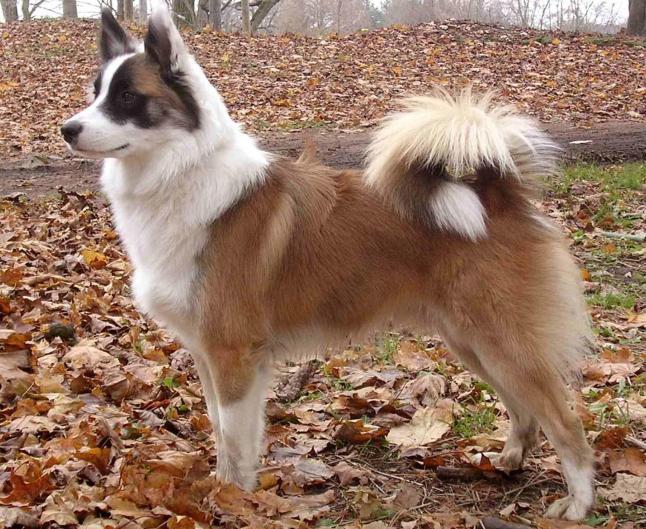
People usually start looking up the Icelandic Sheepdog when they’re weighing up a pup that can keep pace with an active household, handle cool weather, and still settle into family life without being too sharp or suspicious. It’s a small-to-medium herding spitz from Iceland: quick on its feet, bright, and famously vocal.
The details matter. Size, coat type, and the breed’s natural tendency to bark can be the difference between an easy fit and a daily grind. Here’s a clear, grounded guide to what the Icelandic Sheepdog is like to live with, what they need, and what to ask before you commit.1, 2
Breed name: Icelandic Sheepdog
Size: Slightly under medium; ideal height about 46 cm (dogs) and 42 cm (bitches)1, 2
Weight: In proportion to height (commonly around 9–14 kg, depending on sex and build)3
Coat: Double coat; thick and very weather-resistant; short- and long-coated varieties1, 2
Colour: Fawn/red shades, grey shaded, chocolate, black; typically with white markings (including pied patterns)1
Temperament: Cheerful, friendly, inquisitive and alert; typically greets visitors enthusiastically without aggression; barking is part of the breed’s working style1, 4
Life expectancy: Commonly around 12–15 years3
Health concerns: As with many breeds, orthopaedic and eye issues can occur; responsible screening matters5
Exercise needs: Moderate-to-high; daily movement plus mental work suits them best2
Training needs: Moderate; tends to respond well to consistent, reward-based training and plenty of engagement4
History and origin
The Icelandic Sheepdog is Iceland’s native herding dog, shaped by long days moving stock across rough ground, and a life spent close to farms and people. Breed histories commonly link their arrival to early settlers, and modern breed standards still describe a tough, agile herding spitz built to work in challenging conditions.1, 2
Physical characteristics
This is a rectangular, slightly under medium-sized dog with prick ears and a curled tail carried over the back. The overall look is spitz-like: alert, light on the feet, and ready to move, with a coat built to shed weather rather than soak it up.1, 2
Coat and shedding
There are two coat types (short and long), both with a thick undercoat and a coarser outer coat. “Low-shedding” doesn’t really apply here: the coat is designed to renew itself, and many dogs will drop heavily at least seasonally. Regular brushing keeps the undercoat from packing down and helps you spot skin issues early.1
Colour
Dogs Australia’s breed standard allows a wide range of colours, typically with white markings. Grey-shaded and red/fawn dogs may show dark overlay or a mask; black and chocolate dogs often carry tan points.1
Temperament: what they’re like at home
The Icelandic Sheepdog is commonly described as cheerful, friendly, inquisitive and unafraid. They’re usually social with people, but they are also naturally alert and quick to announce changes in their environment—one reason they can feel “busy” in a quiet suburban house if their needs aren’t met.1, 4
Barking: the trait most people underestimate
Breed standards explicitly note barking as a working feature. In practice, that can mean:
- They may “comment” on visitors, movement along the fence line, and unfamiliar sounds.1
- They often need calm, consistent training around door manners and boundary arousal, not harsh corrections.4
Training and exercise needs
An Icelandic Sheepdog typically does best with daily exercise that uses both body and brain. Long, repetitive runs aren’t the only answer; they often thrive on variety—walking, sniffing time, short training sessions, and play that mimics their natural “move and monitor” style.2
What “enough” activity often looks like
- A decent daily walk plus some off-lead time where safe and legal.
- Short, frequent training sessions (recall, loose-lead walking, settle on a mat).
- Enrichment that slows them down: scent games, scatter feeds, puzzle toys.
They’re smart and generally willing, but can be easily distracted by movement and sound. Reward-based training and clear routines suit the breed’s quick, watchful attention.4
Grooming and care
The coat is weatherproof, not dirt-proof. Plan on brushing at least weekly, and more during heavy sheds, to lift dead undercoat and reduce matting behind the ears, around the neck ruff, and through the feathering on long-coated dogs.1
Bathe as needed rather than on a strict schedule. Over-bathing can strip oils that help the coat repel water, while under-grooming can trap moisture against the skin.
Health concerns and common medical issues
No breed is “problem-free”. The practical goal is to understand the patterns seen in dogs generally, then choose a breeder (or rescue dog) with transparent screening and a track record of soundness.
Hip dysplasia (and why weight matters)
Hip dysplasia is a developmental condition where the hip joint doesn’t form tightly, which can lead to osteoarthritis over time. Signs can include stiffness, reduced willingness to jump, or lameness that’s worse after exercise. Management often includes weight control, tailored exercise, and veterinary-guided pain relief; some cases require surgery.5
Eye conditions
Progressive retinal atrophy (PRA) is one example of an inherited eye disease seen across dog breeds. It involves degeneration of the retina and can progress to vision loss. For prospective owners, the most useful step is to ask what eye testing the parents have had and whether results are available in writing.6
Icelandic Sheepdogs in popular culture and media
This breed is occasionally mentioned in media and breed features, but it’s not a fixture of film and television in the way some working breeds are. If you’ve seen claims linking the Icelandic Sheepdog to specific major productions, treat them as trivia unless there’s a reliable source attached.
Finding and choosing the right Icelandic Sheepdog
The best match is usually made before you meet the puppy: it’s a decision about your household rhythm.
Quick fit check
- Noise tolerance: Are you prepared to train and manage a dog that naturally barks as part of its “job”?1
- Time budget: Can you provide daily activity and ongoing training, not just weekend exercise?2
- Coat reality: Are you comfortable with seasonal shedding and regular brushing?1
Questions worth asking a breeder or rescue
- What health screening is done on the parents (hips, eyes), and can you provide documentation?
- What are the adults in your line like in everyday life (barking level, sociability, reactivity to noise)?
- How are puppies raised in the first 8–10 weeks (handling, surfaces, sounds, visitors)?
Final thoughts
The Icelandic Sheepdog is a compact working dog with a big presence: bright-eyed, weatherproof, and tuned to movement in the environment. In the right home—one that expects a talkative herder and enjoys daily engagement—they can be steady, affectionate companions with plenty of spark.1, 4
References
- Dogs Australia (ANKC) breed standard: Icelandic Sheepdog
- Icelandic Sheepdog Association of America: Official AKC breed standard (text)
- United Kennel Club (UKC): Icelandic Sheepdog breed standard (size guidance)
- American Kennel Club: A Comparison of Standards (Temperament) – Icelandic Sheepdog
- Merck Veterinary Manual (Pet Owner Version): Hip dysplasia in dogs
- Merck Veterinary Manual: Progressive retinal atrophy (PRA) in small animals
- The Kennel Club (UK): Icelandic Sheepdog granted recognition (effective 1 April 2025)
- Icelandic Sheepdog Association of America (ISAA): breed information

Veterinary Advisor, Veterinarian London Area, United Kingdom