
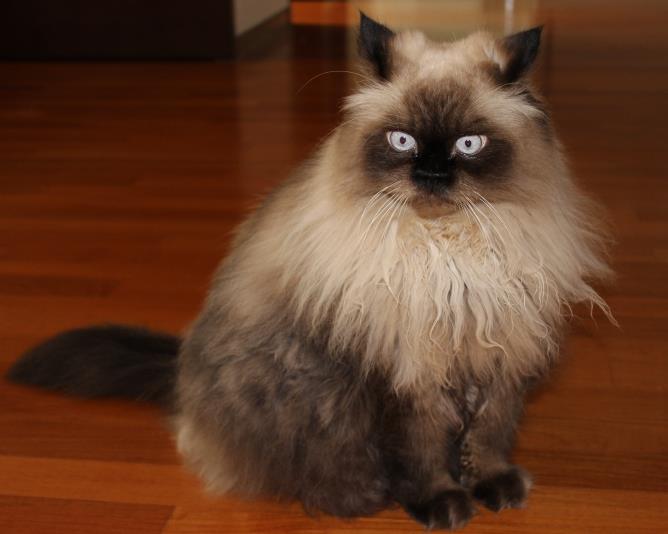
People usually start searching “Himalayan cat” when they’re weighing up a kitten, trying to identify a long-haired colourpoint cat, or working out whether that sweet flat face comes with extra care. The answer is yes: the Himalayan look is closely tied to daily grooming, eye care, and some predictable health risks.
The Himalayan is essentially a Persian-type cat with Siamese-style “points” and blue eyes, bred deliberately by crossing Persians and Siamese lines. What you see on the outside (coat, face shape, tear staining) often dictates what you’ll manage at home (brushing, cleaning, breathing comfort), so it pays to know the practical details before you fall for the coat and eyes.1, 2
Quick facts (at a glance)
- Size: Medium to large (often looks larger because of the coat)1
- Weight: Commonly around 3.5–6.5 kg (varies by sex and line)6
- Coat: Long, dense, with a heavy undercoat that mats easily if neglected1
- Colour and eyes: Colourpoint pattern with blue eyes (darker “points” on face/ears/legs/tail)1
- Temperament: Typically quiet, gentle, affectionate, more “lounging” than leaping1
- Common health concerns: Brachycephalic (flat-faced) issues, dental crowding, watery eyes/eye disease risk; PKD is an important inherited risk in Persian-group cats2, 3, 7
History and origin
The Himalayan was developed by crossing Persian and Siamese cats to combine a Persian body and coat with the Siamese-style colourpoint pattern and blue eyes.1
Breed recognition and naming varies by cat registry. In the UK, the GCCF recognised the long-haired colourpoint type in the mid-1950s, and in the US the Himalayan gained recognition in the late 1950s with major fancier associations (though some registries treat it as a Persian colour variety rather than a separate breed).1, 4
Physical characteristics and appearance
At first glance, a Himalayan reads as a Persian in silhouette: a compact, sturdy body under a long, flowing coat, with a rounded head and small ears sitting low and wide. The colourpoint pattern adds contrast—darker “points” on the face mask, ears, legs and tail—set against a lighter body colour, with blue eyes as part of the colourpoint package.1
The face shape is where owners notice day-to-day consequences. Many Himalayans have a shortened muzzle (brachycephaly), which is linked with watery eyes and a higher risk of breathing, dental and eye problems—especially in cats with more extreme “flat-faced” conformation.2, 3
Personality and temperament
Most Himalayans are calm indoor companions. They tend to be gentle, quiet, and people-focused without being frantic about attention. Some individuals are more talkative than others, but the breed’s reputation is for a soft voice and an unhurried pace—long stretches of stillness punctuated by short bursts of play.1
They usually do best in a steady household where handling is kind and routines are predictable. Like any cat, temperament is shaped by early socialisation, environment, and individual personality, not breed alone.
Grooming and care
A Himalayan coat is beautiful because it is dense. That density is also what knots, mats and felted clumps are made of. Daily combing is the realistic baseline for most cats, especially around friction areas (under the arms, behind the ears, along the ruff, and the belly). Skipping a week can turn grooming into a painful dematting session.1, 5
Simple grooming routine
- Comb daily: Use a metal comb that reaches the undercoat, then finish with a brush if needed.1, 5
- Check eyes daily: Flat faces commonly mean tear overflow; gentle wiping helps prevent staining and skin irritation.1, 5
- Trim nails: Regular trims reduce snagging in long coat and bedding (frequency varies by cat).1
- Teeth care: Crowding and dental disease are common concerns in flat-faced breeds, so ask your vet about home dental care and professional checks.2, 3
Food, weight and the indoor setup
Himalayans are not typically endurance athletes. They often prefer gentle play and comfortable resting spots, so it’s easy for weight to creep up if food portions don’t match activity. Build small daily play into the day—short wand-toy sessions, a few sprints down the hallway, puzzle feeders—and keep an eye on body condition rather than relying on the scales alone.1
Health concerns to understand before you buy
The Himalayan’s biggest health risks are closely tied to its Persian-type conformation. Not every cat will be affected, but the odds rise as facial features become more exaggerated.
Brachycephalic (flat-faced) problems
Shortened skull shape can be associated with ongoing welfare and health issues, including breathing difficulty, eye disease (from prominent eyes and poor tear drainage), and dental crowding. In Australia, animal welfare guidance notes that exaggerated features such as very flat faces can cause lifelong health problems in affected cats.2, 3
Polycystic kidney disease (PKD) and inherited risk
PKD is an important inherited disease seen in Persian-group cats. If you’re buying a kitten, ask what screening the breeder does and request written evidence of testing in the breeding lines where relevant. Your vet can also advise on what testing is appropriate for your individual cat.1, 7
When to seek a vet check promptly
- Noisy breathing at rest, repeated open-mouth breathing, or marked exercise intolerance (especially in warm weather)
- Persistent eye discharge, squinting, redness, or signs of pain around the eyes
- Bad breath, drooling, pawing at the mouth, or reluctance to eat (possible dental pain)
- Coat mats tight to the skin, skin redness under tear staining, or recurrent rashes
Training and exercise
Himalayans can learn household routines quickly, especially when you keep things quiet and consistent. Reward-based training (treats, praise, gentle repetition) works well for simple behaviours like coming when called, tolerating brushing, and calmly accepting eye cleaning. Keep sessions short; stop before your cat gets fed up.
For exercise, think in short scenes rather than long workouts: a minute of chasing a feather wand, then stillness again. That rhythm suits many Persian-group cats.1
Himalayan cats as family pets
In the right home, Himalayans are steady companions—usually affectionate, calm, and more interested in proximity than constant action. They often suit quieter households and indoor living, where coat condition, heat exposure, and eye hygiene are easier to manage.
They are not “low maintenance”, though. Their coat and face need regular hands-on care, and their breed type can come with health vulnerabilities that are expensive and stressful if ignored.2, 5
Breeding and showing
If you’re considering showing or breeding, work closely with a recognised cat club and an experienced mentor, and prioritise health screening and moderate conformation. Welfare guidance is clear that selecting for exaggerated flat faces can increase the risk of significant lifelong health problems, so breeding choices matter long after a ribbon is packed away.2, 3
Final thoughts
A Himalayan is a Persian-shaped cat wearing a colourpoint coat: plush, striking, and often quietly devoted to its people. It’s also a breed that asks for time—daily grooming, regular eye care, and thoughtful attention to breathing comfort and dental health. Choose a kitten (or adult rescue) for soundness and temperament first, and let the points and blue eyes be the bonus.
References
- The International Cat Association (TICA) – Himalayan breed information
- RSPCA Australia Knowledgebase – Health and welfare issues associated with exaggerated physical features in cats
- Universities Federation for Animal Welfare (UFAW) – Persian brachycephaly and associated welfare issues
- Himalayan cat – overview of breed classification and history (summary page)
- PetMD – Himalayan cat health and care (grooming, eye care)
- PDSA – Persian cat care (weight range and health risks relevant to Persian-group cats)
- PetMD – Persian cat health and care (brachycephalic-related care notes relevant to Persian-group cats)
- VetVoice (Australia) – Brachycephalic pets and heat/breathing risk

Veterinary Advisor, Veterinarian London Area, United Kingdom