
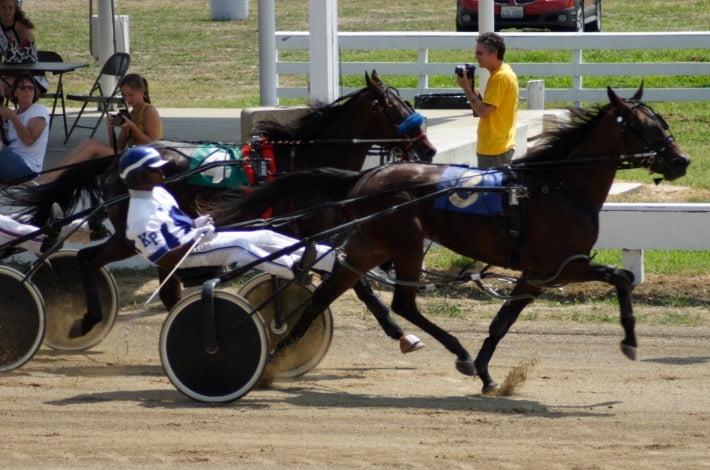
Most people look up harness racing in Australia because they’ve heard the term and want to picture what it actually is: a Standardbred horse holding a steady gait, a driver seated low in a lightweight sulky, and a race that can be won or lost on positioning as much as raw speed.1
It also matters to get the basics right. The rules around gait, starts, and interference shape every result, and they’re part of what keeps the sport credible for participants and punters alike.2
What harness racing is (and what makes it different)
Harness racing is run with Standardbred horses that pull a two-wheeled cart (a sulky, sometimes called a bike) carrying the driver. Unlike thoroughbred racing, the driver doesn’t ride on the horse’s back. The horse must race at a prescribed gait—either pacing or trotting—around an oval track, most often over distances from about one mile (1,609 metres) up to roughly 2,650 metres, depending on the event and venue.1
The feel of the contest is different, too. The field moves in a tight, elastic pack. Lanes are traded for runs. A good driver can turn a quiet, economical trip into a late opening that looks inevitable in hindsight.
How races are started and run
Australian harness races generally start in one of two ways:
- Mobile start: horses score up behind a moving barrier vehicle; the “wings” retract as the vehicle accelerates away.1
- Standing start: horses begin from a stationary position behind elastic tapes, often used when handicaps are applied.1
Most races are run anti-clockwise on tracks commonly in the 700–1,000 metre range. That smaller footprint means corners come often, and the cost of being three wide can be immediate and steep.1
The gait rules: pacing, trotting, and “breaking”
Standardbreds race in two gaits:
- Pacing: the legs on the same side move in unison; pacers make up the majority of Australian harness runners.1
- Trotting: the legs move in diagonal pairs.6
If a horse “breaks gait” (for example, into a gallop), the driver is required to take immediate action to restrain the horse back to its correct gait without gaining an unfair advantage and without causing interference. Stewards can penalise a break in gait by disqualification or by placing the horse in a lower finishing position, depending on what happened in the run.2
A short history of harness racing in Australia
Harness racing has been part of Australian sport for well over a century, growing from informal matches into organised meetings, specialised venues, and a calendar shaped by major series and state-based programs. The modern sport is administered nationally by Harness Racing Australia, with state principal racing authorities enforcing a shared rule set.1
One of the most enduring milestones is the Inter Dominion, first contested in 1936 and still treated as a defining test for elite pacers and trotters across Australasia.3
Major races people talk about
Inter Dominion
The Inter Dominion has been contested since 1936 and is run as a championship series for pacers and trotters. It rotates between Australian and New Zealand venues, and a strong Inter Dominion performance can define a horse’s reputation for years.3
Miracle Mile
The Miracle Mile is one of Australia’s best-known pacing races. It was inaugurated in 1967 and is now staged at Menangle Park Paceway, after being run for decades at Harold Park.4
A.G. Hunter Cup
The A.G. Hunter Cup is a long-running Victorian feature first held in 1949. It has moved venues over time and remains a major target for top-class pacers, especially those suited by sustained speed and pressure racing.5
Notable horses and people
Blacks A Fake
Few Australian Standardbreds have carried a record as distinctive as Blacks A Fake, the only four-time winner of the Inter Dominion Pacing Championship (2006, 2007, 2008 and 2010).7
Chris Alford
Driver milestones can be slippery because they keep moving, but one stands solid: Chris Alford reached 8,000 career wins on 7 February 2024—an extraordinary marker of longevity and consistency at the top level.8
Technology and equipment: what “modern” looks like
Today’s racing is still built on the same essentials—gait, balance, and pace—but the equipment around it has refined. Sulkies are designed to be light and efficient, and “mobile” barrier starts rely on purpose-built starting gates to create a fair, consistent release for the field.1
Even so, the sport remains stubbornly physical. A horse that can hold its gait under pressure, corner cleanly, and quicken without breaking is still the rarest kind of reliability.
Betting and responsible gambling
Wagering is closely tied to Australian harness racing culture, and it’s easy to be drawn in by frequent meetings, large fields, and the sense that a clever read can find value. If you do bet, set limits early and treat them as fixed; the most useful discipline is the one that happens before the first race is run.
Future prospects: what will shape the next decade
Harness racing’s future in Australia will likely be decided in familiar places: public confidence in welfare standards, the everyday health of regional and metro clubs, and the sport’s ability to keep its rules and integrity easy to understand from the outside. The fundamentals—gait, starts, and stewards’ scrutiny—will remain the spine of it.2
References
- Harness racing in Australia (overview: Standardbreds, sulkies, distances, starts, administration)
- Harness Racing Australia Rules (Drivers) — Rule 154–155 on breaking gait and penalties
- Inter Dominion (history and format; first contested 1936)
- Miracle Mile Pace (inaugurated 1967; race details)
- Hunter Cup / A.G. Hunter Cup (inaugurated 1949; event details)
- Temora Trotting Club — Harness racing terminology (trotter gait explanation; driver vs jockey)
- Blacks A Fake (four-time Inter Dominion champion)
- Harnesslink — Chris Alford reaches 8,000 career wins (7 February 2024)

Veterinary Advisor, Veterinarian London Area, United Kingdom