
People usually start looking up Hahn’s macaws when they’re deciding whether one will suit their home, or when they want to double-check care basics like space, diet, noise, and lifespan. With parrots, small details matter: the wrong cage set-up, a seed-heavy diet, or unsafe cleaning habits can quietly cause long-term health problems.
Hahn’s macaws (also called red-shouldered macaws) are the smallest of the macaws—compact, bright green birds with a confident voice and a busy mind. The notes below stick to the practical facts: what they’re like in the wild, what that means in captivity, and the everyday care that keeps them steady over decades.
Size: About 31 cm long1
Weight: Around 165 g (typical adult)1
Lifespan: Commonly around 30 years in captivity (some individuals may live longer with excellent care)1
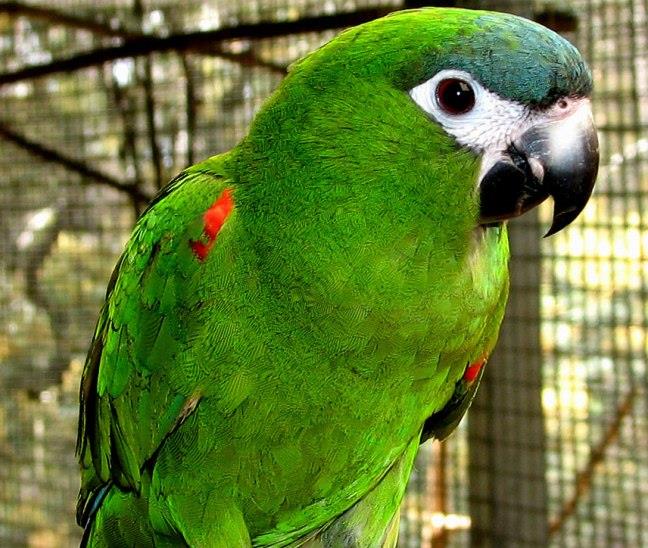
Colour: Mostly green; blue on wings and tail; red on the “shoulder”/wing edge (often more obvious with maturity)2
Diet: A formulated pellet as the staple, with vegetables and some fruit; nuts/seeds as small extras and training rewards3
Temperament: Alert, social, and quick to learn; needs daily interaction and enrichment to prevent boredom behaviours1
Noise level: Capable of sharp calls (especially at peak activity times), though typically less intense than larger macaws1
Cage size: Choose the largest you can fit; prioritise width for climbing and wing-stretching, and bar spacing suitable for a small macaw (ask an avian vet or experienced aviculturist if unsure)
Exercise: Daily supervised out-of-cage time and climbing/foraging opportunities4
Grooming: Nail and wing trimming should be guided by an avian veterinarian (over-trimming can cause injury and long-term problems)4
Meet the Hahn’s macaw
Hahn’s macaws are a subspecies of the red-shouldered macaw (Diopsittaca nobilis nobilis). They’re often described as “big macaw energy in a small body”: long-tailed, curious, and constantly testing perches, toys, and any latch within reach.1
They can learn words and sounds, but they’re not reliably “quiet talkers”. Their natural communication is more about calls and contact notes—short, clear sounds that travel well, even through a house.1
Physical characteristics and identification
At a glance, Hahn’s macaws are mostly green, with blue in the wings and tail and a red patch on the wing/shoulder. Like many macaws, they also have a small area of bare white facial skin, though it’s less extensive than in the larger species.2
Adults are typically about 31 cm long and around 165 g. That small size can be misleading: they still need durable perches, strong enrichment, and safe hardware that won’t fail under persistent beak-work.1
Natural range, habitat, and behaviour
In the wild, red-shouldered macaws occur across northern and central South America, using a mix of wooded habitats and forest edges. They are commonly seen in pairs or small groups, feeding while moving through the canopy and along open woodland margins.2
Wild behaviour translates neatly into pet needs: a Hahn’s macaw is built for daily movement, frequent foraging, and regular social contact. When those needs aren’t met, you often see the substitute behaviours—constant calling, shredding, cage chewing, and feather damage.
Diet and feeding: what “balanced” looks like
For companion parrots, most avian vets recommend a formulated pellet as the mainstay, with vegetables offered daily and fruit in smaller amounts (fruit is nutritious, but easy to overdo). Nuts and seeds are best treated as high-value extras rather than the foundation.3
- Base: formulated pellets suited to small macaws (ask your avian vet for brand and portion guidance).3
- Daily add-ons: leafy greens, carrot, capsicum, broccoli, squash, corn, legumes (cooked and cooled), and other bird-safe vegetables.
- Fruit: small portions; rotate options rather than offering large sweet serves every day.
- Nuts/seeds: small amounts as training rewards and enrichment (foraging toys), not a full bowl.
- Water: fresh daily; clean bowls with hot soapy water and rinse well.
If you’re changing diets, do it slowly. Sudden switches can lead to refusal and weight loss, especially in birds that have only ever known seed.
Housing, exercise, and enrichment
A Hahn’s macaw does best with space to climb and move, a steady day–night rhythm, and an environment that invites safe, legal destruction. Think in terms of “places to perch” and “things to do” rather than just cage dimensions.
Useful basics include:
- Natural timber perches of varied diameter (to reduce pressure points on the feet).
- Shreddable materials (paper, cardboard, palm, untreated soft woods) rotated frequently.
- Foraging toys that make the bird work for part of its daily ration.
- Daily supervised out-of-cage time for climbing and flight (or safe, active movement if flighted exercise isn’t possible).4
Training and socialisation
Hahn’s macaws learn quickly, especially when training is calm and consistent. Short sessions work best—two minutes here, five minutes there—folded into ordinary routines like returning to the cage, stepping up, and accepting gentle handling.
Keep it simple:
- Use positive reinforcement (a tiny nut piece, a favourite vegetable, or a brief game).5
- Reward the behaviour you want the instant it happens.
- End sessions before frustration starts.
- Teach practical skills early: step-up, recall (if flighted), stationing, and calm towel acceptance.
Health concerns to watch for
Many problems seen in pet parrots are slow-burn issues: diet imbalance, lack of exercise, chronic stress, and unsafe household exposures (fumes, aerosols, overheated non-stick cookware). A yearly check with an avian veterinarian helps catch subtle changes early.4
Seek veterinary care promptly if you notice:
- tail bobbing, open-mouth breathing, wheezing, or persistent sneezing
- fluffed posture, sleepiness at unusual times, reduced appetite, or weight loss
- dropping changes that persist beyond a day
- new aggression or withdrawal with no obvious trigger
Psittacosis (parrot fever): a practical safety note
Psittacosis (caused by Chlamydia psittaci) can pass between birds and humans, usually through inhaling contaminated dust from dried droppings or secretions. The risk is higher when birds are unwell, stressed, overcrowded, or housed in dusty conditions.6, 7
Simple habits reduce risk:
- Wet down dusty areas before cleaning; avoid dry sweeping.8, 9
- Wear gloves and a properly fitted P2 respirator when cleaning high-dust areas or caring for a sick bird.8, 9
- Wash hands after handling birds or cage items.10
- Isolate any bird showing signs of illness and contact an avian vet quickly.7, 10
Breeding and reproduction
In captivity, Hahn’s macaws may form strong pair bonds and will use a nest box or hollow-style cavity. Breeding introduces extra demands—nutrition, space, biosecurity, and careful record-keeping—and should be guided by experienced aviculturists and an avian vet, particularly to reduce the risk of calcium issues, egg binding, and infectious disease spread.
Final thoughts
A Hahn’s macaw is small enough to share a living room, but not small in its needs. Provide space, daily enrichment, a pellet-based diet supported by vegetables, and steady training built on rewards. Over time, the bird’s patterns become familiar: morning calls, quiet preening, sudden bursts of play, then long, watchful stillness—an animal shaped by open woodland and canopy edges, learning the contours of a household instead.
References
- Northern Parrots (Rosemary Low) — Hahn’s Macaw fact sheet
- Picture Bird — Red-shouldered macaw (Diopsittaca nobilis) overview
- Merck Veterinary Manual — Nutrition in birds
- RSPCA — Parrot care advice
- IAABC — The Least Intrusive, Minimally Aversive (LIMA) approach
- Victoria State Government (Health) — Psittacosis (ornithosis, parrot fever)
- Agriculture Victoria — Parrot fever (psittacosis) in birds
- NSW Health — Psittacosis control guideline
- NSW Health — Avian chlamydiosis (psittacosis) factsheet
- US CDC — Preventing psittacosis

Veterinary Advisor, Veterinarian London Area, United Kingdom