
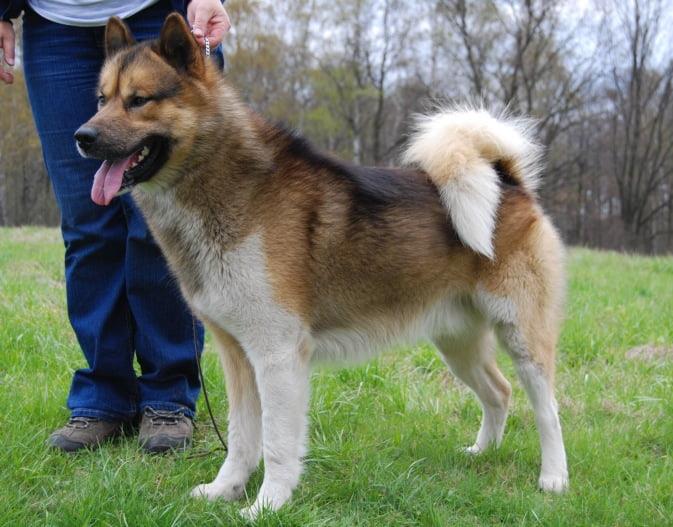
People usually look up the Greenland Dog when they’re weighing up a rare Arctic sled dog as a pet—or checking whether the “husky-like” dog they’ve met is likely to fit a normal suburban life. The stakes are practical. Get it wrong and you can end up with a powerful, pack-oriented working dog that’s bored, noisy, hard to contain, and not especially forgiving of casual training.
The Greenland Dog is built for cold, distance, and teamwork in harness. Below is a clear, breed-standard-grounded picture of what they are, what they need day to day, and the health risks worth planning around, without the folklore.
Quick facts (Greenland Dog)
- Other names: Grønlandshund
- Origin: Greenland (patronage: Denmark)1
- Breed type: Nordic sled dog (Spitz-type working dog)1
- Height: males typically at least ~60 cm at the withers; females at least ~55 cm (standards describe minimums rather than tight ranges)4, 5
- Coat: dense double coat; coarse outer coat with soft undercoat2, 3
- Colours: a wide range is accepted in standards (with albino excluded)2, 3
- Exercise: typically more than 2 hours per day for healthy adults, plus purposeful “work” (pulling, tracking, long hikes)6
History and origin
The Greenland Dog is one of the classic Arctic sled dogs: a landrace shaped by survival, transport, and hunting support in a severe environment, then later formalised into a modern breed standard. In Greenland, dogs like these were used to haul loads and travel over long distances where engines and roads were never a given.
Even today, when kept well, the Greenland Dog still reads like a working animal first: strong body, efficient movement, heavy coat, and a temperament designed to cope in a group under pressure rather than to orbit politely around a lounge room.1, 2
Appearance: what a Greenland Dog looks like (and why)
At a glance, the Greenland Dog is substantial without being blocky. The body is muscular and built to pull, with a broad chest and a neck that looks made for a harness. Movement matters: breed standards describe an efficient, tireless trot—less “showy” and more economical, like a machine that’s been tuned for distance.3
Coat and climate
The coat is a true Arctic double coat: a dense, insulating undercoat and a straight, coarse outer coat that sheds snow and wind. In warmer climates, that same coat becomes a management issue. Heat stress is a real risk if exercise is forced in hot weather, or if a dog can’t rest in shade with reliable water.2, 3
Seasonal moults can be dramatic. Weekly grooming may be enough part of the year, then suddenly not nearly enough when the undercoat “blows”.6
Temperament: pack working dog, not a plush toy
The Greenland Dog is typically independent and robust, often more comfortable with clear structure than with constant negotiation. Many are social with people, but the breed’s centre of gravity is the pack: they were developed to work alongside other dogs, with intensity, and to keep functioning in hard conditions.6
That background can show up in everyday life as:
- High arousal outdoors: a tendency to lock onto movement and scent trails.
- Dog-to-dog intensity: some individuals can be pushy or reactive without careful management and early social exposure.
- Selective listening: not “stupid” or “stubborn”, just bred to make decisions under pressure.
It’s safer to assume a strong prey drive and plan accordingly: secure fencing, a long line for training, and a recall that’s earned slowly and reinforced for life.
Training and exercise needs
These dogs don’t just need exercise; they need a job-like outlet. Two hours of loose backyard time rarely touches the sides. A healthy adult Greenland Dog is often best managed with long, steady work—hiking, pulling sports, canicross, or structured running—plus calm practice at home (settling, handling, leash manners). The Kennel Club’s breed profile lists exercise needs as more than two hours per day.6
Training approach that tends to work
- Start early: gentle handling, body checks, and cooperative grooming before the dog is physically powerful.
- Keep it practical: loose-lead walking, calm crate/pen skills, and “leave it” matter more than tricks.
- Reward what you want: consistent reinforcement builds reliability; harsh methods can increase conflict and avoidance in a strong-willed working breed.
Living with a Greenland Dog: quick reality check
This is not a breed that quietly fits into any home that likes the look of a sled dog. The Greenland Dog can thrive with the right person, but the margin for error is smaller than with many companion breeds.
Often a good match if you have
- experience with large working breeds
- time for daily long exercise (not occasional bursts)
- secure fencing and a plan for containment
- interest in harness work, endurance activities, or structured training
Often a poor match if you have
- a small home with close neighbours and limited outdoor space
- long workdays with minimal daily exercise time
- hot climate living with no cool, shaded recovery areas
- small pets you cannot reliably separate or protect
Health considerations (what’s known, what’s worth watching)
Many Greenland Dogs are physically tough, but “hardy” doesn’t mean invulnerable. Because the breed is uncommon in many countries, you may see less breed-specific data than for popular breeds, so practical prevention and sensible screening matter.
Orthopaedic issues (including hip dysplasia)
Hip dysplasia can occur in large, athletic dogs, and it’s worth asking breeders for hip scoring results where available. Keep young dogs lean and avoid repetitive high-impact exercise while joints are developing.
Eye conditions
As with many purebred dogs, inherited eye disease is a consideration. Ask about eye testing and family history, and organise veterinary checks if you notice cloudiness, redness, squinting, or night-vision changes.
GDV (“bloat”): a genuine emergency
Large dogs, particularly those with deep chests, are at increased risk of gastric dilatation-volvulus (GDV), where the stomach fills and can twist. It can become life-threatening very quickly.7, 8
Common warning signs include a suddenly distended abdomen, repeated unproductive retching, drooling, restlessness, and rapid deterioration. If you suspect GDV, treat it as an emergency and go straight to a veterinary hospital.7, 9
Risk reduction is not perfect, but commonly recommended steps include splitting food into two or more smaller meals, slowing down fast eaters, and avoiding hard exercise around meals.7, 9, 10
Greenland Dog in popular culture
The Greenland Dog has a real and documented place in polar travel and sled work, but popular culture references are often muddled—many productions simply use “sled dog” types without naming the breed accurately. If you’re trying to identify a dog you’ve seen on screen, it’s usually more reliable to look at production notes than to assume the breed based on appearance alone.
Are Greenland Dogs good family pets?
They can be in the right home: experienced handlers, plenty of daily exercise, and careful management around small animals. In a low-activity household, their needs tend to spill out as noise, escaping, and conflict with other dogs.
Can a Greenland Dog live in Australia?
Some individuals can cope, but heat management becomes central: exercise at cooler times, reliable shade, water, and an owner who will not “push through” hot days because the dog looks tough. The double coat is designed for cold, not for Australian summers.2, 3
How much exercise do they really need?
For most adults, think in terms of “more than two hours a day” plus mental work, not a single short walk. Endurance outlets are usually a better fit than stop-start games.6
References
- FCI – GRØNLANDSHUND (Greenland Dog), breed nomenclature entry (No. 274)
- Canadian Kennel Club (CKC) – Greenland Dog breed information
- United Kennel Club (UKC) – Greenland Dog breed standard
- Danish Kennel Club (DKK) – Grønlandshund breed page
- The Kennel Club (UK) – Greenland Dog breed information
- The Kennel Club (UK) – Greenland Dog exercise and care profile
- Cornell University College of Veterinary Medicine – Gastric dilatation-volvulus (GDV) / bloat
- Today’s Veterinary Practice – Gastric dilatation-volvulus (GDV): stabilisation and surgery
- American Animal Hospital Association (AAHA) – Understanding canine bloat (GDV)
- Cornell University College of Veterinary Medicine – GDV prevention and gastropexy notes

Veterinary Advisor, Veterinarian London Area, United Kingdom