
Quick profile: green-winged (red-and-green) macaw
Common names: Green-winged macaw, red-and-green macaw
Scientific name: Ara chloropterus1
Adult size: commonly around 90–95 cm from beak to tail tip (so, closer to a metre than 60 cm). It is one of the largest macaws; the hyacinth macaw is larger.2
Native range: widely distributed across parts of South America (tropical forests, woodland edges, and riverine areas, depending on region).3
Trade status: listed under CITES Appendix II (international trade is regulated and paperwork matters).1
Appearance and identification
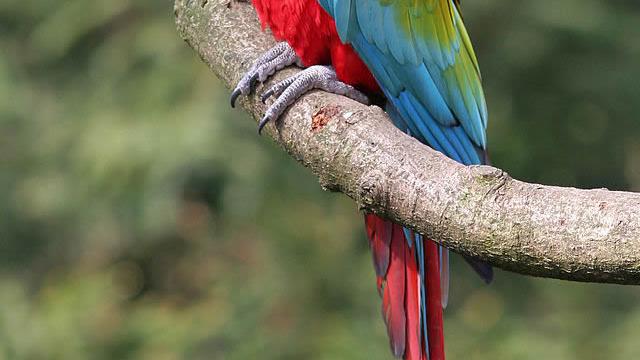
Green-winged macaws are mostly bright red, with broad green across the upper wings and blue toward the flight feathers. The face shows a bare pale skin patch with fine red feather lines around the eye—one of the easiest ways to tell them from scarlet macaws at a glance.2
The beak is large and strongly hooked, built for cracking hard foods and for serious chewing. Feet are dark grey, with a sure, climbing grip that makes latches and loose fittings worth treating as puzzles rather than barriers.
Temperament: affectionate, intense, and very present
Well-socialised green-winged macaws are often described as steady and people-focused, but “rarely aggressive” is too absolute for any large parrot. Like other macaws, they can bite hard when frightened, overstimulated, guarding a space, or when body language is missed. Noise is normal communication, not misbehaviour.
They are also highly social animals. A single bird commonly relies on its household for daily interaction, and a thin social life can slide into screaming, feather-damaging behaviour, or other stress signs over time.4
Lifespan: think in decades, not years
Many parrots are long-lived, and macaws are at the far end of that spectrum. Planning for decades of care (housing, diet, enrichment, and avian vet access) matters more than any single “lifespan number”. RSPCA guidance flags that some birds may live 10–50 years, making this a genuine long-term commitment rather than a phase-of-life pet.5
Individual longevity varies widely with genetics, husbandry, safety, and veterinary care. Treat any claim of “nearly 100 years” as exceptional rather than expected.
Diet: pellets are a base, not the whole story
A good commercial pelleted diet is commonly used as a foundation for companion macaws, but it should be supported with a wide range of fresh vegetables and other whole foods, plus carefully managed higher-fat items (like nuts) depending on the bird’s body condition and activity.6
Aim for:
- High-quality pellets as a consistent baseline (chosen with avian-vet guidance for your bird’s life stage).
- Daily vegetables and leafy greens for variety, texture, and foraging opportunities.6
- Fruit in smaller amounts (often treated as a high-sugar “sometimes food”).6
Foods to avoid: chocolate, caffeine, alcohol, and avocado are commonly listed as dangerous for pet birds. If you’re unsure about a food, assume “not yet” and check with an avian veterinarian.6
Exercise and out-of-cage time: supervision is the point
A big cage is important, but it’s not a full life. Parrots need regular opportunities to move, climb, chew appropriate materials, and make choices. Where birds are confined for long periods, they should have safe opportunities to fly or exercise outside the enclosure, with hazards controlled (windows, ceiling fans, other pets, open water, and toxic fumes).7
Most households find that “out-of-cage time” works best as a predictable daily routine on a play stand or climbing area, with the bird engaged in foraging, training, or supervised destruction of safe chewables rather than the house itself.
Chewing, noise, and the morning “announcement”
Macaws chew because that’s what macaws do. In the wild, large parrots spend much of their day working for food and interacting with their environment; in captivity, that time needs replacing with foraging, enrichment, and safe chewing materials, or the bird will invent its own projects.4
Noise also comes with the territory. Green-winged macaws are often not constant screamers, but they can be loud, especially at dawn and dusk, during excitement, or when routines change. If you live close to neighbours, noise tolerance is a practical constraint, not a moral failing.
Housing and set-up basics
Choose the largest enclosure you can realistically fit and maintain, with enough horizontal space for movement (birds don’t use tall, narrow cages the way people imagine). RSPCA guidance emphasises space, opportunities for flight/exercise, and an environment designed to prevent boredom.7
Day to day, welfare improves when the bird can:
- Use multiple perches (different diameters and textures).
- Access chew and foraging items that are rotated to stay interesting.
- Retreat from household traffic and noise when it wants to rest.8
Before you buy: the checks that save heartbreak
- Time: can you provide daily social contact and enrichment for decades?5
- Noise: are neighbours, housemates, and your own routine compatible with a loud bird?
- Damage: can you accept ongoing chewing risk and manage it with supervision and set-up?
- Veterinary care: do you have access to an avian veterinarian and budget for regular check-ups and emergencies?
- Source: consider adopting through welfare organisations where possible, and avoid impulse buying.5
If you’re in Australia: a note on importing and permits
Australia has strict rules around importing pet birds. The Australian Government’s guidance notes that importing pet psittacine birds is limited and tightly controlled, and (for personal pet imports) is generally only allowed from New Zealand under specific permit and quarantine conditions, alongside environment (wildlife trade) requirements.9, 10
References
- CITES – Ara chloropterus (listing and taxonomy)
- Animal Diversity Web (University of Michigan) – Ara chloropterus overview
- IUCN Red List of Threatened Species – species accounts (search: Ara chloropterus)
- RSPCA Knowledgebase – keeping birds entertained (enrichment and behaviour)
- RSPCA Knowledgebase – are birds the right companion animals?
- VCA Animal Hospitals – macaws feeding (diet basics and unsafe foods)
- RSPCA Knowledgebase – housing birds (space, exercise, enrichment)
- RSPCA Australia – how to help your pet bird have a good life (environment, fumes, noise, welfare)
- Australian Government (DAFF) – Importing your pet bird (requirements and quarantine)
- Australian Government (DCCEEW) – wildlife trade permits (live imports and Live Import List)

Veterinary Advisor, Veterinarian London Area, United Kingdom