
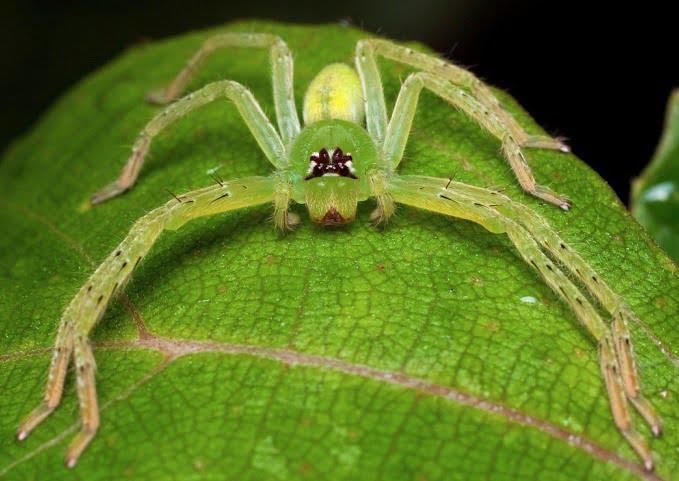
People usually search for “green pet spider” when they’ve spotted a vivid green spider in the garden or house, or they’re weighing up whether a spider could be a sensible, low-fuss pet. The right ID matters. Some spiders are calm display animals; others are better left alone, and a few groups in Australia need urgent first aid if a bite is suspected.
In Australia, “green spider” most often points to certain huntsman spiders (family Sparassidae), including badge huntsman species where juveniles can be bright green. They’re impressive to look at, but they aren’t a “beginner handling” pet, and they’re not harmless in every sense. This guide keeps the language simple: what these spiders are likely to be, what they’re like to live alongside, and what safe, humane care looks like if you’re keeping one as a short-term display animal.1, 2
Quick facts (for a green huntsman-type spider)
Body length: commonly around 2.5 cm (varies by species) with a leg span that can be much larger2
Colour: grey to brown is common; some badge huntsman juveniles can be bright green1, 3
Where you’ll find them: under bark, rocks, in crevices, on walls inside houses1, 4
Diet: insects and other small animals; they hunt rather than using a capture web2, 4
Activity: often nocturnal, but may sit still in sheltered spots during the day2
Venom and risk to people: generally not considered dangerous, but bites can be painful and cause local swelling; they usually prefer to run rather than bite1, 5
What “green pet spider” usually means in Australia
There isn’t one standard species sold everywhere as “the green pet spider”. In Australian homes, the green-looking spider people notice is often a huntsman, especially in the badge huntsman group (Neosparassus), where juveniles can be a clean, leaf-green that stands out on pale bark or house walls.3
Huntsman spiders are not tarantulas, even though people sometimes use the word loosely for any big, hairy spider. They’re a different group, with a flattened, sideways-splayed stance that lets them slip into narrow gaps under bark and behind picture frames.1
A quick correction: not everything green is a spider
Some online “green pet spider” lists accidentally wander into reptiles. The green tree python, for example, is a snake (Morelia viridis), not a spider.6
How to tell a green huntsman from other “green” spiders
Most people don’t need a perfect species name. A few broad cues are usually enough to keep you safe and to decide what to do next.
- Very long legs held out to the side (a crab-like silhouette), plus a habit of flattening into cracks: common huntsman traits.1
- Not sitting in a neat orb web: huntsman spiders are active hunters, not classic web-trappers.2
- Green as a life stage: in badge huntsman spiders, bright green may be strongest in juveniles, with colour shifting as they mature.3
Temperament and handling: what “docile” really looks like
Huntsman spiders are often described as “harmless” because they’re not considered dangerous to humans and they tend to flee rather than fight. But “unlikely to cause serious harm” is not the same as “good to handle”. They’re fast, they’re strong, and a defensive bite can hurt.1, 5
If you keep one, treat it as a display animal. Enjoy the stillness, the sudden motion, the way it folds itself into a shadowed corner. Avoid regular handling. Most stress in captive spiders comes from vibration, bright light, and being forced into the open.
Housing a green huntsman safely (short-term display)
In Australia, keeping native wildlife can be regulated. Before you keep any wild-caught spider long-term, check your state or territory rules and consider whether leaving it where it belongs is the better choice.
If you are housing a huntsman temporarily (for observation, photography, or short-term holding before release), the priorities are security, ventilation, and a place to hide.
- Enclosure: a secure container with plenty of ventilation and a tight-fitting lid. Huntsman spiders climb well and squeeze through gaps.1
- Shelter: a piece of bark, egg carton, or folded cardboard to mimic the narrow spaces they prefer under bark and rocks.1, 4
- Substrate: paper towel or a thin layer of clean, dry material is often enough for short-term holding. Avoid soggy setups; damp, stagnant air invites mould.
- Water: a very shallow dish can help in dry conditions, but don’t create a drowning hazard for feeders or a humidity trap for the spider.
Feeding: simple, sparing, and species-appropriate
Huntsman spiders eat live prey and do well on common feeder insects. In the wild they take a wide range of insects and other small animals, catching prey by stalking or ambush rather than using a capture web.2, 4
- Offer appropriately sized insects (no larger than the spider’s body).
- Remove uneaten prey if the spider is in moult or refusing food.
- Do not use wild-caught insects from areas that may have been sprayed with pesticides.
Common misconceptions to clear up
“Green pet spiders are non-venomous”
Nearly all spiders have venom. The more practical question is whether they’re considered dangerous to humans. Huntsman spiders are generally not considered dangerous, but bites can still cause pain and local swelling, and they should be avoided.1, 5
“They live eight years”
For huntsman spiders, a lifespan of around two years or more is commonly reported, depending on the species. Much longer lifespans are more typical of some tarantulas, not huntsman spiders.2
“Egg sacs have up to 200 eggs”
Egg numbers vary widely by species. It’s better to avoid a precise number unless you’re discussing a confirmed species with a specific reference. What matters for keepers is that a single egg sac can produce many spiderlings, and that housing and feeding large numbers quickly becomes impractical.
Safety note: when spider bites are an emergency
This page is about green huntsman-type spiders, which are generally not considered dangerous. Still, in Australia there are spiders where suspected bites must be treated as potentially life-threatening (notably funnel-webs). If you’re not certain what bit you, don’t guess.
If a funnel-web spider bite is suspected, pressure bandage with immobilisation is recommended and urgent medical care is needed. Australian Museum notes that funnel-web antivenom was first developed for clinical use in 1981 and that there have been no deaths since its introduction.7 NSW Health provides practical steps for pressure bandaging and immobilisation while waiting for emergency help.8
Is a “green pet spider” right for you?
A green huntsman can be a calm, watchable presence for a time, more like a quiet visitor than a companion animal. If you want an animal you can handle, interact with, and keep for many years, a spider is rarely the right fit.
If your interest is observation, a secure enclosure, minimal disturbance, and respect for the spider’s instincts will take you a long way. And if the spider is simply sharing your house, it may already be doing its work—patiently trimming down the night’s insects—without needing anything from you at all.1
References
- Australian Museum — Huntsman Spiders
- Australian Geographic — Fact File: Huntsman spider
- Australian Museum — Badge Huntsman Spiders (Neosparassus sp.)
- Australian Reptile Park — Huntsman Spider
- Australian Museum — Spider facts
- Green tree python (Morelia viridis) — Wikipedia
- Australian Museum — Australian Funnel-web Spiders (antivenom and first aid overview)
- NSW Health (ACI Emergency Care Institute) — Snake and spider bite clinical tool

Veterinary Advisor, Veterinarian London Area, United Kingdom