
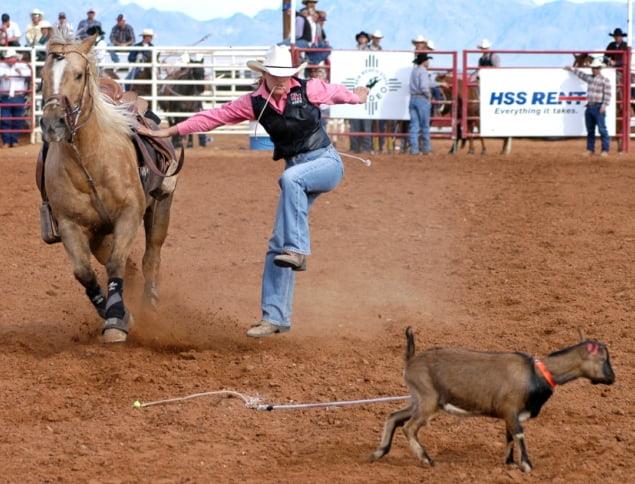
Most people look up goat tying because they’ve seen it at a rodeo (or a gymkhana-style meet) and want to know what actually happens in the arena—how the timing works, what counts as a clean run, and what’s considered unsafe or unfair handling.
It’s a fast event built on small details. Miss the tie, let the goat shake loose, or have your horse step across the stake rope, and the run can disappear into “no time” just as quickly as it began.1, 2
What goat tying is (and where you’ll usually see it)
Goat tying is a timed rodeo event where a mounted competitor rides from a starting line to a tethered goat, dismounts, flanks (tips) the goat, and ties any three legs together—usually with a short thong known as piggin’ string. Time is called when the competitor backs away and signals (commonly hands raised), then the tie must hold for a set period (often six seconds) for the time to count.1, 2
It’s most commonly run at youth, schools and amateur levels rather than top-tier professional rodeo line-ups.3
How a run works (step by step)
- The set-up: the goat is tethered to a stake with a rope (commonly 10 feet / about 3 metres).1, 2
- The approach: horse and rider cross the start line, ride straight to the goat, and the rider dismounts.
- The catch and flank: the rider catches the goat by hand, tips it onto its side in a controlled way, and positions the legs for the tie.
- The tie: any three legs are crossed and tied with piggin’ string (or an equivalent thong).1, 2
- The finish: the rider backs away and signals time; the tie must hold for the required “stand-off” period (commonly six seconds).1, 2
Timing, scores, and common penalties
Formats vary by association and age group, but most rule sets share the same spine: fastest time wins, and the tie has to hold after the competitor has stepped away. If the goat comes untied before the hold period is up, it’s typically a no score/no time.1, 4
Other common “run killers” (or time additions) include:
- Horse interference: the horse contacting the goat or the tether rope can result in a no time.4
- Touching after signalling: touching the goat or the tie after you’ve signalled completion—before the hold time is up—can void the run.4
- Undue roughness: harsh handling can lead to disqualification under many rulesets.5
Equipment that matters (and what “good” looks like)
Goat tying uses simple gear, but it has to be consistent and safe.
- Horse and saddle: a quiet horse that will rate down and stand while you tie is a bigger advantage than raw speed.
- Piggin’ string (tie thong): a short leather thong or string designed to be fast to wrap and finish with a secure “hooey” style finish.1
- Goat tether and stake: the goat is tethered to a fixed point with a set rope length in many organisations, and the arena crew should keep footing even and predictable.1, 2
Despite how it can look from the stands, goat tying is not primarily a roping event. The competitor doesn’t usually rope the goat first; the goat is already tethered, and the “catch” is by hand.1, 2
Training the horse: calm, straight, and still
A goat-tying horse learns the same things, again and again, until they feel like weather:
- Rate to the goat: travel hard from the line, then come back under you without drifting into the rope.
- Stand through movement: tolerate the rider dismounting quickly, moving around the horse, and stepping away.
- Respect the tether zone: avoid stepping across or into the stake rope area, which can trigger penalties or no time in some rule sets.4
Most problems blamed on “slow hands” start with a horse that won’t stay straight and quiet. The tie can’t settle if the approach is messy.
Common mistakes that cost time (or wipe the run)
- Rushing the flank: tipping the goat without control leads to scrambling legs and a tie that won’t hold.
- Loose wraps: if the legs aren’t properly crossed and cinched, the goat can kick free during the hold period—no time.1, 4
- Signalling too early: hands up is a promise to the judge; after that, you generally can’t fix anything without risking a no time.4
- Letting the horse drift: the horse stepping into the tether area can undo an otherwise clean run.4
Speed and precision: what actually wins
At a glance, goat tying is a sprint followed by fast fingers. In practice, the best runs look almost quiet: a straight line to the goat, a dismount that doesn’t unsettle the horse, a controlled flank, then a tie that lands neatly and holds without drama.1, 2
That last detail—holding after you step away—is why precision matters as much as speed. A fraction saved on the run-up means nothing if the goat shakes loose at five seconds.
Physical preparation: the movements that take a toll
Goat tying asks for repeated, uneven efforts: a short burst of speed, a quick drop to the ground, twisting under time pressure, then standing and backing out cleanly. Warm-up, mobility, and simple strength work (legs, hips, trunk, grip) reduce the chance that your body becomes the slowest part of the run.
If you’re returning from injury—or training juniors—get advice from a qualified health professional and coach, and keep the focus on safe repetition rather than max-effort volume.
Animal welfare and safety concerns (and why rules exist)
Rodeo events involving livestock are contested ground in Australia. Government codes acknowledge that rodeo animals may be exposed to multiple stressors (handling, transport, unfamiliar environments, equipment) and place responsibilities on organisers and competitors to safeguard welfare.6
The RSPCA and other welfare advocates argue that rodeo events—particularly calf roping—cause unacceptable fear, distress and risk of injury, and they encourage the public to avoid rodeos where such events occur.7
On the organiser side, major rodeo bodies in Australia state they require affiliated events to follow applicable welfare codes and legislation.8, 9
If you’re competing or taking a child to compete, it’s worth checking which association’s rules apply on the day, what welfare code the event operates under in your state or territory, and how stock is managed between runs.
Final thoughts
Goat tying rewards calm organisation: a horse that stays put, hands that tie cleanly under pressure, and enough discipline to finish the same way every time. The best runs don’t look forceful. They look tidy, controlled, and repeatable—then the goat stays tied when the judge counts it out.1, 2
References
- National High School Rodeo Association (NHSRA) – General Information (Goat Tying rules overview)
- National High School Rodeo Association (NHSRA) – High School Events (Goat Tying summary and 6-second rule)
- Wikipedia – Goat tying (overview; general context on where it’s commonly contested)
- University of Nebraska–Lincoln Extension – Nebraska 4‑H Goat Tying (disqualifications and re-runs)
- New Jersey High School Rodeo Association – Event Descriptions (Goat Tying; no score and disqualification examples)
- NSW Department of Primary Industries – NSW Code of Practice for animals used in rodeo events
- RSPCA Australia – Calf roping in rodeos (welfare concerns and legal status summary)
- Australian Bushmen’s Campdraft & Rodeo Association (ABCRA) – Animal Welfare
- National Rodeo Association (Australia) – Animal Welfare

Veterinary Advisor, Veterinarian London Area, United Kingdom