
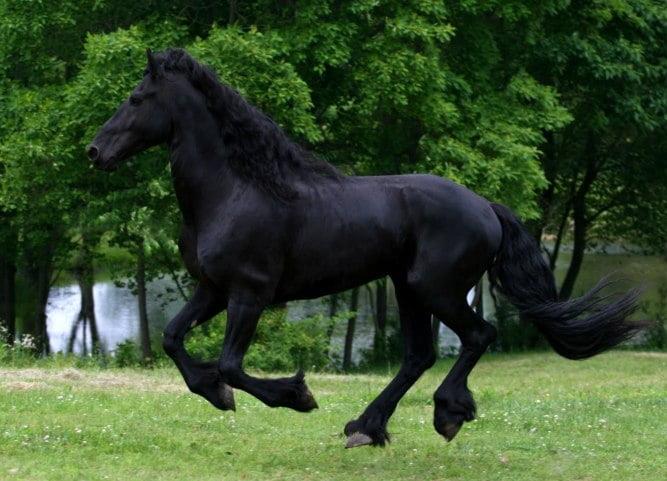
People usually start looking up Friesian horses when they’re weighing up a purchase, checking whether a horse is genuinely Friesian (and registered), or trying to understand what daily care will really look like. The details matter: registration rules affect value and breeding choices, and this breed’s genetics mean a casual “she’ll be right” approach can carry real risk for mares, foals, and owners.
Below is a clear, practical profile of the Friesian horse—where it comes from, what it typically looks and moves like, what it’s used for, and the care decisions that keep it sound. The earlier mention of the Dutch Keeshond has been removed; it isn’t related to this breed and can confuse readers.
Friesian horse at a glance
- Origin: Friesland, in the northern Netherlands1
- Height: commonly around 15–17 hands (about 152–173 cm)1, 2, 3
- Weight: often around 570–660 kg (about 1,250–1,450 lb)1
- Coat colour: black for studbook-registered Friesians (minor white is tightly restricted; rules vary by registry)2, 3
- Distinct features: thick mane and tail; feathering on lower legs; high, active trot1
- Common uses: harness/driving and ridden work, including dressage at many levels1, 4
- Typical lifespan: many horses live into their 20s with good care (individual variation is normal)5
History and origin
The Friesian is named for Friesland, a northern province of the Netherlands where black, strong-framed horses were valued for both work and transport. The modern breed has passed through periods of decline—at times coming close to disappearing—before being rebuilt through careful studbook management.1
Today, Friesians are best known as elegant harness and riding horses. Their “Baroque” outline—arched neck, compact power, and showy action—still echoes the type that was prized long before modern sporthorse breeding reshaped many other lines.4
Physical characteristics and movement
Most Friesians present as medium-to-large horses with a compact, muscular body, a high-set, arched neck, and a mane and tail that tend to grow thick and long. Feathering—longer hair around the fetlocks—adds to the breed’s distinctive silhouette, but it also means you need to keep an eye on skin health in wet weather.1
Under saddle or in harness, Friesians are widely recognised for an energetic, high-stepping trot. It’s eye-catching, and it can feel powerful to ride, but it also means conditioning and soundness management matter—especially as training intensity increases.1
Colour and markings (what “purebred” can mean in practice)
Many registries only accept black Friesians, and some allow only very limited white marking (often a small star). If colour and registration status matter to you—purchase price, showing, breeding—check the exact registry rules and the horse’s paperwork rather than relying on appearance alone.2, 3
Temperament and suitability
Well-handled Friesians are often described as willing and people-oriented, with a steady nature that suits driving, pleasure riding, and dressage. Like any breed, temperament is shaped by training, handling, and health; the quiet horse in the paddock can become tense under saddle if it’s sore, under-fed, or under-prepared for the job.2
Uses and disciplines
Friesians are widely used for:
- Driving and carriage work, where their presence and trot are a natural fit1, 3
- Dressage and general riding, particularly at introductory to advanced club levels (some types may find elite modern dressage demands more challenging than purpose-bred warmbloods)4
You’ll also see Friesians in ceremonial and entertainment settings. Their black coat and flowing hair read clearly at a distance, which is part of why they’re frequently chosen for public-facing roles.4
Breeding and genetics: what to know before you breed
The Friesian population has experienced historical bottlenecks and inbreeding. That doesn’t mean an individual horse is unhealthy, but it does mean genetic management is taken seriously, and DNA testing has a practical role in breeding decisions.6, 7
Two well-described inherited conditions
- Hydrocephalus in Friesians has been linked to a mutation in B3GALNT2 and is inherited in an autosomal recessive pattern. Affected foals are often stillborn and births can be complicated for the mare, which is why carrier testing matters in breeding programmes.7, 8
- Dwarfism with joint laxity in Friesians has been associated with a mutation in B4GALT7, also described as recessive. Research links the trait to the breed’s history of inbreeding and bottlenecks.6, 9
Practical takeaway for owners
If you plan to breed, don’t guess—test. A carrier horse can be healthy, but pairing two carriers of the same recessive condition increases the risk of an affected foal. Work with a veterinarian and breed society or registry guidance, and keep records as carefully as you would for soundness or performance.8
Training and care
Friesians thrive on consistent handling, clear boundaries, and gradual conditioning. Their movement can look effortless, but fitness still has to be built: heart, lungs, topline, feet, and tendons all need time to strengthen.
Daily care basics
- Diet: most do best with plenty of quality forage (pasture and/or hay), with hard feed added only to match workload and body condition. Use a veterinarian or equine nutritionist if you’re managing weight, ulcers, or heavy training loads.5
- Hooves: regular farrier care is non-negotiable. The breed’s animation is easiest on the body when the feet are balanced and comfortable.
- Skin and feathering: in wet or muddy conditions, feathering can trap moisture and grime. Keep legs clean and dry where possible, and check for irritation, scabs, and swelling.
- Grooming: mane and tail care is part of the job. Detangle patiently, keep an eye out for rubbing, and avoid practices that thin the hair unless there’s a clear reason.
Common myths and quick reality checks
- “All Friesians are jet black.” For many registries, black is the required colour, but shade and seasonal fading can make a horse look brownish without it being a different colour genetically. Check registration papers rather than judging by a summer coat.2
- “They’re perfect family horses by default.” Many are steady, but suitability still depends on training, rider skill, and soundness. Big, powerful movement can be more horse than some beginners expect.
- “Famous Friesians from the 1600s are documented.” Specific named horses from that era are rarely verifiable in reliable breed records. It’s safer to focus on what the breed is demonstrably used for today, and on documented genetics and registry standards.1, 3
References
- Wikipedia — Friesian horse
- Friesian Horse Association of North America (FHANA) — FAQ
- American Museum of Natural History — OLogy: Friesian
- Fédération Equestre Internationale (FEI) — Friesian breed profile
- University of Minnesota Extension — Horse care and management
- BMC Genomics (2016) — Dwarfism with joint laxity in Friesian horses associated with a splice site mutation in B4GALT7
- PubMed — A nonsense mutation in B3GALNT2 is concordant with hydrocephalus in Friesian horses
- Utrecht University — Mutation causing hydrocephalus in Friesian horses discovered
- PubMed — Dwarfism with joint laxity in Friesian horses associated with a splice site mutation in B4GALT7

Veterinary Advisor, Veterinarian London Area, United Kingdom