
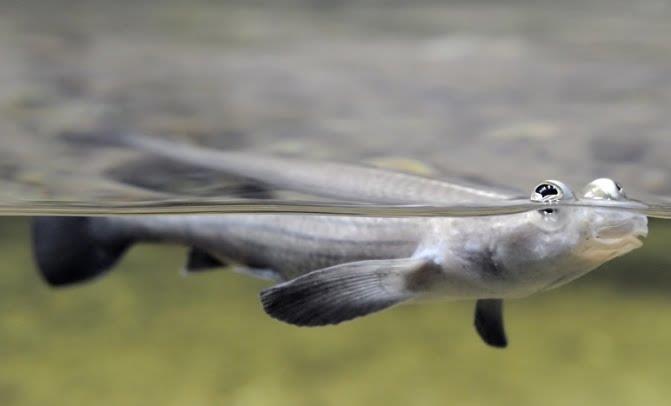
Four-eyed fish show up in aquariums when someone wants a surface-dwelling oddity that looks like it’s watching two worlds at once. Before you buy one, the key questions are practical: how big do they really get, do they need brackish water, will they jump, and can they live with other fish without constant friction.
The short version: “four-eyed fish” (Anableps species) don’t have four separate eyes—each eye is split so it can focus above and below the surface at the same time.1, 2 They’re active fish from estuaries and mangrove edges, and they do best in a long, covered aquarium with room to cruise the surface.
Quick facts (at a glance)
- Common name: Four-eyed fish (often “largescale foureyes”)
- Scientific name: Anableps anableps (most commonly kept), genus Anableps1
- Adult size: up to about 30 cm total length (commonly smaller)1, 3
- Natural habitat: estuaries, coastal lagoons, mangrove shorelines; fresh to brackish water3, 4
- Diet: insects and other invertebrates; also small fish and other foods depending on opportunity3, 4
- Social behaviour: often seen schooling, especially when young6
- Reproduction: livebearer (internal fertilisation), not an egg-layer7, 8
- Special consideration: needs a tight-fitting lid; surface fish that can launch themselves out of gaps
What are four-eyed fish?
Four-eyed fish are surface specialists from the Neotropics—places where river water meets the sea, where tides push and pull through mangroves and mudflats. The genus is Anableps, and the best-known species in the aquarium trade is Anableps anableps.1, 3
They spend much of their time right at the meniscus, holding the waterline across their eyes. That posture is the whole trick: each eye is divided so the upper portion is tuned for air vision and the lower portion for underwater vision, letting the fish track movement in both worlds at once.1, 2
The “four eyes” explained (without the myth)
Despite the name, an Anableps has two eyes, not four. Each eye is internally and externally divided into an upper and lower half, with anatomical tweaks that help form useful images in air and in water at the same time.1, 2
In anatomical descriptions, the split includes features such as two pupils within each eye and specialisation in corneal and lens shape between the aerial and aquatic halves—an elegant solution to the optical problems created by the air–water boundary.2, 5
Natural range and habitat
Anableps anableps is recorded from northern South America, including Trinidad and the mainland coast from Venezuela through to the Amazon delta region, and it’s closely tied to lowland coastal waters—estuaries, lagoons, and mangrove edges where salinity can swing with tides and rain.3, 4
That background matters in captivity. These fish aren’t stream-dwellers in the usual “freshwater community tank” sense; they’re built for broad, shallow, changeable places where the surface is the main stage.
Temperament and group dynamics
In the wild, Anableps are often seen in groups, and juveniles can congregate in sizeable schools.6 In aquariums, they’re generally best treated as social fish: keeping a small group can spread attention and reduce the intensity of dominance displays.
They are also energetic, surface-oriented cruisers. A cramped tank doesn’t just limit swimming space; it forces constant close contact at the surface, where they naturally spend most of their time.
Tank setup that suits their biology
Tank size and shape
Because Anableps can reach around 30 cm and are persistent surface swimmers, tank length matters more than tank height.1, 3 A long aquarium gives them room to move without repeatedly colliding, turning, and jostling at the same patch of surface.
Cover and escape prevention
Plan for a tight-fitting lid and block small gaps around hoses and cables. Surface fish often accelerate quickly, and startled individuals may clear the waterline in a single burst. Treat the lid as essential equipment, not an optional extra.
Fresh vs brackish water
In nature, Anableps anableps is associated with both fresh and brackish environments, commonly linked to coastal lagoons and mangrove shorelines where salinity can vary with tides.3, 4 Many aquarists therefore keep them in brackish conditions to better match typical habitat. If you choose brackish water, change salinity gradually and keep it stable once set.
Temperature and basic water quality
They’re tropical fish and are commonly listed around the mid‑20s °C as typical.3 More important than chasing a single “perfect” number is steady temperature, strong filtration, and consistent maintenance—especially because these fish eat eagerly and produce a fair amount of waste for their time at the surface.
Feeding: what they eat (and how they hunt)
Anableps feed on insects and other small invertebrates, and may also take small fish and other foods depending on what’s available.3, 4 In an aquarium, this translates well to a varied diet built around quality prepared foods plus frozen or live options.
They’re set up to notice movement above the surface, so floating foods and surface feeding can become a regular part of their routine. Keep an eye on tankmates: slow feeders can be outcompeted when an Anableps group is in feeding mode.
Compatibility: choosing tankmates carefully
Four-eyed fish occupy the surface almost constantly. That alone narrows the list: avoid other surface specialists that will compete at the same layer, and avoid nippy species that target fins.
If you keep tankmates, aim for peaceful fish that prefer mid-water or the bottom, and that tolerate the same fresh-to-brackish conditions you’re running. Watch for subtle stress signals—frayed fins, clamped posture, or fish refusing to use open water—and adjust before it becomes chronic.
Breeding basics (and a common mistake corrected)
Four-eyed fish in the family Anablepidae (including Anableps) are livebearers. They use internal fertilisation, and females give birth to live young rather than laying eggs that are fertilised externally in the water.7, 8
A further twist: in Anableps anableps, the genital opening and the male’s gonopodium can be oriented to the left or the right, and successful mating generally requires compatible “handedness”.8, 9
Where to buy four-eyed fish (Australia)
Look for specialist aquarium shops with experience in brackish species and a track record of selling robust, well-acclimated fish. Ask what salinity and temperature the fish are currently kept in, and match those conditions closely during quarantine and acclimation. Avoid impulse purchases from sources that can’t tell you the water parameters.
Final thoughts
Four-eyed fish reward patient keepers who build a tank around how the species actually lives: a long surface runway, stable water, and a lid that leaves no doubt. Get that foundation right and you’ll see the quiet, constant scanning that makes Anableps so distinctive—half in one world, half in the other, with the waterline drawn straight through their gaze.1, 2
References
- Encyclopaedia Britannica — “four-eyed fish (Anableps)”
- JAMA Ophthalmology — “Four-Eyed Fish” (eye structure and split vision)
- FishBase — Anableps anableps species summary (distribution, size, temperature, ecology)
- FishBase (Muséum national d’Histoire naturelle mirror) — Anableps anableps summary
- Proceedings of the Royal Society B / PMC — corneal specialisation in Anableps anableps
- The Ohio State University Museum of Biological Diversity — Four-eyed fish overview (species notes and schooling behaviour)
- PubMed — “Follicular placenta and embryonic growth of the viviparous four-eyed fish (Anableps)”
- California Academy of Sciences — Four-eyed fish creature close-up (viviparity and mating compatibility)
- Proceedings of the Royal Society B / PMC — genital asymmetry (“left” and “right” mating) in Anablepidae

Veterinary Advisor, Veterinarian London Area, United Kingdom