
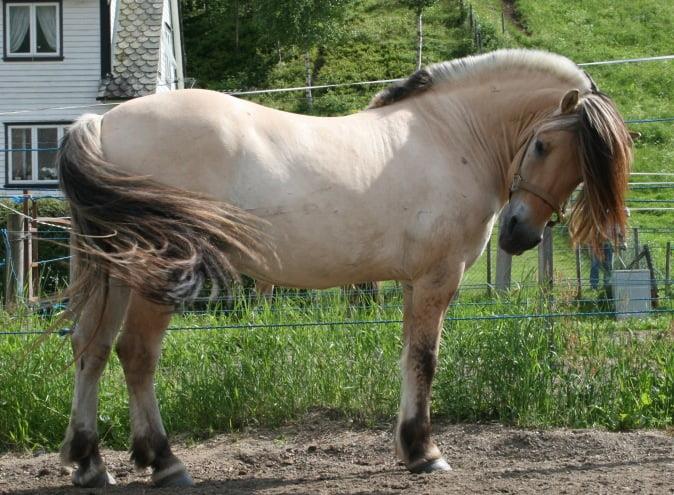
Most people meet a Fjord horse at a practical crossroads: choosing a first family mount, looking for a tough little driving horse, or checking whether that striking dun “pony” with the upright mane will really suit Australian conditions. The decision matters. A small, strong horse can be a joy to live with, but only if its size, temperament, health needs and handling requirements match your day-to-day reality.
The Norwegian Fjord is a compact draught-type horse with a long working history, a distinctive dun coat and a reputation for steadiness. Here’s what those traits look like in real life—how big they tend to be, what their colour actually means, what they’re commonly used for, and the care routines that keep them sound and useful.
At a glance: Norwegian Fjord horse
- Type: Compact, draught-influenced horse (often called a “pony” because of height, but it’s a horse breed)
- Height: Commonly about 13.2–14.2hh (some individuals fall outside this range)1, 2
- Weight: Commonly about 410–545 kg (900–1,200 lb), depending on build and condition2
- Coat: Dense winter coat; sheds to a shorter summer coat1
- Colour: Dun only, with recognised shade variations and primitive markings (dorsal stripe, leg barring)1, 3
- Distinctive feature: Two-toned mane (dark centre with lighter outer hair), often traditionally trimmed to stand up1, 4
- Temperament (general): Often described as calm, willing and trainable, with a practical “workhorse” mindset when handled consistently1
- Common uses: Riding, driving, farm and pleasure work, trail/trekking, showing and some performance disciplines (varies by individual and training)1
Origin and history
The Fjord comes from Norway, developed as a working horse in steep country where footing is uncertain and weather changes fast. That background shows in the modern breed: compact, muscular, and typically comfortable doing steady, repetitive jobs without fuss.1
Outside Norway, Fjords are now kept mainly for riding and driving, with some used in therapeutic and education settings because their size and steadiness can be a good match for supervised programs.1
Physical characteristics (what you actually notice in the paddock)
A Fjord is built like a small tractor with tidy edges: short-coupled, broad through the chest, and strongly muscled for its height. The head is usually broad through the forehead with a straight to slightly dished profile; ears tend to be small, and the overall look is compact rather than fine-boned.1
Feet and legs are part of the Fjord’s practical reputation. The breed is widely described as having sturdy legs and good feet, though soundness still depends on breeding, hoof care, workload and terrain—no horse is “maintenance-free”.1
Colour: correcting a common misconception
Fjords aren’t “brown, black, grey, palomino” in the usual mixed-breed sense. The breed standard centres on dun colouring, with recognised dun shade variations and primitive markings such as a dorsal stripe and leg barring (often called zebra stripes).1, 3
The mane: natural vs traditional presentation
A Fjord’s mane naturally grows long and can fall to one side like any other horse. The familiar upright mane is a human choice—traditionally clipped so it stands up and shows the darker centre stripe framed by lighter outer hair.4
Temperament and trainability
Well-bred, well-handled Fjords are commonly described as calm, willing and intelligent. Many are steady enough to suit novice riders with proper instruction, yet strong enough to carry adults and do serious work when conditioned.1, 2
Temperament is still individual. A Fjord that’s under-exercised, poorly fed, sore in the mouth or feet, or asked to do confusing work can become dull, resistant or pushy. Their strength means manners matter early, especially around the ground.
Riding, driving and competition
Fjords are used under saddle and in harness, often chosen for trail riding and driving because their compact power and balance suit varied terrain. Some compete in disciplines such as dressage and jumping, usually at levels that match their conformation and training rather than extreme speed or scope.1
For riders, the main adjustment is feel: Fjords can be broad and strong through the shoulder, with a workmanlike stride. Fit your saddle carefully and build fitness slowly, especially if the horse is an “easy keeper” that gains weight quickly.
Care and maintenance in Australia
A Fjord can live well in Australia, but “hardy” should never be read as “low-risk”. Heat, parasite pressure, rich pasture, and biosecurity concerns can shape management more than breed does.
Feeding and weight
Many Fjords are efficient doers. On improved pasture, that can mean weight gain and a higher need for grazing management. Aim for a forage-first diet, adjust feed to workload, and use tools like strip grazing, a dry lot, or a grazing muzzle when needed.
Hoof care
Plan routine farrier or trimmer visits based on growth and wear. Even with “good feet”, hooves change with seasons, workload and ground conditions. Keep an eye on cracks, uneven wear, heat, digital pulse changes and any sign of tenderness.
Dental care
Dental checks matter because horses’ teeth keep erupting and can develop sharp points or uneven wear. For many adult horses on mostly roughage, an annual check is a common baseline; younger horses, performance horses, and those with dental issues may need more frequent reviews, guided by your dental professional or vet.5
Health checks and vaccination (including Hendra virus)
In Australia, biosecurity is part of horse ownership. Hendra virus is a serious zoonotic disease risk. Australian government guidance notes that a registered equine Hendra vaccine has been available since 2012, and vaccination is described as the most effective way to help manage Hendra virus risk in horses (including known variants).6, 7
Good stable hygiene and reducing horse contact with flying-fox feed and water contamination are also recommended risk-reduction measures, even when horses are vaccinated.8
Breeding and genetics (a realistic view)
Responsible Fjord breeding aims to preserve the breed’s distinct type—compact strength, dun colour with primitive markings, and an even, workable temperament—while selecting for soundness and function. If you’re buying a youngster, prioritise a breeder who can show long-term hoof, temperament and performance outcomes in their lines, not just colour and mane.
Adoption and rescue
Fjords are less common than many breeds in Australia, so dedicated Fjord rescues may be limited. If you’re considering adoption, assess the horse in the same practical way you would any other: soundness, handling, feet, teeth, and suitability for your riding or driving goals. A calm-looking horse can still have training gaps, pain, or anxiety triggers that only appear with new routines.
Final thoughts
The Fjord horse is small enough to feel manageable, but solid enough to do real work. Its dun coat and upright mane draw the eye; its value is usually quieter—steady feet, compact strength, and a trainable nature when managed with consistency and care.1
References
- Wikipedia — Fjord horse (Norwegian Fjord Horse): characteristics, colour and mane
- Horse Journals — The Norwegian Fjord: a horse for all ages (height/weight overview)
- Horse & Hound — Fjord horse: height range, dun colours and primitive markings
- WeHorse — Fjord horse breed profile (coat colours and mane presentation)
- Equine Dental Association Australia — How often should horses’ teeth be checked?
- NSW Health — Hendra virus control guideline (equine vaccine schedule and notes)
- Australian Government Department of Agriculture, Fisheries and Forestry — Hendra virus (prevention and vaccination)
- Agriculture Victoria — Hendra virus: vaccination and risk-reduction measures

Veterinary Advisor, Veterinarian London Area, United Kingdom