
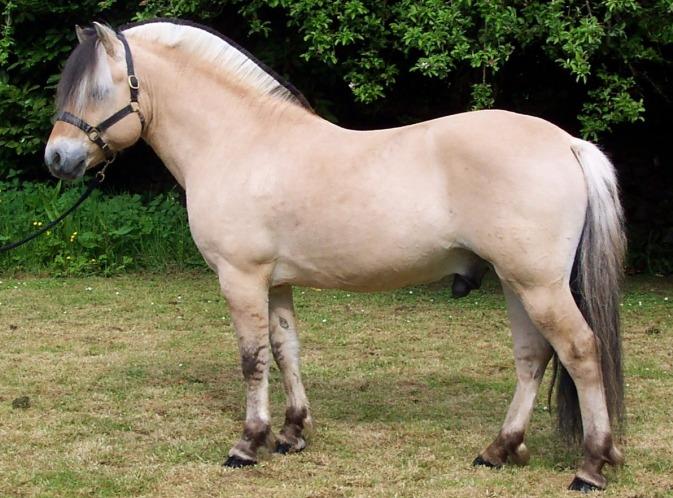
People usually search for Fjord horses when they’re trying to check a breed’s size and temperament before buying, choosing a first family mount, or matching a horse to a job like driving, trekking, or light farm work. With a compact body and a very specific breed standard, small details—height range, colour rules, and what “calm” looks like in practice—matter more than they first appear.
The Norwegian Fjord (Fjordhest) is built for uneven ground and steady work: short-coupled, muscular, and typically dun with clear primitive markings. Below is a practical, breed-standard grounded overview of what a Fjord is, what it’s like to live with, and what to look for if you’re viewing one in person.1, 2
Quick facts: Norwegian Fjord horse
- Origin: Western Norway (fjord districts)1
- Height: Desired height at the withers is 135–150 cm (about 13.1–14.3 hands) in many studbook descriptions; individuals can sit outside this preferred range depending on registry rules2, 3
- Weight: Commonly around 400–500 kg1
- Coat colour: Dun, in recognised shades (for example brown dun, red dun, yellow dun, grey/blue dun, and white dun/uls dun), with primitive markings1, 3
- Mane and tail: Two-toned mane with a darker centre stripe; traditionally trimmed upright to show the stripe and the dorsal line2, 4
- Typical uses: Riding, driving, and light draught/farm work1, 3
- Temperament (breed aim): Co-operative, dependable, willing, and calm in most situations (training and handling still matter)3
History and origins
The Fjord horse comes from the fjord landscapes of western Norway, where steep ground and changeable weather reward a certain sort of horse: compact, durable, and careful with its feet. It has long been used as a working farm and transport horse, and that practical selection still shows in the breed’s body and movement today.1, 2
Modern breeding is organised through studbooks and national breed organisations, with an emphasis on preserving the Fjord’s distinct type—especially its dun colour and primitive markings—along with soundness and usable temperament.1, 5
Physical characteristics and appearance
Build: small, strong, and sure-footed
Fjords are relatively small in height but not pony-light in substance. The desired height range often cited in breed materials is 135–150 cm at the withers, paired with a solid frame and good bone—useful when a horse needs to pull, carry, or travel over uneven terrain without fuss.1, 3
Breed descriptions commonly highlight a relatively small head with a broad forehead and a slightly concave nasal profile, strong muscling through the neck and hindquarters, and straight, sturdy legs set up for efficient, balanced movement.2
Colour and markings: “dun, with a signature stripe”
Fjords are dun, with recognised shade variations. Across those shades, the primitive markings are part of the point: a dorsal stripe running along the topline, darker leg barring, and darker points that can be more or less distinct depending on the individual’s shade.1, 2
Mane and tail: the upright trim is traditional
The mane is typically thick and two-toned, with a darker centre section. Many owners keep it trimmed upright in a curved outline so the darker stripe is visible—traditional, practical, and very recognisable in a paddock full of horses.2, 4
Personality and temperament
Fjords are widely valued for steadiness. Breed standards often describe the ideal Fjord as calm in most situations, co-operative, and dependable—traits that suit family homes, riding schools, and driving barns where manners matter as much as movement.3
Still, “calm” isn’t a guarantee. Handling, early education, and day-to-day management shape what you actually live with. A well-bred Fjord with poor hoof care, irregular work, or confusing training can become dull, pushy, or difficult, just like any other horse.
Breeding and genetics (what “purebred” usually means here)
Fjord breeding is typically managed through formal studbooks, with countries working together to keep type and identification consistent. Fjord Horse International acts as an umbrella body connecting national organisations and studbooks, supporting shared guidance for breeding and judging.5
Within that system, colour and markings are not a side note—they’re central to breed identity. Across the 20th century, selection strongly reinforced dun colour and primitive markings, and that focus remains visible in modern descriptions of the breed.1
Uses and disciplines
The Fjord is best understood as an all-rounder: a horse that can carry an adult, teach a child, pull a vehicle, and still feel confident on rough tracks. That versatility is built into many breed standards, which describe a horse expected to perform in riding, driving, and draught work, including over difficult terrain.3
In practical terms, you’ll often see Fjords in:
- pleasure riding and trekking
- driving (recreational and competitive)
- riding school and family use
- some low-to-mid level competition (discipline depends on the individual horse, not the label)
Training and care
Fjords are commonly described as willing and sensible, and they often do well with clear, consistent handling. Short sessions, tidy boundaries, and reward-based work tend to suit them—especially early on, when you’re building leading manners, standing for the farrier, and calm acceptance of harness or saddle.
For everyday welfare and soundness, the basics matter more than breed:
- Hooves: plan routine farrier visits; guidance for general horse care commonly recommends trimming about every 6–8 weeks, adjusted for the individual and workload6
- Teeth: schedule regular dental checks; annual checks are commonly recommended as a baseline for paddock-kept horses, with younger horses sometimes needing more frequent assessment6
- Vaccination and parasites: follow veterinary advice suited to your region and risk, and keep a realistic worm control plan rather than guessing6
- Daily oversight: pick up early signs—heat in feet, shifting weight, dull appetite, subtle lameness—before they become expensive problems7
Associations and organisations
If you want breed-standard detail, reputable breeding pathways, or local contacts, start with recognised organisations. Fjord Horse International provides an international forum linking national member bodies and studbooks.5
Final thoughts
The Norwegian Fjord is a small, powerful horse shaped by steep country and steady work. Expect dun colour and crisp markings, a compact frame with real pulling and carrying ability, and a temperament that’s often calm and co-operative when it’s handled with clarity and kept in good routine.1, 3
If you’re viewing a Fjord, pay attention to the ordinary things: feet, teeth, body condition, and manners on the ground. A Fjord that’s comfortable and well-managed tends to look quietly capable—like it could walk all day, and still have something left for the trip home.
References
- NordGen — Norwegian Fjord Horse
- Norwegian Fjord Horse Center — The Norwegian Fjord Horse (breed description)
- Canadian Fjord Horse Association — Breed Standard
- Horse & Hound — Fjord horse: Norway’s distinctive and adaptable draught horse
- Fjord Horse International — Organisation (mission and members)
- Agriculture Victoria — Basic horse care
- Agriculture Victoria — Code of Practice for the Welfare of Horses at Horse Hire Establishments (health care)
- Fjord Horse International — Homepage
- Norwegian Fjord Horse Center — Description of the breed

Veterinary Advisor, Veterinarian London Area, United Kingdom