
Most fish-tank water problems don’t start with a dramatic crash. They begin quietly: a freshwater tank that slowly drifts harder and more alkaline, or a marine tank that creeps saltier as water evaporates. Fish may breathe faster, refuse food, or become more prone to disease—not because the water “looks dirty”, but because basic chemistry has shifted.
Salinity and hardness are two different levers. One is about dissolved salts overall (mostly a saltwater question). The other is about calcium and magnesium (mostly a freshwater question). Once you know which one you’re dealing with, the fixes become straightforward—and much safer than guessing.
Salinity: what it is (and when it matters)
Salinity is the total amount of dissolved salts in water. In marine aquariums, it’s the backbone of stable conditions because it affects osmoregulation, oxygen exchange, and how many other parameters behave (including alkalinity and calcium balance). In freshwater tanks, salinity is usually close to zero unless you deliberately add salt or keep brackish species.
Natural seawater sits around 35 ppt (often written as 35 PSU in scientific contexts).1, 2
Recommended salinity targets (practical guide)
- Freshwater tanks: generally aim for near 0 ppt unless a specific species or treatment plan calls for salt. (Adding salt “just because” often causes more harm than good.)
- Marine (reef or fish-only): aim for ~35 ppt (commonly read as roughly 1.026 specific gravity at 25 °C, depending on the instrument).1, 3
Specific gravity vs ppt: why numbers don’t always match
A common trap is treating specific gravity (SG) as a universal number. SG readings depend on temperature and on how the hydrometer or refractometer is calibrated, so the same true salinity can produce different SG values on different tools.3
If you keep a marine tank, it’s usually clearer to track salinity as ppt (or conductivity), and to calibrate your refractometer properly.
How to measure salinity accurately
Hydrometer (budget-friendly, but variable)
Plastic swing-arm hydrometers are common and cheap, but they’re easy to misread and sensitive to bubbles, residue, and temperature effects. They can be fine for rough checks, but they’re not ideal for tight marine stability.
Refractometer (preferred for marine tanks)
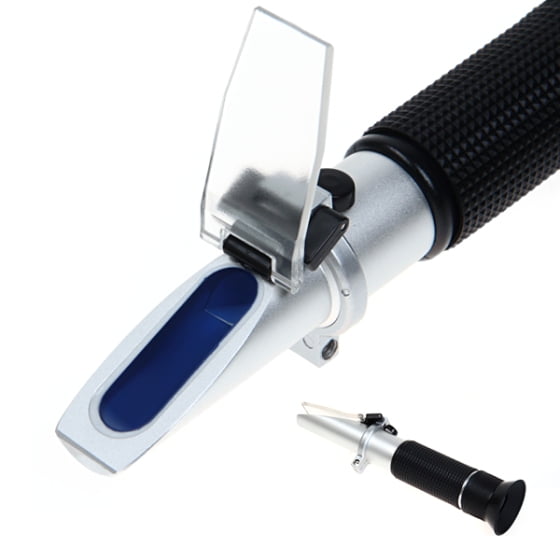
A refractometer is usually the best day-to-day tool for marine aquariums, as long as you calibrate it with a 35 ppt seawater calibration solution rather than pure water. Many measurement errors come from incorrect calibration and temperature assumptions.3
Common salinity problems (and what usually causes them)
Salinity creeping higher
In marine tanks, rising salinity is most often evaporation. Water leaves; salt stays.
- Quick check: has the waterline dropped between top-ups?
- Safer fix: top up with fresh (RO/DI) water, not saltwater, then re-test.
Salinity dropping lower
Low salinity in a marine tank is usually caused by topping up evaporation with saltwater (compounding mistakes), overly large freshwater additions, or inaccurate readings.
- Safer fix: raise salinity slowly by replacing small amounts with correctly mixed saltwater, checking between adjustments.
Water hardness: what it really measures
Hardness is mostly a freshwater topic, and it comes in two flavours that are often mixed up:
- GH (general hardness): a measure of dissolved divalent minerals—mainly calcium (Ca²⁺) and magnesium (Mg²⁺). It’s commonly reported as °dGH or as mg/L (ppm) CaCO3 equivalents.4, 5
- KH (carbonate hardness / alkalinity): a measure of carbonate/bicarbonate buffering, which helps resist rapid pH change.6
They’re related, but not the same thing. You can have high KH with modest GH, or high GH with modest KH, depending on what’s dissolved in the water.7
Units: °dGH, °dKH and ppm
Hardness kits may report results in “German degrees”. As a working conversion, 1 °dH ≈ 17.8 mg/L (ppm) as CaCO3.4, 8
Does hardness increase salinity?
Only slightly, in most freshwater contexts. Calcium and magnesium are dissolved ions, so they do contribute to total dissolved solids, but GH and KH are usually discussed separately from salinity because they influence fish and pH stability in different ways—and at very different concentration scales in typical aquariums.7
How to test GH and KH in your aquarium
Most aquarium GH/KH tests are simple titration kits: you add drops until the colour changes, then count the drops to get °dGH or °dKH. Test:
- your tap water (so you know what you’re starting with),
- your tank water (to see what has shifted),
- and after any adjustments (to confirm you moved the number you meant to move).
Managing hard water (without fighting the tank every week)
If GH/KH are too high for your fish
- Dilute with RO/DI water (or demineralised water) during water changes, then re-mineralise only as needed for your species.
- Avoid “pH-down” quick fixes when KH is high; the buffer will push back, and the tank can become unstable.
If GH/KH are too low
- Raise KH with controlled carbonate/bicarbonate sources (used carefully), or with a remineraliser designed for aquariums.
- Raise GH with calcium/magnesium remineralisers rather than guessing with mixed products.
In practice, stability matters more than chasing a single “perfect” number. Many fish do well across a range, but struggle when conditions swing.
Simple habits that keep water chemistry steady
- Top up evaporation correctly: marine tanks lose water, not salt—so top up with fresh water.
- Mix saltwater consistently: same salinity target, same temperature window, and allow time for full dissolution before use.
- Test before you correct: one accurate reading saves a week of undoing guesswork.
- Make changes slowly: fish can often adapt to a stable “not-perfect” parameter better than to rapid adjustments.
Final thoughts
Salinity is the headline parameter for marine tanks; hardness (GH and KH) is often the quiet driver behind freshwater stability. Keep them separate in your mind, measure with tools you trust, and adjust in small steps. The tank settles. The fish settle with it.
References
- Introduction to Oceanography (Pressbooks) – “Salinity of seawater … average … 35 ppt”
- Geosciences LibreTexts – Salinity and practical salinity units (PSU)
- D-D The Aquarium Solution – Refractometer instructions (SG varies with calibration temperature; why SG can mislead)
- Wikipedia – dGH (degrees of general hardness) definition and conversions
- Aquarium Science – Water hardness overview (GH/KH concepts and relationship)
- Wikipedia – Carbonate hardness (KH) definition and units
- Aquarium Science – GH and KH can vary independently (examples)
- Wikipedia – KH conversion to ppm (as CaCO3)

Veterinary Advisor, Veterinarian London Area, United Kingdom