
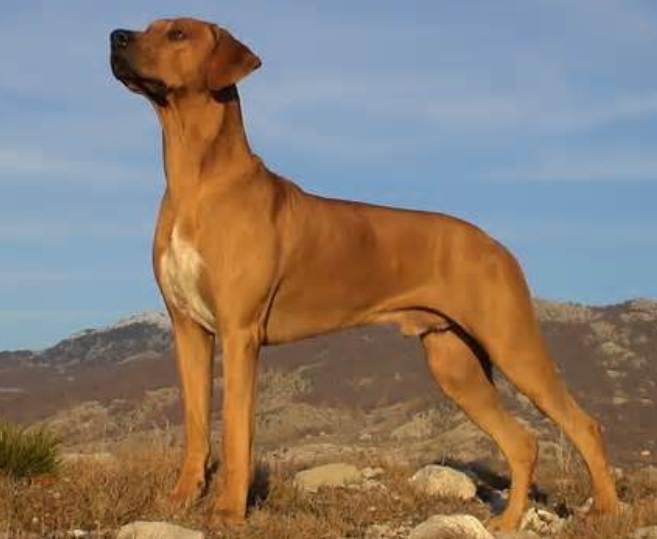
People usually start searching “Rhodesian Ridgeback” when they’re weighing up whether this is the right dog for their home — strong enough to feel safe, steady enough to live with, and suited to the space and time they can realistically offer.
A Ridgeback can be calm indoors and strikingly athletic outdoors, but the same traits that make the breed impressive — size, speed, independence — can become hard work without early training, room to move, and thoughtful management of health risks.
Rhodesian Ridgeback at a glance
- Height: 63–69 cm (males), 61–66 cm (females)1
- Typical weight: around 36.5 kg (males), 32 kg (females)1
- Coat: short, dense, sleek; the ridge is formed by hair growing in the opposite direction along the spine1, 2
- Colour: light wheaten to red wheaten (a little white on chest/toes is permitted; excessive white is undesirable)1
- Temperament (breed standard): dignified, intelligent, often aloof with strangers without aggression or shyness2
- Exercise: typically suited to owners who can provide substantial daily exercise (often more than two hours)3
- Commonly discussed breed risks: hip dysplasia; dermoid sinus (congenital and heritable)4
What makes a Ridgeback a Ridgeback
The ridge is the breed’s signature: a clearly defined strip of hair along the back that grows in the opposite direction, beginning just behind the shoulders and running towards the hips.1, 2 It’s more than a cosmetic detail — the ridge is bound up with the breed’s history, and it’s also why prospective owners should be aware of dermoid sinus, a congenital defect that occurs most commonly in Ridgebacks.4
In build, a Rhodesian Ridgeback is meant to be balanced, strong, muscular, agile and capable of endurance with a fair amount of speed — a dog designed to travel ground efficiently rather than carry bulk.1
History and origin (the short, accurate version)
The Rhodesian Ridgeback developed in southern Africa, with ancestry linked to ridged dogs kept by the Khoikhoi/Khoisan peoples, later shaped through crossings with dogs brought by European settlers.3 The breed became known for work as a hunting and property-guarding dog, and in Rhodesia (now Zimbabwe) it was used largely for tracking lions and holding them at bay until hunters arrived — not for tackling them outright.3
A key figure often mentioned in breed history is big-game hunter Cornelius van Rooyen, associated with breeding “lion dogs” that contributed to the Ridgeback we recognise today.5
Temperament and behaviour
At its best, the Ridgeback comes across as quiet confidence: observant, physically capable, and not automatically social with everyone who walks through the gate. Breed standards describe a dog that is dignified and intelligent, typically aloof with strangers while showing no aggression or shyness.2
With family, visitors, and the wider world
Many Ridgebacks settle into a calm, low-fuss presence at home once their exercise needs are met, but they tend to notice changes in their environment quickly — a breed shaped to track, guard, and move with purpose.1, 2
Because they can be reserved and physically powerful, early, steady socialisation matters. The goal isn’t to force friendliness; it’s to build neutrality — a dog that can watch quietly without escalating, and can take direction from the handler in new places.
Training and exercise needs
A Rhodesian Ridgeback can learn quickly, but independence is part of the design. Training tends to go best when it’s calm, consistent, and rewarding, with clear boundaries from puppyhood and an emphasis on recall, loose-lead walking, and polite greetings.
How much exercise is “enough”?
This is a breed usually grouped with dogs that need substantial daily exercise — often more than two hours a day, depending on age, fitness, and the individual dog.3 Long, purposeful walks, controlled off-lead time in secure areas, and scent-based games can suit them well.
A practical daily rhythm
- One longer outing for steady movement and sniffing time.
- One shorter session for training, recall practice, or structured play.
- Quiet decompression at home — many Ridgebacks switch off well once their needs are met.
Health and lifespan
Many Rhodesian Ridgebacks live into their second decade, and commonly cited average lifespan figures sit around 10–12 years.6 Like all large breeds, they benefit from routine veterinary care, appropriate conditioning, and keeping body condition lean rather than “solid”.
Hip dysplasia
Hip dysplasia is a recognised problem across many medium-to-large breeds. If you’re buying a puppy, ask what hip screening has been done in the breeding lines, and discuss results with your vet. Screening programs exist to help identify lower-risk dogs for breeding and selection.7
Dermoid sinus (important for Ridgebacks)
Dermoid sinus (also called pilonidal sinus) is a congenital defect caused by incomplete separation of skin and nervous tissue during embryonic development. It is most common in Rhodesian Ridgebacks and is considered heritable, so affected dogs should not be bred.4
In practical terms, it can look like a small opening or tract along the midline of the neck/back, sometimes with a swirl of hair. Because some sinuses can extend deeper and may connect to tissues around the spinal cord, diagnosis and treatment should be handled promptly by a veterinarian, and surgery is often recommended depending on type and extent.4
Grooming and coat care
The Ridgeback’s short, dense coat is usually low maintenance. Weekly brushing is often enough to remove loose hair and dust and to keep the coat glossy.3 Use grooming time to check ears, nails, and skin (including along the ridge), especially after runs in long grass.
Diet and feeding (keeping it simple and evidence-based)
Choose a complete and balanced diet that suits your dog’s life stage, and adjust portions to keep a visible waist and an easy-to-feel rib outline under light cover. If you’re comparing foods, ingredient lists can be misleading; veterinary nutrition guidelines recommend looking at the whole diet and the manufacturer’s quality controls rather than marketing claims.8
Feeding pattern and bloat awareness
Deep-chested, large dogs can be at risk of gastric dilatation-volvulus (GDV, “bloat”). There’s no single guaranteed prevention, but commonly recommended risk-reduction habits include splitting food into two or more meals and avoiding vigorous exercise around mealtimes.9
Living conditions: space matters, but so does management
Ridgebacks tend to do best in homes with room to move and owners who can provide daily exercise and training. A yard helps, but it doesn’t replace structured walks and engagement — a bored, under-exercised Ridgeback can invent its own entertainment very quickly.
If you live in a smaller space, the deciding factor is rarely the floorplan. It’s whether you can meet the breed’s exercise needs consistently, keep the dog safely contained, and provide calm, ongoing training in real-world settings.
Final thoughts
The Rhodesian Ridgeback is built for distance and decision-making: a dog with quiet presence, strong physicality, and a watchful nature. In the right hands, that combination is steady and beautiful. In the wrong fit, it can become heavy to live with.
If you’re considering one, spend time with adult Ridgebacks, ask breeders about health screening (especially for hips and dermoid sinus), and be honest about how much daily movement and training you can sustain over the long term.
References
- National Rhodesian Ridgeback Council Australia — Breed standard (size, coat, colour, ridge description)
- The Kennel Club (UK) — Rhodesian Ridgeback breed standard (temperament, ridge description)
- The Kennel Club (UK) — Rhodesian Ridgeback breed information (exercise, origin overview)
- American College of Veterinary Surgeons — Dermoid (pilonidal) sinus overview and breed association
- Cornelius van Rooyen — background and connection to early Ridgeback breeding
- Purina UK — Rhodesian Ridgeback breed profile (lifespan and general overview)
- The Kennel Club (UK) — Hip dysplasia screening scheme overview
- WSAVA Global Nutrition Guidelines — choosing diets and interpreting food information
- VetZone (Australia/NZ) — Gastric dilatation-volvulus (bloat) risk reduction advice

Veterinary Advisor, Veterinarian London Area, United Kingdom