
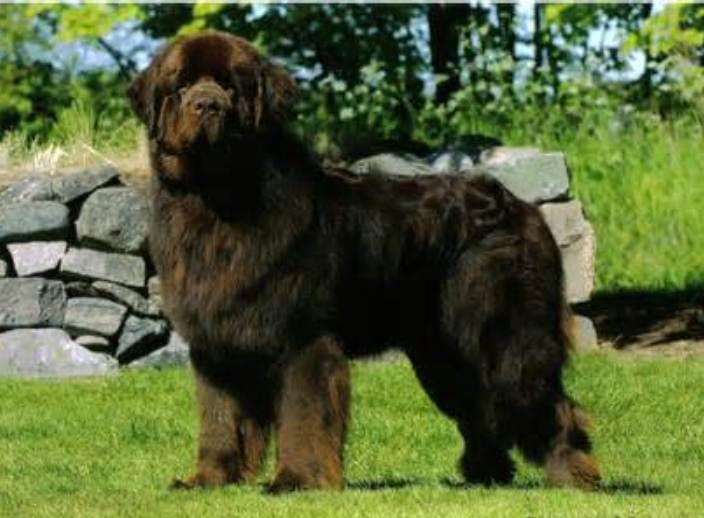
People usually look up Newfoundlands when they’re weighing up a very large family dog, checking whether the “gentle giant” reputation is earned, or trying to understand the real care load behind that thick coat and heavy frame. The practical stakes are simple: space, cost, training, and health management all scale up quickly with a giant breed.
The Newfoundland is a powerful water-working dog shaped by cold seas and hard labour, then softened by centuries of living close to people. Calm, steady, and famously capable in the water, they can be a wonderful match for the right household—provided you plan for size, grooming, heat, and a few breed-linked health risks.1, 6
Newfoundland at a glance
- Type: Giant, heavy-boned working breed with a dense, water-resistant double coat.1
- Typical size (breed standard averages): About 71 cm at the shoulder for males and 66 cm for females; roughly 64–69 kg for males and 50–54.5 kg for females.1
- Colours (recognised in breed standards): Black, brown, and white with black markings (Landseer pattern).2, 6
- Temperament: Typically calm, patient, and even-tempered; best with steady handling and early training.6
History and origin
The breed developed on the Canadian island of Newfoundland, where dogs worked alongside fishing communities. In cold, rough coastal conditions, usefulness mattered: strength for hauling and pulling, a coat that handled water, and a body that moved confidently through surf and current. Over time, these traits became part of the breed’s “shape”—dense coat, strong build, and a characteristic ease in the water.6
Newfoundlands are still closely associated with water work. Their swim ability isn’t a trick; it’s a set of physical features working together—large frame, powerful movement, water-resistant coat, and feet that are often described as webbed.1, 9
Physical characteristics
A Newfoundland is built like a working draft animal: broad, deep-chested, heavily boned, and strong through the shoulder and hindquarters. The coat is flat, dense, and oily to the touch in breed descriptions—practical insulation for cold water rather than soft decoration.2
Size (what “giant” really means)
Breed standards give useful averages: males around 71 cm at the shoulder and 64–69 kg; females around 66 cm and 50–54.5 kg. Individual dogs can sit outside these figures, but the overall picture is consistent—this is a lot of dog, even when the dog is “average”.1, 6
Coat and colour
The double coat helps repel water and hold warmth. Recognised colours include black, brown, and white with black markings (often called Landseer). In practical terms, the coat means you’ll be managing shedding, tangles, and damp-dog smell if your Newfoundland swims often.2, 6
Temperament and behaviour
Newfoundlands are widely described in breed standards as calm, patient, and steady. Many families love them for their soft approach to household life—slow to react, more inclined to lean than lunge—yet still physically imposing.6
They’re often talked about as “nanny dogs”, but it’s safer to treat that as reputation rather than a guarantee. Any dog can bowl over a small child by accident, and any dog can react poorly if stressed, sore, or poorly socialised. Supervision and training matter, especially when the dog outweighs the child.6
Children and other animals
With sensible introductions and consistent routines, many Newfoundlands live peacefully with children and other pets. The key is early, calm socialisation and teaching polite body manners—waiting at doors, not crowding food bowls, not charging up to visitors—because “friendly” at 65 kg can still be unsafe if it’s untrained.6
Training, socialisation, and exercise
Start early. A giant breed puppy becomes physically unmanageable long before it becomes mentally mature, so the useful window for teaching lead skills, gentle greetings, and calm handling comes quickly. Keep sessions short, use rewards, and prioritise everyday behaviours that prevent accidents—loose-lead walking, recall foundations, and relaxed handling for grooming and vet checks.6
Exercise should be regular and joint-friendly. Many Newfoundlands enjoy swimming, and it can be a good low-impact way to build fitness. Avoid turning exercise into repetitive high-impact pounding, especially while the dog is still growing.9
Health and lifespan
Newfoundlands are a giant breed, and that comes with predictable themes: joint wear, heart concerns, and a shorter average lifespan than smaller dogs. A commonly quoted lifespan range is around 8–10 years.9
Common issues to discuss with your vet
- Orthopaedic disease: Large breeds are more prone to conditions such as hip and elbow dysplasia.
- Heart disease: Newfoundlands are among breeds discussed in relation to subaortic stenosis (SAS) in general breed health guidance.
- GDV (bloat): Deep-chested, large dogs are at higher risk of gastric dilatation-volvulus, a true emergency.
If you’re choosing a puppy, ask breeders about health screening and family history. If you already have a Newfoundland, ask your vet what monitoring makes sense for your dog’s age and risk factors.10
GDV (bloat): simple prevention habits that help
GDV can’t be prevented with a single trick, but feeding and routine choices can reduce risk. For large and giant breeds, recommendations commonly include splitting food into multiple smaller meals, avoiding raised feeders in at-risk dogs, slowing down fast eaters, and limiting hard exercise around mealtimes.4, 5, 8
For some at-risk breeds, vets may discuss a preventive gastropexy (often done at the time of desexing). It doesn’t stop gas build-up, but it can reduce the risk of the stomach twisting—the life-threatening part of GDV.5, 7
Grooming and maintenance
The Newfoundland coat is designed to resist water, and it behaves like it. Expect regular brushing as baseline care, with heavier shedding at seasonal changes. Pay attention to damp areas after swimming—behind ears, under the collar, and in the feathering—because trapped moisture and mats can irritate skin.2
Because these dogs are heavy, basic handling skills are part of grooming: standing calmly for brushing, allowing paws to be checked, and accepting ear checks without fuss. Teach this gently from puppyhood and it becomes quiet, routine maintenance rather than a wrestling match.
Diet and nutrition
A Newfoundland’s diet needs to support a large body without pushing it into excess weight, which loads joints and can worsen mobility over time. Choose a complete and balanced diet appropriate to life stage, and ask your vet for guidance on amounts—calorie needs vary widely between a young, active dog and an older, sedentary one.4
For GDV risk reduction, many veterinary sources recommend feeding two to three smaller meals rather than one large meal, and using slow-feeding strategies if your dog bolts its food.4, 8
Famous Newfoundlands and enduring myths
You’ll often hear that Newfoundlands have an instinct to “save drowning people”. What’s more reliable is the underlying truth: the breed is physically and behaviourally well-suited to water work, and many individuals take naturally to swimming and retrieving. Treat it as potential, not a promise, and always keep water safety and supervision front and centre.9
Final thoughts
A Newfoundland brings weight, hair, and presence into a home—along with a calm steadiness that many people find deeply reassuring. When their training starts early, their weight is kept sensible, and their routine is built around cool exercise, grooming, and preventative vet care, these dogs settle into family life with the quiet competence of an animal shaped by work.6
References
- Dogs Australia (ANKC) — Newfoundland breed standard
- Dogs Victoria — Newfoundland breed standard (coat/colour/size)
- United Kennel Club (UKC) — Newfoundland breed standard (size and movement)
- Purina Institute — Canine gastric dilatation-volvulus (GDV): feeding practices and risk reduction
- Cornell University College of Veterinary Medicine — Gastric dilatation-volvulus (GDV) overview and prevention
- The Kennel Club (UK) — Newfoundland breed standard (size, general description)
- American College of Veterinary Surgeons — Gastropexy and GDV
- American Animal Hospital Association (AAHA) — Understanding canine bloat (GDV)
- Royal Canin Australia — Newfoundland breed guide (traits and general care considerations)
- RSPCA Australia — What to consider before getting a dog

Veterinary Advisor, Veterinarian London Area, United Kingdom