
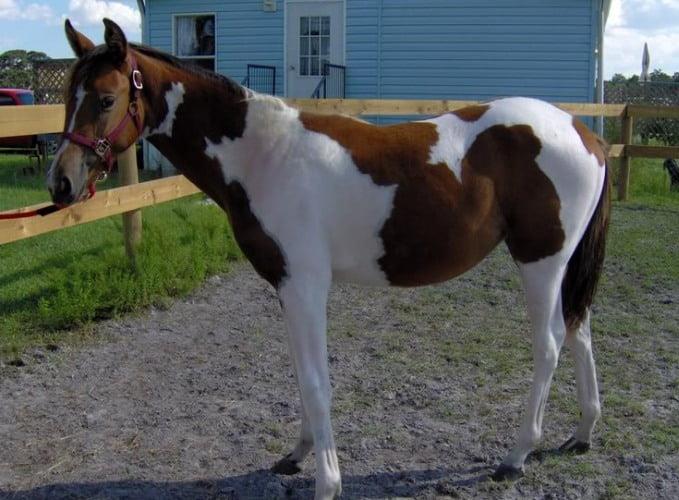
People usually look up the Florida Cracker Horse when they’re weighing up a rare-breed purchase, trying to recognise one, or checking whether the “Cracker” is genuinely distinct from other Spanish-derived horses. The details matter: size, type, and gait affect day-to-day handling, and the breed’s rarity means good information helps avoid misidentification and supports responsible breeding.
What follows is a clear profile of the Florida Cracker Horse—where it came from, how it tends to be built and move, what it’s like to live with, and the practical care points that keep a tough little horse healthy for decades.1, 2, 3
Florida Cracker Horse: quick facts
- Height: about 13.2 to 15.2 hands2, 4
- Weight: roughly 700 to 1,000 lb (about 320 to 450 kg)4, 5
- Colours: many colours occur; solid colours are common4
- Type: compact, short-backed, sloping croup; refined head with straight to slightly concave profile4
- Uses: stock work, trail riding, endurance and general riding pursuits2, 4
- Status: a rare heritage breed with ongoing conservation work6, 7
History and origin
The Florida Cracker Horse descends from Spanish horses brought into Florida in the 1500s. Isolated by geography and shaped by work, the type stayed small, quick, and durable—useful traits in scrub, swamp edges, and long hot days.2, 4
The name “Cracker” is tied to Florida’s early cattle culture—stockmen moving cattle over open country, often using long whips whose crack carried across the flats. The horse became part of that working system, valued for agility and stamina rather than bulk.2, 5
Numbers fell sharply in the 20th century as cattle handling changed and larger horses (notably Quarter Horses) became more popular for roping and heavier work. A small set of ranching families kept remnant lines going, and organised preservation accelerated from the late 1980s onward through the Florida Cracker Horse Association and partner herds.4, 5, 7
Official recognition
Florida designated the Florida Cracker Horse (also called the “Marshtackie”) as the official Florida state horse in 2008, written into state law.1, 8
Physical characteristics: what they tend to look like
Cracker Horses are small saddle horses with a strong back, a sloping croup, and a refined head. Breed descriptions commonly note a straight to slightly concave profile, a fairly narrow chest, and a compact frame that reads “built to travel”.4
Coat colour is variable. Solid colours are commonly seen, but the key identifiers are body type, movement, and provenance rather than colour alone.4
Gait and movement (including the “single-foot” idea)
Some Florida Cracker Horses are naturally gaited. The Florida Cracker Horse Association recognises the running walk and an ambling gait, alongside the usual walk, trot, canter and gallop.4
You’ll sometimes hear the term “single-foot” used loosely for smooth, four-beat intermediate gaits. In practice, it’s more accurate to describe what the horse is actually offering—an amble, running walk, or another comfortable four-beat gait—rather than assuming every Cracker will be strongly gaited.4
Temperament and behaviour
Breed descriptions tend to emphasise an alert, willing nature—horses that pay attention, learn quickly, and stay useful with consistent handling. As with any breed, temperament varies with genetics, training, and day-to-day management, so it’s worth meeting the horse in a calm setting and watching how it settles after a few minutes of quiet work.2, 4
Family suitability: a gentle reality check
Many Cracker Horses suit pleasure riding and can be sensible partners, but a horse is still a large, reactive animal with quick reflexes and strong flight responses. “Good with children” depends less on the breed name and more on the individual horse, its training, and close adult supervision around yards, gates, feed, and feet.
Training and exercise needs
Cracker Horses were shaped by work that required steady miles and short bursts of speed, so they tend to do well with regular, varied exercise: trail riding, arena schooling, cattle work, and long slow conditioning. Keep sessions frequent enough to maintain fitness, and short enough to avoid drilling—especially in heat.2
Early handling matters. Calm exposure to yards, saddling, foot handling, and transport builds a horse that copes when the world gets noisy.
Health and lifespan
Many horses live well into their 20s with good care. Longevity is less about “hardy breed” mythology and more about the quiet basics: feet, teeth, forage, parasites, and prompt attention when something looks off.
Common health issues to watch for
No breed is immune to the big equine problems. Two that matter on any property are colic and laminitis—both influenced by feeding practices, routine, and how quickly signs are noticed.9, 10
Practical preventative care
- Keep the diet forage-first: most horses do best on grass and hay, with concentrates (grains) added only when genuinely needed for work or body condition.9
- Change feed slowly: abrupt diet changes can upset the gut; transition over several days (or longer) when swapping hay, hard feed, or turnout routines.9
- Split meals: smaller, more frequent feeds are closer to natural grazing patterns than one or two large grain-based meals.9
- Stay ahead of routine care: vaccinations, dental care, farriery, and parasite control should be set with your vet for local conditions.
When to call a vet urgently
Colic can look like pawing, repeated looking at the flank, kicking at the belly, stretching as if to urinate, reduced droppings, rolling, or sudden dullness. If you suspect colic, prompt veterinary attention is the safest move.10
Diet and nutrition
Think of the Cracker Horse as a small, economical traveller: it still needs plenty of fibre, steady water intake, and consistent routines. Pasture and good-quality hay form the base. Grain is not a default; it’s a tool for particular cases (higher work, weight gain, some older horses), and it’s easiest on the gut when used in moderation and split into small feeds.9
Conservation and responsible ownership
The Florida Cracker Horse remains a rare heritage breed, with organised conservation and registry work supporting its survival. If you’re buying or breeding, start with verified registration, documented bloodlines, and a clear plan for responsible placement of offspring—small breeds survive on careful record-keeping and patient decisions.6, 7
Final thoughts
The Florida Cracker Horse is a compact, capable animal shaped by Florida’s cattle country: light on its feet, built to travel, and still rare enough that every well-managed horse matters. For owners, the reward is in the everyday rhythm—good feet, steady forage, calm training, and a horse that keeps showing up, year after year.2, 4
References
- Florida Department of State — State Horse (Florida Cracker Horse)
- Oklahoma State University — Breeds of Livestock: Florida Cracker Horses
- Florida Statutes — Fla. Stat. § 15.0526 (Official state horse)
- Florida Cracker Horse Association — About Us (history and breed characteristics)
- Spanish Mustang Foundation — Mid Atlantic Strains (Florida Cracker Horse summary)
- The Livestock Conservancy — Conservation Priority List announcement (annual list context)
- Florida Cracker Horse Association — Home (preservation and registry growth)
- Florida Senate — CS/CS/HB 131 (2008) Bill Text: designating Florida Cracker Horse as official state horse
- Michigan State University College of Veterinary Medicine — Colic: Prevention (feeding and management)
- Merck Veterinary Manual (Horse Owners) — Introduction to digestive disorders of horses (colic signs and urgency)

Veterinary Advisor, Veterinarian London Area, United Kingdom