
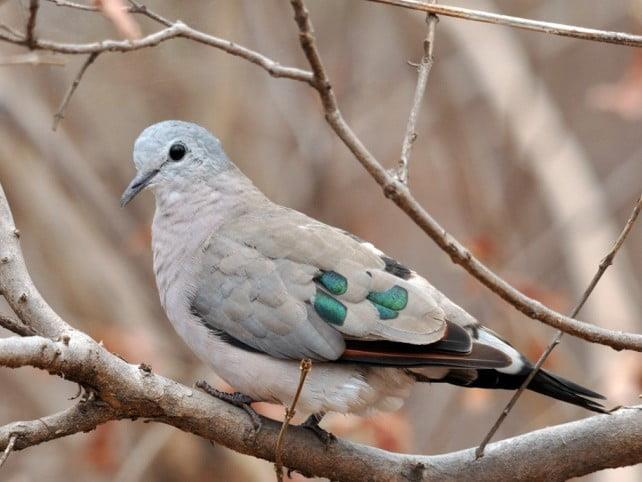
People usually look up the Black-billed Wood Dove when a soft, steady cooing is coming from dry scrub or savanna woodland—and the bird itself refuses to show. Getting the ID wrong is easy, especially where several similar Turtur doves share the same pale browns and quick, low flights.
The Black-billed Wood Dove (Turtur abyssinicus) is a small African pigeon of the Sahel and nearby dry country: often on the ground, often near water, and most reliably recognised by its all-black bill and the dark, glossy wing patches that flash when it turns. 1, 2
Quick identification
At rest, this dove can look plain. In motion, it becomes more readable: low, fast flight; warm tones in the wing; and bold bars and patches that appear and vanish as it banks through thorny trees.
- Size: small and compact, typically about 20 cm long. 1
- Bill: entirely black (a key field mark). 1, 2
- Upperparts: pale grey-brown with dark, metallic-looking wing patches; two darker bars across the lower back are often noted in field descriptions. 1, 3
- Underparts: pinkish wash on the breast, paling towards the belly. 1
- In flight: quick, low flight; rufous/chestnut tones show in the wing. 1, 2
Range and habitat
The Black-billed Wood Dove is a widespread resident across a broad belt of Africa just south of the Sahara, strongly associated with dry landscapes—near-desert, scrub, savanna and thorny woodland. 1, 2
It is not considered a long-distance migrant. Movements are better described as local shifts—often tied to water and seasonal food—rather than regular migration. 2
Behaviour (why you hear it more than you see it)
This is a bird of edges and cover: moving quietly through low trees, dropping to the ground to feed, then slipping away on fast wingbeats when approached. It is frequently encountered alone or in pairs, though larger gatherings can form where conditions concentrate birds—especially at waterholes. 1, 2
Vocalisations
The song is a persistent, fluted cooing that carries well across open scrub. It can be the first (and sometimes only) clue that the bird is nearby. 1, 3
Diet and feeding
Black-billed Wood Doves feed mainly on small seeds, taking much of their food from the ground. Like many doves, they may also pick at other small plant material when available, but they are best thought of as seed-eaters built for life in dry country. 1, 2
Breeding
The nest is a simple platform of sticks placed in a tree—often in thorny species such as acacias—and the usual clutch is two pale eggs. Breeding can occur whenever local conditions are favourable, rather than being locked to a single, narrow season across the whole range. 1
Predators and risk
In open savanna and scrub, eggs and adults may be taken by a mix of predators. Snakes are common nest raiders, and raptors are an obvious threat in open country. Mammalian predators can also take birds on or near the ground, especially around cover and water. (Specific predator lists vary by location and are not consistently documented for this species in open references.) 5
Conservation status
The Black-billed Wood Dove is listed as Least Concern on the IUCN Red List, reflecting its wide range. That said, broad-scale habitat change in parts of the Sahel and surrounding regions can still affect local abundance over time, and trends can vary across its distribution. 4
Notes for birdwatchers
- Best places to look: dry scrub, thorny savanna woodland, and the margins of near-desert habitats—especially near water in the heat of the day. 1, 2
- Best approach: stop, listen, then scan low branches and the ground beneath trees. The bird often feeds quietly before flushing low and fast. 1
- Similar species: other African wood doves can look close at a glance; the all-black bill and the particular pattern of wing patches and back bars are useful anchors. 3
How big is a Black-billed Wood Dove?
It is a small dove, typically about 20 cm long. 1
Is it migratory?
No. It is generally resident, with local movements that track food and water rather than long-distance migration. 2
Where does it live?
Across a wide belt of sub-Saharan Africa, strongly associated with dry habitats such as scrub and savanna. 1, 2
What does it eat?
Mostly small seeds gathered on the ground. 1, 2
References
- Wikipedia — Black-billed wood dove (Turtur abyssinicus)
- Earth Life — Black-billed Wood Doves (Turtur abyssinicus)
- Cornell Lab of Ornithology (eBird) — Black-billed Wood-Dove
- IUCN Red List of Threatened Species — Home (assessment source for category)
- BirdLife International — Home (species accounts and conservation context)

Veterinary Advisor, Veterinarian London Area, United Kingdom