
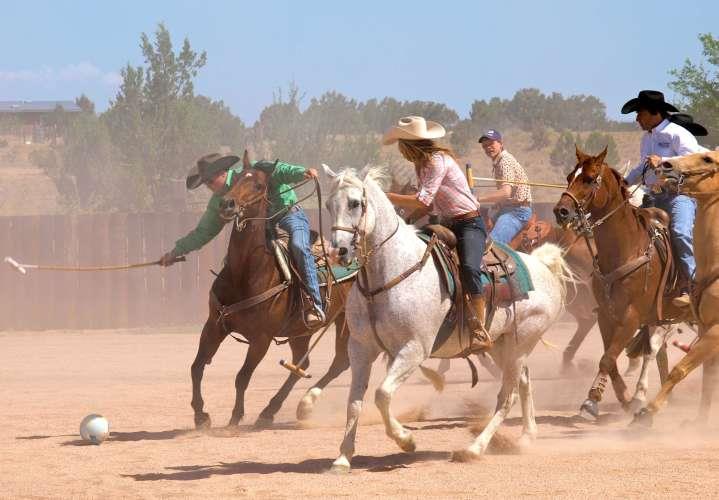
Most people look up cowboy polo when they’ve heard the name at a showground, seen a clip online, or been invited to a local game and want to know what they’re actually watching. The details matter: team size, the ball, and the arena “zones” change the pace and the tactics, and it’s easy to confuse cowboy polo with arena polo or field polo.
Cowboy polo is a Western-flavoured variation of polo, usually played in a rodeo-style arena on dirt, using Western tack and a larger ball. It keeps the core idea—horseback riders driving a ball through goals—but the format is shaped to suit stock horses, tight spaces, and community events.1
What cowboy polo is (and what it isn’t)
Cowboy polo is a variation of polo played mostly in the western United States. It’s typically played in an enclosed arena (often a rodeo arena), using Western saddles and gear, and a large red rubber ball rather than the small hard polo ball used in field polo.1
It’s often muddled with arena polo. Arena polo is another recognised format of polo, also played in an enclosed arena, but it generally uses three players a side and a smaller ball, and it sits more squarely within mainstream polo club structures.2, 3
Origins and where it’s played
Cowboy polo grew as a more informal, lower-cost way to play a mallet-and-ball game on horseback, using the horses and equipment people already had. Modern cowboy polo is now reported as being played largely in Montana, with fewer clubs than in earlier decades.1
The earlier draft named specific founders, associations, and championship events, but those claims aren’t consistently supported by reliable, citable sources. It’s safer—and more accurate—to say the sport has been organised locally through clubs and recurring community fixtures, rather than tied to one documented founder.
Rules and gameplay (the quick, practical version)
Cowboy polo keeps polo’s basic objective: score by sending the ball through the opponent’s goal using a mallet, from horseback, over timed periods called chukkas.1
Team size and officials
Unlike field polo’s four-a-side format, cowboy polo commonly uses five players per team, with mounted referees and goal spotters assisting with calls and scoring.1, 2
The arena, zones, and scoring
A distinctive feature in many cowboy polo rule sets is the zoned arena. Players are assigned to zones, and crossing into the wrong zone can hand possession to the other team. Scoring may also reward longer shots: goals can be worth one, two, or three points depending on the zone the shot is taken from and whether it is touched along the way.1
Timing
Cowboy polo is often played in four chukkas of 15 minutes, with rest breaks between periods and a longer halftime break. Local events may vary, but the “four chukkas” structure is commonly described for the sport.1
How it differs from traditional field polo
The simplest way to tell them apart is the setting and the gear. Field polo is played on a very large grass field with four players per side; the pace is built around space, long passes, and frequent horse changes.2, 4
Cowboy polo is usually played in a rodeo arena or enclosed dirt area, with Western saddles and equipment, and it uses a large rubber ball that behaves differently off the mallet and the ground. The tighter footprint pulls play into closer quarters and makes angles, rebounds, and quick turns matter.1
Horses and equipment
Horses
Cowboy polo is commonly played on stock-type horses rather than specialist polo ponies. Sources describing the sport often mention the American Quarter Horse as a typical choice, valued for agility and quick acceleration and stopping in tight spaces.1
Another practical difference from field polo: riders may use one horse throughout, with limits on the number of horses permitted per game in some competitions.1
What players use
Equipment varies by club, but cowboy polo is widely described as using:
- Western saddles and Western tack1
- Long-shaft mallets (often with durable, modern materials)1
- A large red rubber ball (commonly described as a rubber “medicine ball”)1
Skills that matter on the day
Cowboy polo rewards calm control at speed. Riders need to steer one-handed, manage tight turns, and keep their horse straight through contact and congestion without losing balance or line. Good striking still counts, but so does reading rebounds, protecting space, and choosing when to take a longer, higher-value shot if your rules use zone scoring.1
Health and safety basics
Horseback sport carries real risk, particularly in enclosed arenas where players converge quickly. Helmet use is a common baseline expectation, and Australian equestrian bodies publish clear lists of approved helmet safety standards (such as AS/NZS 3838 and several equivalent international standards).5
For horse welfare, good practice is unglamorous and consistent: soundness checks, adequate rest, and the ability for stewards or veterinarians to inspect a horse if welfare concerns arise are widely recognised principles in regulated equestrian sport.6
Getting involved (especially in Australia)
If you’re keen to try cowboy polo, start by watching a match in person. Because rule sets can be club-based, the best first question is simply: “Which rules are you playing today?” From there, look for a local equestrian club or polo community that can point you to arena-based polo opportunities and safe coaching pathways.2, 3
If you’re already playing polo in Australia, note that equipment rules can shift over time. For example, the Australian Polo Federation has published updated helmet rules with an effective date of 1 March 2026, reflecting a tightening focus on certification and quality-control marks for approved helmets.7
Fun facts (kept honest)
- Cowboy polo is often described as being played in a rodeo arena with a large red rubber ball, which changes how the ball carries and bounces compared with field polo.1
- Team size is commonly five-a-side in cowboy polo—one of the quickest ways to spot that you’re not watching standard field polo.1, 2
Final thoughts
Cowboy polo looks familiar at first glance—mallets, horses, goals—but the arena, the larger ball, and the zoned structure give it a different texture. It’s closer, dustier, and more compressed, with decisions made in tight turns and short bursts, and it tends to sit naturally in communities where horses are working partners first and sporting partners second.1
References
- Cowboy polo (overview, rules, equipment, team size) – Wikipedia
- FAQs (team size in field polo and arena polo) – Polo Museum
- Polo rules (field vs arena team size; chukkas) – Hurlingham Polo
- Beginner’s guide to playing polo (field size and structure; arena basics) – The Washington Post
- Current approved safety standards for helmets – Equestrian Australia
- FEI Veterinary and Welfare Rules (changes and welfare oversight context) – Fédération Équestre Internationale (FEI)
- APF Polo Rules (October 2025) – Helmet rules effective 1 March 2026 – Australian Polo Federation

Veterinary Advisor, Veterinarian London Area, United Kingdom