
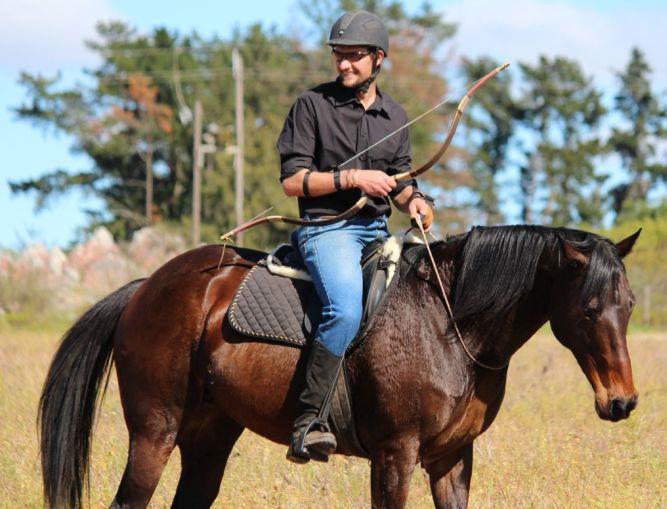
Mounted archery tends to find people at a very practical moment: choosing whether to try it, working out what gear is actually needed, or checking what’s involved before taking a horse onto a track with arrows flying. It’s a sport where small details matter—fit, timing, horse preparation, and safety habits—because speed magnifies everything.
Below is a clear look at where mounted archery comes from, how it’s practised now, what equipment is genuinely useful, and how competitions are usually structured. Where traditions differ (for example, ceremonial yabusame versus modern sport formats), those differences are made explicit.
Mounted archery at a glance
Mounted archery is shooting a bow from horseback while the horse is moving—often along a straight track, sometimes through patterns. The rider manages balance and aim while the horse maintains rhythm and line. In many modern rule sets, the emphasis is on accuracy under time pressure, with welfare and safe conduct written into competition rules.1, 2
History and origins
From necessity to tradition
Horseback archery developed wherever horses, open ground, and composite or short bows made mobile shooting practical. In the Eurasian steppe, mounted archery became a defining tool of nomadic warfare and hunting; in Japan it took on both military and ceremonial forms over time.3, 4
Japan’s yabusame: a ceremonial branch of mounted archery
Yabusame is a formalised Japanese tradition performed on shrine grounds. Riders gallop a course of roughly 250 metres and shoot three arrows at three targets, with the focus on correct form and successful hits rather than winning a sporting contest.3, 4
Equipment and gear
Bow and arrows
Most mounted archers favour compact bows that are easier to handle around a moving horse—often traditional-style horse bows or short recurves. Competition rules may restrict modern accessories (such as sights or stabilisers) depending on the organisation and track rules, so it’s worth checking the rulebook before buying equipment.1, 5
- Bow: manageable length, comfortable grip, and a draw weight you can control while moving.
- Arrows: consistent spine and weight; durable shafts suited to repeated shooting.
- Quiver system: secure and predictable—body quivers are common, and some disciplines allow or favour bow-hand loading styles.5
Tack and horse considerations
A calm, straight-moving horse with reliable brakes and steering is more important than specialised tack. Riders commonly choose a saddle that allows a stable seat without locking the hips, and they avoid anything that interferes with the horse’s shoulder or breathing when speed increases. Welfare-focused rulesets emphasise well-fitting tack and prohibit rough handling.2
Modern innovations (useful, but not magic)
Materials have changed—carbon arrows and durable synthetic strings are common—but the limiting factor is still coordination: the horse’s rhythm, the rider’s balance, and the ability to draw and release cleanly without disrupting the line of travel.
Core techniques and skills
Start slow, then add speed
The cleanest mounted archery tends to look almost quiet: the horse stays steady, and the rider’s upper body moves independently from the stride. Most training progressions begin at a walk, then trot, then canter, and only later bring in gallop work once the horse is settled with the equipment and the rider can shoot without grabbing the reins for balance.
What good form usually includes
- Stable base: weight balanced through seat and legs, allowing the torso to remain tall without stiffening.
- Consistent draw: same anchor and draw length each time, even as the horse’s stride changes.
- Timing: releasing in a repeatable part of the stride so the sight picture doesn’t “bounce”.
- Safe rein management: control without entanglement; some traditions steer with knees while both hands are on the bow.3
Training: the horse–rider partnership
Mounted archery training is two overlapping lessons. The rider learns to shoot while moving. The horse learns that the bow, arrows, and the sound of shots are ordinary parts of work.
- Desensitisation: introduce bow movement, arrows, and target noise progressively, keeping sessions short and calm.
- Line and rhythm: practise riding straight down a track at consistent speed before adding shooting.
- Welfare first: choose methods that avoid fear and force; reputable rule sets place equine welfare at the centre of the sport’s culture and conduct expectations.2
Competitions and events
How modern events are commonly run
Many competitions use a straight course with targets placed along the side. Riders are scored for hits, and sometimes also for time (or penalties for being too slow/too fast). Exact target sizes, distances, and scoring rings vary by track style and governing body.1, 5
Examples of rule frameworks
Two widely used frameworks include the International Horseback Archery Alliance (IHAA), which publishes a rulebook and a grading system, and the World Federation of Equestrian Archery (WFEA), which describes standardised timing and target specifications for its competition formats.1, 5
Safety and welfare
Helmet and head injury basics
Falls happen quickly in any equestrian discipline, and head knocks can be easy to underestimate. Australian equestrian bodies commonly require (and broadly recommend at all times) an approved riding helmet with the chin strap fastened, built to recognised safety standards.6
Concussion guidance in Australian sport emphasises taking every concussion seriously and following staged return-to-sport protocols. Equestrian Australia has aligned its approach with the Australian Institute of Sport’s concussion guidance and return-to-play expectations.7, 8
Practical safety checks before you shoot
- Check tack fit and condition (girth, stirrup leathers, billets, bridle) before every session.
- Use a helmet that meets an approved standard and is correctly fitted and fastened.6
- Train in an enclosed, predictable space with safe backstops and clear no-go zones.
- Keep early sessions unhurried: calm horse first, arrows later.
Health and fitness
Mounted archery quietly demands two kinds of stamina: postural endurance (staying stable in the saddle without bracing) and upper-body control (drawing and releasing consistently). Many riders find their core and shoulder endurance improves with steady practice, but the biggest “fitness” gain is often coordination—learning to keep hands and seat soft while the horse moves underneath.
Final thoughts
Mounted archery sits at the meeting point of speed and stillness. The horse carries momentum; the rider finds a brief, repeatable moment to draw, aim, and release. Whether you’re drawn to steppe history, Japanese ceremony, or modern sport tracks, the most lasting progress usually comes from the same place: patient basics, careful welfare, and practice that stays calm even when the pace quickens.2
References
- International Horseback Archery Alliance (IHAA) — Rules (January 2025 rulebook referenced)
- International Horseback Archery Alliance (IHAA) — Equine Welfare and Clean Sport
- Government of Japan (HLJ) — Galloping Across Worlds: The Sacred Art of Yabusame (Dec 2025)
- Japan Tourism Agency (MLIT) — Yabusame Archery Track (Tsurugaoka Hachimangu)
- World Federation of Equestrian Archery (WFEA) — Rules
- Equestrian South Australia — Current approved safety standards for helmets
- Equestrian Australia — 2024 Concussion Protocol Update for Coaches
- Australian Sports Commission — Concussion in sport (AIS resources)
- PubMed — Incidence of concussions and helmet use in equestrians (2022)

Veterinary Advisor, Veterinarian London Area, United Kingdom