
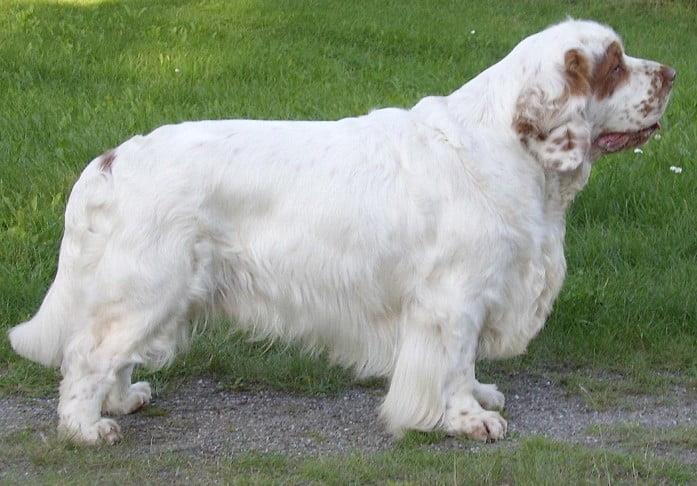
People usually start looking up Clumber Spaniels when they’re weighing up a calm, sturdy family dog—one that’s affectionate at home but not frantic on walks. The details matter: this breed’s build, coat and habits can be a good match for some households, and a slow-burn headache for others.
Below is a clear, practical guide to what a Clumber Spaniel is like to live with, what their breed standard actually says, and what owners tend to manage day-to-day: weight, grooming, exercise, training, and the health issues worth planning for.
Clumber Spaniel at a glance
- Size: Large, heavy-boned and low to the ground.
- Typical adult weight (breed standard): Dogs 29.5–34 kg; bitches 25–29.5 kg.1, 2
- Height: Commonly around 43–50 cm at the withers (many sources describe this range; individual dogs vary).2, 3
- Coat: Abundant, straight, silky coat with feathering on legs and chest.1, 2
- Colour: Plain white body preferred; lemon markings common; orange permissible; light freckling on muzzle can occur.1, 2
- Temperament: Steady, reliable, kind and often a little aloof with strangers; aggression is unacceptable.2
- Energy level: Generally low to moderate—built for steady work rather than constant speed.2, 3
- Lifespan: Often around 10–12 years.3
History and origin
The Clumber Spaniel takes its name from Clumber Park, the Nottinghamshire estate associated with the Duke of Newcastle. It’s an old gundog type, bred to push through heavy cover at a determined pace—less bustle than many spaniels, but plenty of purpose when there’s scent on the ground.2
Some origin stories drift towards the romantic (French nobility, dramatic rescues and revolutions). The more grounded version is simpler: a heavy, steady spaniel developed on an English estate from the hunting dogs available at the time.3
Physical characteristics and appearance
Clumbers are long in body, low in leg, and noticeably substantial through the chest and bone. The head is broad and square, the expression is often thoughtful and dignified, and the movement tends to be efficient rather than flashy—made for hours of work, not quick sprints.2
The coat is one of the breed’s signatures: abundant, close, straight and silky, with feathering that collects burrs, grass seeds and mud if you let it wander unmaintained.1, 2
About tail docking (Australia)
You may see older descriptions saying the Clumber’s tail is “usually docked”. In Australia, cosmetic tail docking has been banned nationwide since 2004, and it should only be done for therapeutic reasons by a veterinarian.5, 6
Temperament and behaviour
The Clumber Spaniel is typically steady and kind, with a quiet confidence around the home. Many are reserved with unfamiliar people and new settings, more watchful than effusive, but the breed standard is clear that any tendency towards aggression is unacceptable.2
At their best, Clumbers are gentle companions who like to be near their people without needing constant entertainment. They can be stubborn in the way many scent-led breeds are: not defiant, just thorough, with a nose that sometimes outranks your timetable.
Training and exercise needs
A Clumber doesn’t usually need high-octane exercise, but they do need regular movement to keep joints, weight and mood steady. Think unhurried daily walks, sniffing time, and short training sessions that feel like a routine rather than a drill.
Training is typically straightforward when it stays positive and consistent. Keep sessions short, use food rewards wisely (this breed can gain weight easily), and practise calm repetition in new environments.
A simple weekly rhythm that suits many Clumbers
- Daily walks at a comfortable pace, with time to sniff.
- Two to four short training sessions per week (recall, loose-lead walking, polite greetings).
- A few “brain jobs”: food puzzles, scent games in the yard, or hide-and-seek with a toy.
Grooming and maintenance
Clumber coats are not delicate, but they are generous—dense hair plus feathering means they pick up debris and shed pale hair that shows up everywhere. Regular brushing helps prevent mats behind ears, under the chest and through leg feathering, and it reduces the amount of coat that ends up on your floors.1, 2
Ears are long and hang close, which can trap moisture and grime. If your dog is prone to ear trouble, your vet can show you a safe cleaning routine and help you spot early signs of infection.
Teeth, nails and the quiet essentials
Dental disease is common in dogs, and home care makes a difference. Veterinary dental guidelines often recommend daily tooth brushing for real benefit, with products chosen for safety and evidence (for example, items accepted by the Veterinary Oral Health Council).7, 8
Nails should be kept short enough that the dog moves comfortably and doesn’t splay the feet—especially important for a heavy-bodied breed.
Health concerns and lifespan
Clumbers are sturdy dogs, but their build and appetite mean owners often spend their effort on prevention: weight management, joint comfort, skin and ear care, and regular check-ups.
Common issues to watch for
- Hip dysplasia and osteoarthritis: hip dysplasia is an abnormal development of the hip joint that can lead to degenerative joint disease. It’s influenced by heredity as well as growth, nutrition and other factors, and it’s most common in larger breeds.9
- Obesity: easy to slide into if exercise is gentle and treats are generous. Extra weight increases load on joints and can worsen mobility problems over time.
- Ear infections: long, close-hanging ears can create a warm, moist space where problems develop, especially after swimming or frequent bathing.
Many Clumber Spaniels live around 10–12 years, with variation depending on genetics, weight, preventative care and plain luck.3
Clumber Spaniel as a family pet: what tends to work (and what doesn’t)
Often a good fit if you want
- A calm dog who enjoys being nearby, rather than a constant go-go-go companion.
- A gentle breed that can be steady around children when supervised and taught good manners on both sides.
- A dog who’s happy with daily walks and a predictable routine.
Often not a good fit if you can’t tolerate
- Regular coat care and seasonal shedding.
- Slow, scent-driven walks that take as long as they take.
- A dog who may be reserved with strangers and needs patient socialisation.
- Managing weight carefully—this is not a “free-feeding” breed.
Final thoughts
The Clumber Spaniel is a quiet, heavy-set gundog with a soft coat and a steady nature. In the right home—one that likes slow walks, consistent training, and the simple upkeep of a big white coat—it can be an unusually peaceful companion, moving through the household like a small bear with excellent manners.
References
- Dogs Australia (ANKC) – Clumber Spaniel breed standard
- The Kennel Club (UK) – Spaniel (Clumber) breed standard
- Purina UK – Clumber Spaniel breed information
- Dogs NSW – Clumber Spaniel breed overview
- RSPCA Knowledgebase – Why do some dogs still have docked tails?
- RSPCA Knowledgebase – Is tail docking legal in Australia?
- American Animal Hospital Association (AAHA) – Dental care guidelines (home care and products)
- Veterinary Oral Health Council (VOHC) – Accepted products
- Merck Veterinary Manual (Professional) – Hip dysplasia in dogs

Veterinary Advisor, Veterinarian London Area, United Kingdom