
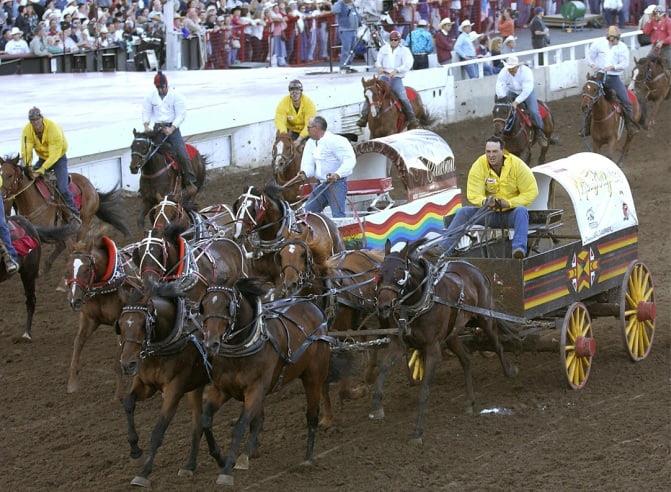
People usually go looking for chuckwagon racing when they’ve seen a clip online, heard it mentioned alongside rodeos, or spotted it on an event program and want to know what it actually involves. The details matter: the sport is fast, heavy, and hard on horses and people, and it has a long-running welfare debate attached to it.
What follows is the straight picture—where chuckwagon racing came from, what happens in a modern race, why it’s risky, and what “in Australia” really means (because it’s far less established here than many articles claim).
What chuckwagon racing is (in plain terms)
Chuckwagon racing is a timed horse-and-wagon race. A team (often called an “outfit”) launches from a standing start, loops around infield barrels, then sprints a lap of the track while outriders keep pace. Penalties are added for rule breaches, so the winner is the fastest combined time, not just the first wagon to look like it crossed.
The best-known, most formalised version is the Calgary Stampede’s “GMC Rangeland Derby” in Canada, where the sport has an established rulebook, dedicated veterinary oversight, and a long history of incremental safety changes. 1, 2
Origins: camp wagons, range work, and the Calgary template
The sport’s modern identity is closely tied to the Calgary Stampede, where organiser Guy Weadick introduced the first Stampede chuckwagon competition in 1923. Early races were designed to echo the rhythm of moving camp on the range—wagons, horses, helpers, and a fast run between “camp” tasks. 1, 2
That Calgary format became the reference point many people picture today, even when smaller exhibitions elsewhere borrow only parts of it.
How a race works (typical modern format)
Exact rules vary by event, but the core elements in established competition generally include:
- A wagon pulled by a four-horse team (the heavy unit that must be controlled through turns at speed). 2
- Outriders (mounted riders who perform start duties and then chase the wagon to the finish within a required distance to avoid penalties). 3
- Infield barrels (the wagon turns a figure-eight pattern around barrels before joining the main track). 3
- Timed heats with penalties (infractions add time; the “run” is not judged only by position). 4
In Calgary specifically, the event has also adjusted the number of outriders and wagons per heat over time as part of safety reform, alongside programs such as “Fitness to Compete” and horse identification/record systems. 5
Equipment that matters (and why it’s built the way it is)
A racing chuckwagon is not a museum wagon. It’s engineered for speed and stability while carrying gear and absorbing punishment from tight turns, chopped-up dirt, and the kinetic shove of a four-horse team. Brakes and running gear have to cope with sudden load changes when a team surges, checks, or drifts sideways.
Outriders also matter to safety. Their job is functional—start control and disciplined pursuit—rather than decoration, and rule changes around outriders have been part of broader attempts to reduce risk. 5
Training and preparation: what “ready to race” really means
Race horses in this sport need more than fitness. They must tolerate noise, tight quarters, flying dirt, sudden lateral forces in turns, and the presence of multiple wagons moving close together. Drivers need the reflexes and judgement to keep a team straight without over-correcting—because a small mistake can become a tangle of harness, wheels, and hooves.
At the formal end of the sport, preparation includes veterinary checks and fitness requirements designed to reduce the chance of starting compromised horses. 5
Why chuckwagon racing is dangerous
The dangers aren’t mysterious. They’re built into the physics:
- High speed + tight turns: wagons can tip or slide, and a fall at pace can be catastrophic.
- Close packing: multiple wagons in a heat increases the chance of contact and chain-reaction incidents. (Some events have reduced wagons per heat as a safety measure.) 5
- Horse welfare risk: collisions, falls, and exertion can lead to serious injury. This is a central point of ongoing public criticism and reform efforts. 5
Even supporters who know the horses well tend to describe it as a sport that needs constant rule pressure to stay within an acceptable safety envelope—because the moment the pace lifts, the margin for error narrows. 5
Chuckwagon racing in Australia: what’s true, and what’s often overstated
In Australia, chuckwagon racing is not a widespread, nationally organised professional sport in the way rodeo circuits are. You may see “chuckwagon” used as a theme at western events, but a consistent national calendar and a single dominant rule authority are not as clear-cut as they are in Canada.
If you’re trying to confirm whether an Australian event is running a genuine chuckwagon race (rather than a themed demonstration), the quickest checks are practical:
- Is there a published rule set and penalty system?
- Are qualified veterinarians on-site, and are horse fitness checks documented?
- How many wagons run per heat, and what are the collision-prevention rules?
- Who is the sanctioning body, and what welfare standards are being enforced?
Animal welfare: the wider rodeo debate carries over
In Australia, most public welfare guidance you’ll find is aimed at rodeo events generally, not chuckwagon racing specifically. The RSPCA position is that rodeos pose serious welfare risks and that stronger, enforceable standards are needed (and in some cases, particular events should cease). 6
Government guidance also acknowledges that animals used in rodeo events can be exposed to multiple stressors (handling, transport, unfamiliar environments, equipment), and places responsibility on organisers and participants to safeguard welfare. 7
That context matters because chuckwagon racing—where it appears alongside rodeos—sits in the same public conversation about acceptable risk, oversight, and enforcement.
“Famous racers” and common misconceptions
A few claims often repeated online don’t hold up well:
- “Chuckwagon racing began in Australia in the late 1800s.” Australia certainly has deep horse-and-stockwork traditions, but the best-documented origin of the modern spectacle sport points to Calgary in 1923. 1, 2
- “Tom Mix won the race in 1912.” Calgary’s chuckwagon racing began in 1923, so a 1912 chuckwagon win at the Stampede doesn’t fit the established event history. 2
If you’re looking for a single “anchor” event in the sport’s global story, the Calgary Stampede’s Rangeland Derby is the one most commonly cited and most thoroughly recorded. 2
Is chuckwagon racing the same as rodeo?
No. It’s a wagon race, sometimes staged as part of a wider western show program that may also include rodeo events. Welfare oversight and rules may be shared only loosely, depending on the organiser. 7
How many horses pull a chuckwagon?
Commonly four horses pull the wagon in established competition formats. 2
Why are there outriders?
Outriders perform start duties and then chase the wagon; their distance from the wagon can affect penalties. Their role has also been adjusted in some events as part of safety changes. 5
Is chuckwagon racing legal in Australia?
Animal welfare and event regulation in Australia is largely state and territory based, and rules differ by jurisdiction and by event type. Where chuckwagon-style activities are staged in connection with rodeos, organisers may point to relevant codes of practice and association standards, but enforcement and specificity vary. 7, 8
References
- Calgary Stampede — Heritage: History of Chuckwagon Races (mentions first competition in 1923 and early format)
- Calgary Stampede (Corporate) — Early Chuckwagon Race (1923 origin; timing/penalties note)
- Chuckwagonracers — Rules (illustrates typical barrels/figure-eight and outrider roles; useful for understanding common format)
- Canada’s History — Thundering Chuckwagons (overview of rules evolution and safety measures)
- Canada’s History — Thundering Chuckwagons (details on reforms: outriders, heats, fitness-to-compete, microchipping)
- RSPCA Australia — “A cruel spectacle – why you should never attend a rodeo” (welfare concerns and position)
- NSW Department of Primary Industries — Code of Practice for animals used in rodeo events (stressors, responsibilities, recognised associations)
- National Rodeo Council of Australia — Animal Welfare standards (example of industry welfare framing and rules)

Veterinary Advisor, Veterinarian London Area, United Kingdom